History
Luxor stands on the site of ancient Thebes, the religious and political center of Egypt for much of the New Kingdom. UNESCO inscribed it in 1979 as Ancient Thebes with its Necropolis, and the phrase describes the geography exactly: the city of the living on the east bank where the sun rises, and the city of the dead on the west bank where it sets. Both are within a few kilometers of each other, and no other place in Egypt puts so much of the ancient world within one day’s reach.
Karnak was not built by one king. It is the accumulated work of something like two thousand years of pharaohs adding, demolishing and rebuilding on the same sacred ground — a temple complex that grew rather than a temple that was designed. That is why it feels less like a building than a city of stone, and why the same site holds work from the Middle Kingdom through to the Ptolemies and the Romans.
What you will see
The east bank
Karnak is the largest religious complex of the ancient world, dominated by the Great Hypostyle Hall — a forest of 134 enormous columns, still carrying color high up where the sun has not reached it. Beyond it lie the sacred lake, a series of pylons and courts, and the precincts of other gods. It is very large; two hours is a minimum and it can absorb a morning.
Luxor Temple sits in the middle of the modern town, joined to Karnak by an avenue of sphinxes. It is smaller, more comprehensible and best seen in the evening, when it is lit and the temperature has dropped. Its layers are unusually visible: a pharaonic temple with a Roman shrine inside it and a working mosque built on top, all still standing together.
The west bank
The Valley of the Kings holds the rock-cut tombs of the New Kingdom pharaohs, including Tutankhamun’s. A standard ticket admits you to a rotating selection of tombs, with a few — Tutankhamun, Seti I, Ramesses V and VI among them — ticketed separately. The painted walls, not the architecture, are the reason to go.
Deir el-Bahari, the mortuary temple of Hatshepsut, is built in terraces against a sheer cliff and is the most immediately striking building in Egypt after the pyramids.
The Colossi of Memnon, two seated statues standing alone in a field, are what remains above ground of a mortuary temple that was once larger than Karnak.
Also on this bank: the Valley of the Queens, the tombs of the nobles with their scenes of ordinary life, and Deir el-Medina, the village of the workers who cut the royal tombs — a site that tells you more about how Egypt actually functioned than any temple does.
Visiting
Split the banks over two days if you can. Done in one, it is a very long day in high sun with a river crossing in the middle of it. The conventional and sensible order is the west bank at first light, when the valley is coolest and quietest, and the east bank temples in the late afternoon and evening.
The Valley of the Kings is open, exposed ground with a shuttle covering part of the approach; each tomb is a stepped or ramped descent and re-ascent, and the air inside is warm and close. Tomb photography rules vary and some tombs prohibit it entirely to protect the pigments — follow what is posted. Karnak involves a long walk on uneven stone with very little shade.
Hot air balloon flights over the west bank at dawn are widely offered and are the classic Luxor extra. As with any adventure activity, check the operator’s safety record and your insurance cover before booking rather than after.
Getting there
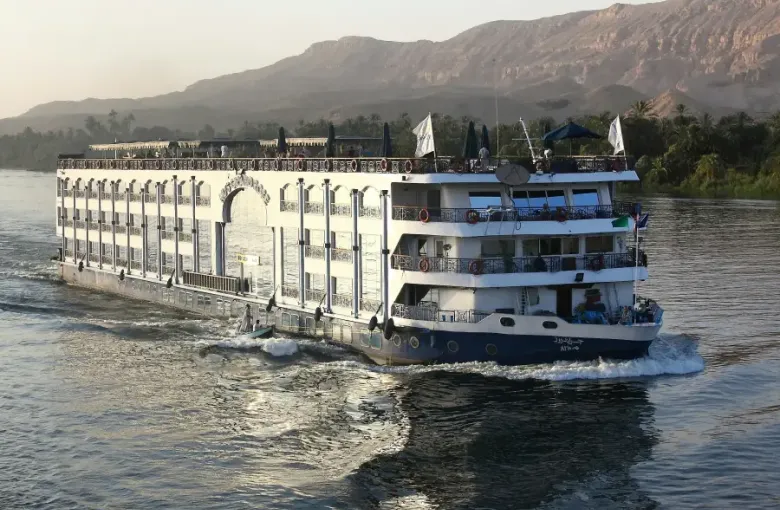
Luxor has an airport with domestic connections to Cairo, and sits on the Cairo–Aswan railway, including sleeper services. It is also the northern end of the standard Nile cruise, which is how a good number of visitors arrive. Motor launches cross to the west bank continually, and the road bridge is some distance south of the town.
Visiting respectfully
The tombs are painted, and the pigment is fragile. Do not touch the walls; the oils on skin are part of what has damaged them. Do not use flash where it is prohibited. Keep to the walkways. In the temples, do not climb on the blocks. Photography of local people should be asked for first, particularly on the west bank where the villages are close to the sites.
Seeing it on a LABUSA Travel journey
Our Egypt journeys give Luxor two working days from the river, with the west bank at dawn and Luxor Temple after dark — the pacing that this particular place needs. Guiding is Egyptian and site-specific, which at Karnak is the difference between an impressive ruin and a legible one.
Other Articles
Giza Pyramids: Visitor and Heritage Guide
Abu Simbel: Visitor and Heritage Guide