The quick answer
Egypt is doable with limited mobility, and it is uneven. Newer buildings — the Grand Egyptian Museum above all — are built to modern accessibility standards. Ancient sites were not built to any, and the ground at most of them is sand, broken stone, ramps of rock and steps without handrails. The realistic plan is not “is Egypt accessible” but “which parts, and what is the alternative for the rest”.
What works well
The Grand Egyptian Museum at Giza is purpose-built and modern, with level access, lifts and accessible facilities, and it holds an enormous part of what people come to Egypt to see, including the Tutankhamun material. For a visitor with significant mobility limits it is the single strongest item on an Egyptian itinerary.
Nile river vessels are, in principle, a good format: your accommodation moves with you, so the exhausting part of Egyptian travel — repeatedly packing, transferring and checking in — disappears. In practice vessels differ enormously. Some have lifts between decks; many do not. Boarding is often over a gangway and sometimes across another moored vessel. This has to be checked per vessel, not assumed.
Hotels in the international chains in Cairo, Luxor, Aswan and the Red Sea offer accessible rooms. Independent and heritage properties usually do not.
Some temple sites are better than their reputation. Karnak and Luxor Temple are largely flat, if long and uneven underfoot. Philae is reached by boat but is manageable once there. Kom Ombo sits close to the river.
What is genuinely hard
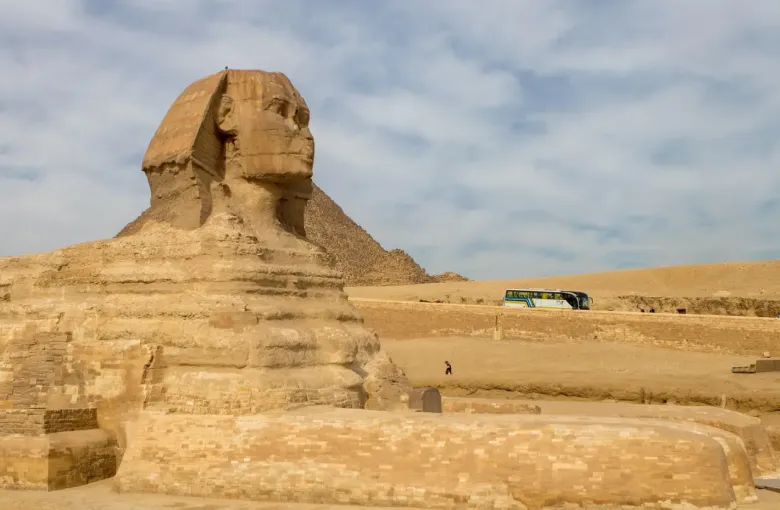
The Giza plateau is open sand on a slope. Vehicle access reaches the main viewing points, which solves a lot, but moving between the pyramids and the Sphinx on foot is hard going on loose ground.
Pyramid interiors require descending a long, steep, low passage, often bent double, with no way to turn back quickly if you change your mind. They are unsuitable for anyone with mobility, cardiac, respiratory or claustrophobia concerns, and there is no adapted alternative.
The Valley of the Kings involves a walk over open, exposed ground between tomb entrances, and each tomb is a ramped or stepped descent. A shuttle covers part of the main approach. The tombs themselves vary; some are relatively short and gently ramped, others are long and steep.
Old Cairo and Khan el-Khalili are narrow, crowded, stepped in places and uneven throughout. Rewarding, and not navigable in a wheelchair without significant help.
Practicalities
Pavements in Egyptian cities are inconsistent, high-kerbed and frequently obstructed; crossing roads is difficult. Accessible taxis are not a normal part of the market, so transport is generally a private vehicle arranged in advance, with a driver who can help with transfers. Egyptian people are in general extremely willing to assist, which covers a great deal of the gap left by infrastructure — but it is help from strangers, not a designed provision, and it should not be the whole plan.
Bring your own equipment and spares. Repairs and replacement parts for mobility aids are hard to source quickly outside Cairo. If you use a wheelchair, a model with larger wheels handles sand and broken stone far better than a narrow indoor chair.
Heat as an accessibility issue
It belongs in this guide rather than the weather one. Heat is what turns a long day into an impossible one for many visitors with chronic conditions, and Egyptian sites offer almost no shade and few places to sit. Traveling October to April, starting early, and building genuine rest into the middle of the day are accessibility decisions as much as comfort ones.
The questions to ask before booking
For each vessel: is there a lift between decks, how is boarding done, and how wide are the cabin and bathroom doors? For each hotel: is the accessible room genuinely step-free from the street, or step-free once you are past three stairs at the entrance? For each site: what is the surface, how far is the walk from where a vehicle can stop, and is there anywhere to sit? Ask for specifics and photographs. “Accessible” is used loosely across the industry, and the gap between the word and the reality is where trips go wrong.
Common questions
Can I do Egypt in a wheelchair?
A version of it, yes, and a good one — the Grand Egyptian Museum, Karnak, Luxor Temple, Philae, a river journey on the right vessel, and Cairo’s modern museums. Pyramid interiors and most tombs, no.
Is there discounted entry for disabled visitors?
Concessions exist at state sites; the arrangements are set by the Ministry of Tourism and Antiquities and change, so ask at the ticket office and bring documentation.
Should I travel with a companion?
If your mobility is significantly limited, yes. The environment assumes one.
Seeing it on a LABUSA Travel journey
Tell us what you need at inquiry rather than at booking, and we will build the itinerary around it — the right vessel rather than the standard one, private transport with a driver who assists, sites chosen for terrain, and a pace that has rest designed into it rather than squeezed out.
Other Articles
Egypt for Senior Travelers
Getting Around Egypt