The quick answer
Egypt suits older travelers well, on two conditions: go in the cool season, and let the river do the moving. A Nile journey unpacks once and carries you between sites, which removes the part of Egyptian travel that is genuinely tiring. Then choose deliberately what to skip — because two or three of the famous things here are strenuous in a way the photographs do not convey.
Pacing
The classic Egyptian itinerary is dense: Cairo, Giza, an internal flight, several temples, a valley of tombs, Aswan, Abu Simbel. Done at full tilt in a week it is exhausting at any age. The adjustments that make the difference are simple and worth insisting on. Start early, when it is cool and the sites are quiet. Take the middle of the day out properly rather than pushing through it. Accept one substantial site a day rather than three. Build in a whole day with nothing scheduled, around the midpoint.
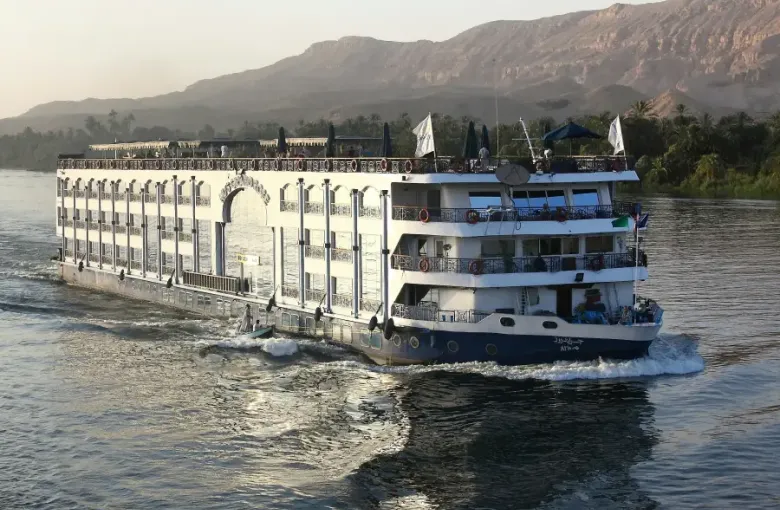
The single largest structural improvement is choosing the river over the road for the Luxor–Aswan section. You sleep in the same bed, your luggage stays where it is, and the temples come to the boat rather than the other way round.
Heat
Travel between October and April. In summer, Upper Egypt reaches temperatures at which anyone with a cardiac or respiratory condition, or on medication affecting hydration or blood pressure, should be having a conversation with their doctor rather than reading a travel guide. Even in winter, the sun at midday on an unshaded site is strong. Drink more than you feel you need — dry air conceals dehydration — wear a wide-brimmed hat, and sit down before you need to.
What is strenuous, and what is not
Manageable for most: the Grand Egyptian Museum, which is modern, level and lift-served; the Egyptian Museum in Cairo; Karnak and Luxor Temple, which are long walks but flat; Philae; Kom Ombo; a felucca on the Nile; Abu Simbel, where the walk from the coach to the temples is short and level.
Demanding: the Valley of the Kings, where the walking is exposed and each tomb is a ramped or stepped descent and re-ascent; the Giza plateau on foot, which is loose sand on a slope; Old Cairo and Khan el-Khalili, which are crowded and uneven.
Genuinely hard, and easy to underestimate: going inside a pyramid. The passage is long, steep and low enough to require walking bent over, the air is warm and close, and there is no convenient point to turn back. There is no shame at all in standing outside; the outside is what the photographs are of.
Health preparation
See a travel clinic six to eight weeks before departure — recommendations depend on your medical history and vaccination record, not only on the destination. Bring all prescription medication in its original labeled packaging, in your hand luggage, with a copy of the prescription and a letter from your doctor for anything unusual. Bring more than the trip requires, in case of delay. Take a written list of your medications, conditions and allergies, using generic drug names rather than brand names, which travel badly.
Travel insurance that explicitly covers your pre-existing conditions and includes medical evacuation is not optional on this trip. Good private hospitals exist in Cairo; the picture in Upper Egypt is thinner, and evacuation cover is what bridges that.
Follow the standard food and water care the CDC advises for Egypt, and carry rehydration salts. A stomach upset that is a nuisance at thirty can be a genuine problem at seventy in a hot climate.
Things worth arranging in advance
A private vehicle and driver rather than group coaches, which lets you leave a site when you have had enough rather than when the group has. A guide who knows to slow down. Ground-floor or lift-served rooms. A vessel with a lift if stairs are difficult. And a seat — ask your guide to identify where you can sit at each site, because at several of them the answer is genuinely “nowhere” and it is better to know that in the morning.
Common questions
Is a Nile cruise a good idea?
For most older travelers it is the single best decision available on this itinerary, for the unpacking reason alone.
Will I miss the highlights if I take it slowly?
No. The Egyptian highlights are large, slow, outdoor things. What a slower pace removes is the third temple of the day, and that is rarely the one people remember.
Should I worry about the walking distances?
Worth checking rather than worrying. The distances are moderate; the surfaces and the sun are what make them count.
Seeing it on a LABUSA Travel journey
Our Egypt journeys are river-based for exactly these reasons, with private transfers, early starts and rest built into the middle of the day. If pacing is a concern, say so at inquiry — it changes the itinerary rather than the price.
Other Articles
Accessible Travel in Egypt
Best Time to Visit Egypt