History
The Giza plateau holds the pyramid complexes of three Fourth Dynasty kings — Khufu, Khafre and Menkaure — built in the middle of the third millennium BCE, together with the Great Sphinx, smaller queens’ pyramids, causeways, valley temples and the cemeteries of the officials who served them. UNESCO inscribed it in 1979 as part of Memphis and its Necropolis — the Pyramid Fields from Giza to Dahshur, and the wording matters: Giza is the most famous part of a much longer belt of royal burial sites running along the desert edge south of Cairo.
The Great Pyramid of Khufu was the tallest structure built by human beings for something close to four thousand years. It is not an isolated monument but the center of an organized complex — temple, causeway, boat pits, subsidiary tombs — and the archaeology of the workers’ settlement nearby has replaced the old story of slave labor with a picture of a large, fed, housed and administered workforce. That is one of the more significant shifts in how this site is understood, and it is worth carrying with you when you stand in front of it.
What you will see
Three pyramids of decreasing size, in a line that is not quite a line. Khufu’s is the largest and closest to the modern city. Khafre’s looks taller because it stands on higher ground, and it keeps a cap of the original polished limestone casing at its summit — the only place you can still see what all three once looked like. Menkaure’s is the smallest of the three by a wide margin. Below and east of Khafre’s causeway sits the Sphinx, carved from the bedrock, with its valley temple beside it.
The panoramic viewpoint out in the desert is where the three-pyramid photograph is taken from and is a short drive from the main entrance. It is also where most of the camel and horse offers are.
Visiting
Entry to the plateau is one ticket; going inside a pyramid is a separate ticket, sold in limited numbers, and the Great Pyramid’s is the one that sells out. Photography rules vary by area and by whether you are inside; they are posted and enforced, and some interiors carry an additional photography fee. Tickets, opening hours and concessions are set by the Ministry of Tourism and Antiquities and change — check current arrangements rather than an older account.
Going inside is a real undertaking. The ascent through the Great Pyramid means a long, steep, low passage taken bent double, in warm still air, with no easy way to turn back once you are in a queue moving through it. There is nothing to see at the top but an empty granite chamber. People with claustrophobia, or with cardiac, respiratory or knee problems, should skip it without regret; the interior is an experience rather than a sight.
Go at opening. The plateau is exposed, unshaded sand and the difference between eight in the morning and noon is enormous, in both heat and crowds. Wear proper shoes: the ground is loose sand, rubble and slope, not paving.
The Grand Egyptian Museum
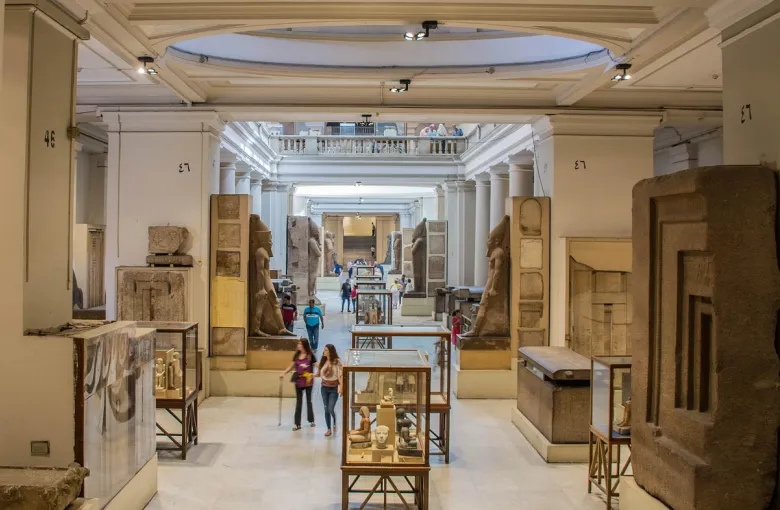
The museum stands within sight of the plateau and belongs in the same visit. It was built to house Egypt’s collections at a scale the old Tahrir Square museum could not, including the complete Tutankhamun material, and it is modern, air-conditioned and fully accessible — which makes it the natural other half of a Giza day, particularly in the heat. Seeing the objects and the site together, rather than a week apart, is the way to do it.
Getting there
Giza is on the western edge of Cairo, and the journey from central Cairo is short in distance and long in traffic. Allow far more time than the map suggests, and go early for that reason as well as the heat. The plateau has more than one gate; which one you use affects how much walking your day involves, so agree the plan with your driver or guide before you set off.
Visiting respectfully
This is a cemetery, and an active archaeological site. Do not climb the monuments — it is prohibited, it damages them, and people have died doing it. Do not remove anything, including stone fragments. Photography of people, including the camel and horse handlers, should be asked for first and will usually carry a charge. Commercial approaches at Giza are persistent; a friendly, unbroken “no, thank you” without stopping is the technique that works, and agreeing a price and duration in writing before mounting any animal is the way to avoid the most common dispute on the plateau.
Seeing it on a LABUSA Travel journey
We take Giza at opening, with an Egyptian guide, and pair it with the Grand Egyptian Museum in the same day so the objects and the place explain each other. Tickets, gates and transfers are arranged in advance, which on this particular site is the difference between a morning and an ordeal.
Other Articles
Luxor and Karnak: Visitor and Heritage Guide
Best Time to Visit Egypt