The quick answer
Egypt is in Africa, and the deepest African story in it is the one that runs south from Aswan. Nubia — the Nile corridor stretching from the first cataract into what is now Sudan — has its own language, its own architecture, its own long history of kingdoms that at times ruled Egypt itself, and a living community in Aswan today. If you have come to Egypt looking for a connection to Africa rather than an exception to it, that is where to look.
The Nile as a corridor, not a border
Ancient Egypt is often presented as a self-contained civilization with a wall at its southern edge. The river tells a different story. Trade, migration, conquest and religion moved along the Nile in both directions for thousands of years, and the relationship between Egypt and Nubia was continuous, mutual and frequently reversed — periods of Egyptian control in the south, and periods when Nubian rulers governed Egypt. The monuments themselves make the point: the temples that UNESCO lists as the Nubian Monuments run from Abu Simbel in the far south to Philae at Aswan, and they are Egyptian and Nubian at once.
What happened in the 1960s
The building of the Aswan High Dam created Lake Nasser and flooded a large part of Nubia. Two things followed. The first is well known: an international campaign coordinated by UNESCO cut apart and relocated the great temples, Abu Simbel among them, to higher ground — an operation that directly shaped the modern idea of world heritage. The second is much less discussed: tens of thousands of Nubians were displaced from villages that are now under the lake, and resettled elsewhere. Both facts are part of the same event, and a visit that takes in only the first has taken in half of it.
Where to encounter this
The Nubia Museum, Aswan
Established with UNESCO involvement as part of the response to the flooding, and the single best place to understand Nubian history on its own terms rather than as an annexe to Egyptian history. It covers prehistory, the Nubian kingdoms, Christian and Islamic Nubia, and the resettlement itself. Start here, before the villages.
The Nubian villages at Aswan
Communities on the west bank and on the islands, reached by boat, with the painted houses and open courtyards that are Nubian rather than Egyptian architecture. They are visited — this is not an undiscovered place — and the visit is worth doing well: go with someone who has a relationship with the community, accept hospitality on the terms it is offered, ask before photographing anyone, and buy from the people who made the thing.
Philae and Abu Simbel, read differently
Both are on almost every itinerary. Both read differently once you know they are Nubian monuments that were moved, and that the moving was necessary because of something that also moved people. It costs nothing to hold both halves of that in mind while standing in front of them.
An honest note about a contested subject
The relationship between ancient Egypt and the rest of Africa has been argued over for a long time, often for reasons that have little to do with Egypt. This guide does not attempt to settle any of it. What it does say is uncontroversial and evidenced: Egypt is geographically African; the Nile connected it to African societies to the south throughout its history; Nubian kingdoms were major powers in their own right and ruled Egypt for a period; and Nubian people, language and culture are a living presence in southern Egypt now. Those are the things you can go and see.
Common questions
Is there anything for visitors of African descent specifically?
Nubia is the substantial answer — the museum at Aswan, the villages, and the monuments read in their Nubian context. It rewards time rather than a photo stop.
Is Nubian a separate language?
Nubian languages are distinct from Arabic and are still spoken, alongside Arabic, in the communities of southern Egypt and northern Sudan.
How much of old Nubia can still be visited?
The relocated temples, and the living communities. The villages themselves are under Lake Nasser. That absence is part of what the Nubia Museum exists to record.
Seeing it on a LABUSA Travel journey
Our Egypt journeys include Aswan with time in it rather than a change of transport, and the Nubian element is built in — the museum before the villages, and a visit arranged through people the community knows. It is the part of the itinerary that most often turns out to be the reason people came.
Other Articles
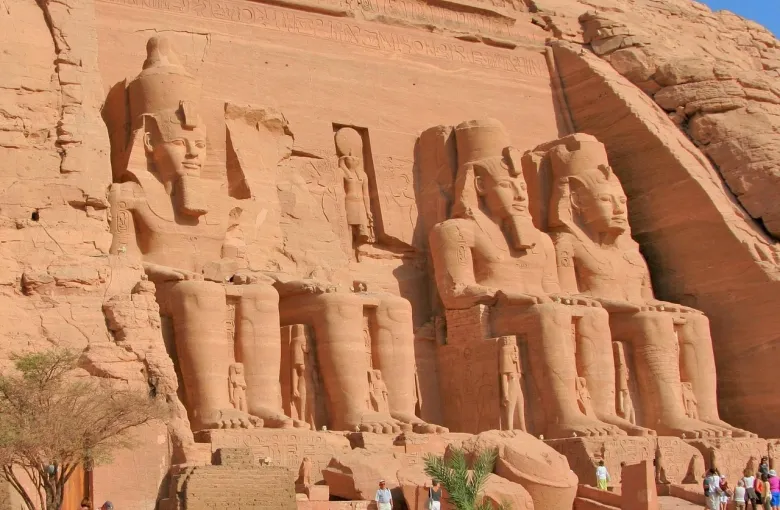
Abu Simbel: Visitor and Heritage Guide
Egypt Culture and Etiquette Guide