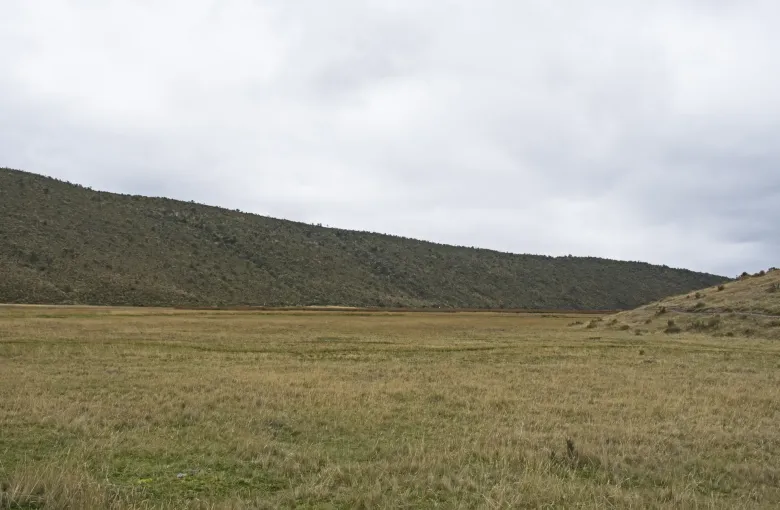
Quito was inscribed on the World Heritage List in 1978, in the first group of properties the List ever contained, and carries reference number 2. The citation records it as the best preserved and least altered historic center in Latin America, which is a strong claim and holds up on the ground: the colonial core was never demolished for a business district and never rebuilt after an earthquake in the way that Lima or Santiago were.
What is actually there
Roughly three hundred and twenty hectares of sixteenth to eighteenth century streets on a slope, at about 2,850 m, hemmed in by the flanks of Pichincha on one side and a ravine on the other. The topography is the reason the center survived: there was nowhere for it to expand, so the modern city went north and left the old one alone.
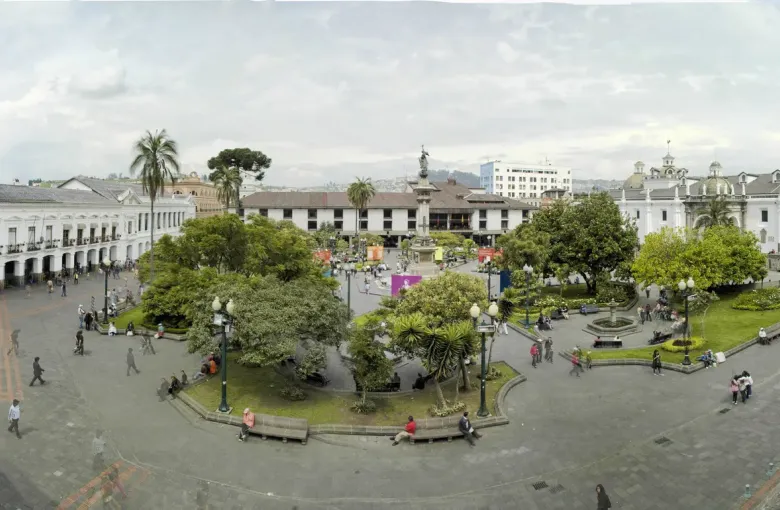
- Plaza Grande, also called the Plaza de la Independencia, with the presidential palace along one side, the cathedral on another and the archbishop's palace on a third. It is a working square rather than a monument, and late afternoon is when it is at its best.
- La Compania de Jesus, a Jesuit church whose interior is almost entirely gilded. It is the single most photographed interior in the country and repays going early.
- San Francisco, the oldest and largest of the colonial religious complexes, begun within a few years of the Spanish founding of the city.
- La Ronda, a restored lane of workshops and small bars that gives some sense of how the streets worked before the restoration.
Altitude first, sightseeing second
Altitude sickness is a real risk in Ecuador, and Quito is where most visitors meet it first. Acclimatize before you go higher, never during. A first day spent walking the center slowly, with nothing booked and an early night, is not a wasted day: it is the thing that makes the rest of the trip work. The streets are steep and the combination of gradient and thin air catches people who consider themselves fit.
This page publishes no medication and no dose. Whether to take anything, and what, is a conversation with your own clinician, who knows your history.
The cited health source records no malaria transmission in the cities of Guayaquil or Quito, and yellow fever vaccination is not recommended above 2,300 m, which Quito is comfortably above. Neither is part of a highland itinerary.
Getting around the center
The old town is walkable and the gradients are the limiting factor rather than the distances. The cable car up the flank of Pichincha takes you to about 4,000 m in ten minutes, which is a spectacular view and a genuinely poor idea on your first day. Leave it until you are acclimatized.
Ordinary city caution applies in the center and more of it after dark; the travel safety guide covers what the source says. Quito is not on the advise-against list. Its province, Pichincha, is named in the separate state of emergency, which is a different instrument with a different map.
The middle of the world
The equator monument north of the city is the obvious excursion and is slightly, enjoyably wrong: the line was placed by an eighteenth century French expedition with the instruments of the day, and satellite measurement later moved it a couple of hundred meters. The neighboring museum sits on the corrected line. Both are worth an hour, and the story of the discrepancy is better than either.
For the rest of the highlands see the seasons guide, and for the other two inscriptions the Cuenca guide and the Galapagos guide.
Sources
- UNESCO World Heritage Centre: City of Quito, inscribed 1978 and carrying World Heritage reference number 2, recorded as the best preserved and least altered historic center in Latin America. Accessed 17 September 2026.
- UNESCO World Heritage Centre: Ecuador States Party record: five properties inscribed on the World Heritage List, three cultural and two natural, together with a tentative list of fifteen further sites. Accessed 17 September 2026.
- UK Foreign, Commonwealth & Development Office: Ecuador travel advice: the standing warning that the FCDO advises against all but essential travel to parts of Ecuador, the Coastal Region province list, the twenty kilometer strip along the Colombian border, and the state of emergency declared on 15 September 2026 for sixty days in eight provinces including Pichincha. Accessed 17 September 2026.
- Centers for Disease Control and Prevention: Ecuador traveler health: yellow fever vaccine recommended for travelers aged nine months and over going below 2,300 m east of the Andes in Morona-Santiago, Napo, Orellana, Pastaza, Sucumbios, Tungurahua and Zamora-Chinchipe, generally not recommended west of the Andes and not recommended above 2,300 m; malaria transmission below 1,500 m in Cotopaxi, Esmeraldas, Morona-Santiago, Orellana, Pastaza and Sucumbios with rare cases below 1,500 m elsewhere, no transmission in the cities of Guayaquil or Quito, and no transmission on the Galapagos Islands. Accessed 17 September 2026.
Other Articles
Best Time to Visit Ecuador
Accessible Travel in Ecuador