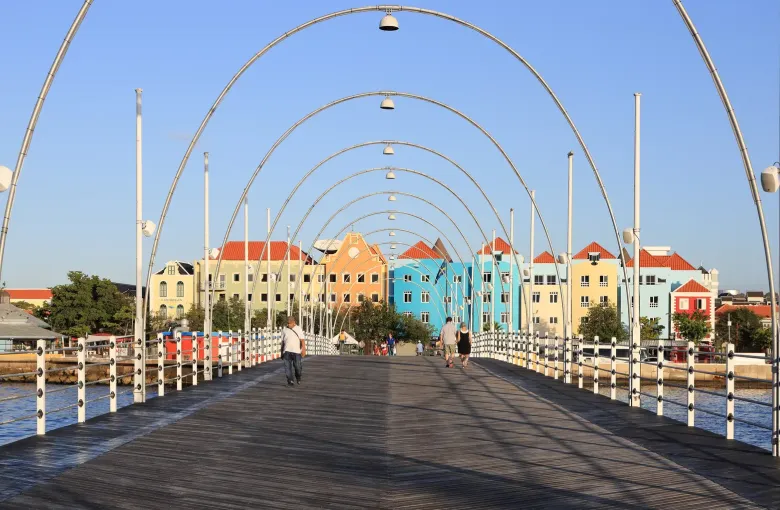
The market that arrives by boat.
The floating market on the Punda waterfront is the most literal expression of where this island sits. Boats cross from the South American mainland and sell produce from the water, tied up along the quay, awnings out. It is a working market rather than a display, and it is the clearest single answer to the question of how a dry island eats fresh food.
That dryness is the governing fact. The interior is cactus and thorn scrub; the agriculture that would feed a wetter island is not there. What arrives, arrives: by boat, by plane, by the trade route the island has always sat on.
Where the influences come from.
Curaçao is a country within the Kingdom of the Netherlands, an arrangement the Dutch government states plainly when it writes that each country within the Kingdom has its own government. Four centuries of that connection are on the table: Dutch cheese and Dutch baking sit beside West African cooking carried here through the slave trade, beside Venezuelan and Colombian produce from across the water, beside Sephardic Jewish traditions carried by one of the oldest continuous Jewish communities in the Americas.
Papiamentu, the island's own creole, is the same story in a different register: Portuguese, Spanish, Dutch, African and Arawak, settled into one language. The food went the same way.
This section is description rather than citation, and it is marked as such. No source in this cluster's register publishes a culinary history of Curaçao, so nothing here is presented as quoted fact.
What this page will not claim.
It will not give you dish names it cannot source, prices it cannot verify, or a list of restaurants. The blue liqueur that carries this island's name worldwide is made here, and this page names it without describing a production process it has not read a source for.
What it can tell you is where to look: the Punda and Otrobanda waterfronts for the everyday places, the floating market for produce, and the beach clubs along the leeward coast for the long-lunch version.
One health precaution that lands at mealtimes.
TravelHealthPro, writing about the Dutch Caribbean islands as a group, records that there is a risk of dengue on these islands and advises travelers to avoid mosquito bites, particularly during daytime hours.
Most visitors reverse that instinctively and protect themselves at dinner. The mosquitoes that matter here feed in the day, so the meal to think about is lunch on a terrace, not supper. Repellent before a daytime outdoor meal is the practical form of that advice.
If you would like a trip built around eating rather than around sights, tell us that and we will shape it that way.
Sources
- TravelHealthPro, the National Travel Health Network and Centre: the Caribbean Islands (Netherlands) country page, which covers the Dutch Caribbean islands as a group: that there is no risk of yellow fever on these islands but there are certificate requirements; that for Aruba, Bonaire and Curacao proof of vaccination against yellow fever is required under International Health Regulations from travelers aged 9 months or over arriving from countries with risk of yellow fever transmission and for travelers having transited for more than 12 hours through an airport of a country with risk of transmission; that there is a risk of dengue on these islands and that travelers should avoid mosquito bites particularly during daytime hours; that the Zika virus statement is given for Aruba, Bonaire and Sint Maarten; and that rabies has not been reported in this country. Accessed 21 September 2026.
- UK Foreign, Commonwealth and Development Office: Curaçao travel advice, entry requirements: that the authorities in Curaçao set and enforce entry rules; that a passport must be valid for the duration of the stay; that a traveler will be denied entry without a valid travel document or with a passport reported lost or stolen; that a digital immigration card must be completed 48 hours before arrival and must also be completed by anyone traveling through Curaçao; that a visitor may stay for up to 90 days in a calendar year without a visa and may request an extension beyond 90 days at immigration on showing travel insurance for the duration of the extended stay; that a certificate proving yellow fever vaccination is required to enter from a country listed as a transmission risk; and that there are strict rules about goods taken into or out of the country and anything prohibited or subject to tax or duty must be declared. Accessed 21 September 2026.
- Government of the Netherlands: the governance of Aruba, Curaçao and St Maarten: that each country within the Kingdom has its own government; that Aruba, Curaçao and St Maarten each have their own Governor who represents the King in their respective governments; that the Governor is appointed by the King for six years, after which he or she may be reappointed for one more term, so that a Governor can serve for a maximum of 12 years; that the Governor has no ministerial responsibility and does not participate in the day-to-day business of government; and that Aruba, Curaçao and St Maarten each have a Minister Plenipotentiary in The Hague who, together with the ministers of the Dutch government, make up the Council of Ministers for the Kingdom. Accessed 21 September 2026.
Other Articles
Curaçao Culture and Etiquette Guide
Curaçao Currency and Money Guide