No rate appears on this page, and that is deliberate.
This cluster publishes figures it can attribute to a source it has read. For Curaçao's currency there is no such source available to it. The island's central bank returns a security interstitial to every automated request, including from a full browser, and the government portal answers a proof-of-work challenge and then a human-verification page. Neither can be quoted.
So this page gives no exchange rate, no peg and no statement about what the currency is called or whether that has changed. Those are all things a reader could check in thirty seconds at a bank, an airport kiosk or a card statement, and all things that would be wrong on this page within a year of being written. A rate invented to look complete is the worst of both.
This is the third destination in this batch to decline a rate, for a third different reason. Barbados's central bank builds its table in the browser; Trinidad and Tobago's rate path returns a 404; Curaçao's is behind a bot wall. The pattern is worth knowing if you are planning several islands: assume you will convert on arrival and check the rate then.
The money the official sources do name.
Three costs are stated, and all three are conditions rather than prices.
Travel insurance is a condition of extending your stay. The entry rules say you can request an extension beyond 90 days at immigration if you can show you have travel insurance for the duration of your extended stay. The insurance is not advice there; it is the document you produce.
European health cards do not work here. The European Health Insurance Card (EHIC) and Global Health Insurance Card (GHIC) is not valid in Curaçao, and the same advice says to make sure you have adequate travel health insurance and accessible funds to cover the cost of any medical treatment abroad and repatriation. Accessible funds is a specific phrase: money you can reach quickly, not only cover you can claim back later.
Taxis are negotiated, not metered. Most taxis do not have meters, and the advice is to check that a taxi is registered and agree the price before taking the ride. That is covered properly in the transport guide; it is here because it is the most common cash transaction a visitor makes.
Practical shape of a day's spending.
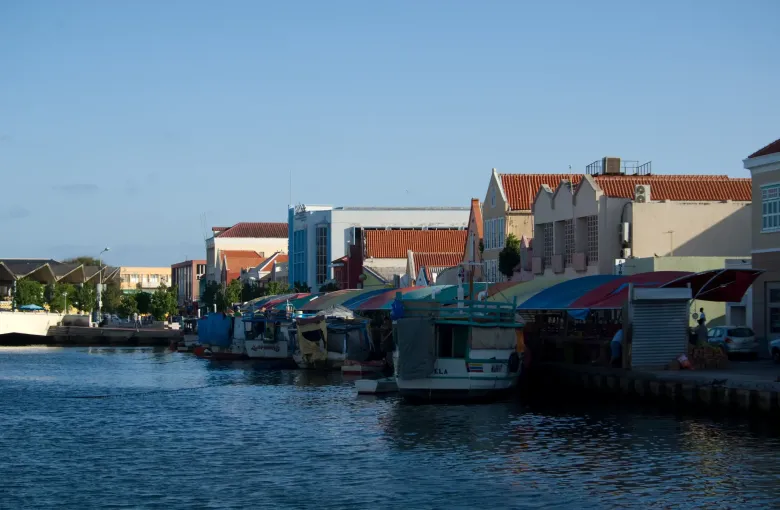
Willemstad's two halves, Punda and Otrobanda, hold most of the shops, and the floating market on the Punda waterfront is where produce changes hands. Beach clubs on the leeward coast, the dive operators and the car hire companies are the other regular costs. None of those has a published tariff this page can quote.
Hire cars carry a condition worth budgeting for rather than a price: companies often have stricter requirements for their customers, such as a year of driving experience and a higher minimum age.
If you would like a trip costed properly rather than estimated, tell us the shape of it and we will price it against live quotes.
Sources
- UK Foreign, Commonwealth and Development Office: Curaçao travel advice, entry requirements: that the authorities in Curaçao set and enforce entry rules; that a passport must be valid for the duration of the stay; that a traveler will be denied entry without a valid travel document or with a passport reported lost or stolen; that a digital immigration card must be completed 48 hours before arrival and must also be completed by anyone traveling through Curaçao; that a visitor may stay for up to 90 days in a calendar year without a visa and may request an extension beyond 90 days at immigration on showing travel insurance for the duration of the extended stay; that a certificate proving yellow fever vaccination is required to enter from a country listed as a transmission risk; and that there are strict rules about goods taken into or out of the country and anything prohibited or subject to tax or duty must be declared. Accessed 21 September 2026.
- UK Foreign, Commonwealth and Development Office: Curaçao travel advice, health: that in an emergency a traveler should call 912 and ask for an ambulance; that at least 8 weeks before a trip a traveler should check the latest vaccine recommendations for Curaçao; that Curaçao has 3 local hospitals, that Curaçao Medical Center is the largest with an extensive emergency room and the only intensive care unit on the island, and that Taams Clinic and The Antillean Adventist Hospital also offer a wide range of medical services and specialists; that in an emergency the attending doctor will decide which hospital is best; and that the European Health Insurance Card and Global Health Insurance Card are not valid in Curaçao, so adequate travel health insurance and accessible funds are needed to cover treatment and repatriation. Accessed 21 September 2026.
- UK Foreign, Commonwealth and Development Office: Curaçao travel advice, safety and security: that although there is no recent history of terrorism in Curaçao attacks cannot be ruled out; that petty theft and street crime are a concern and that there are violent crimes related to the illegal drugs world but the main tourist areas are generally safe; the listed precautions of avoiding isolated areas including beaches after dark, keeping valuables secure and out of sight, and being on the look-out for bag snatchers; that criminals continue to use the islands of the Dutch Caribbean to smuggle illegal drugs from South America to Europe and North America, that luggage should never be left unattended when departing the country, that a traveler should not discuss or agree to carry a package for anyone, that a body scan may be asked for at some airports and that Dutch authorities generally screen all baggage and passengers from the Dutch Caribbean; that a copy of the photo page of a passport must always be carried; that a UK photocard driving license may be used to drive in Curaçao and that a paper license may need updating or the correct version of an international driving permit; that hire car companies often have stricter requirements such as a year of driving experience and a higher minimum age; that a taxi should be checked as registered and the price agreed before the ride, that most taxis do not have meters and that registered taxis have number plates starting with TX; and that the hurricane season in the Dutch Caribbean normally runs from June to November, that most hurricanes pass well to the north of Curaçao which has no record of a recent major hurricane, and that there are occasional tropical storms. Accessed 21 September 2026.
Other Articles
Curaçao Visa and Entry Requirements
Getting Around Curaçao