The general picture, in the official words.
The Foreign, Commonwealth and Development Office's assessment is measured. Petty theft and street crime are a concern. There are violent crimes related to the illegal drugs world, but the main tourist areas are generally safe.
That second sentence is doing something careful. It does not say there is no violent crime; it says where it sits and where it mostly does not. Both halves belong on this page, because a guide that reports only the reassurance is not reporting the source.
The precautions named are the ordinary ones, and they are worth quoting rather than paraphrasing: avoiding isolated areas, including beaches, after dark, keeping valuables secure and out of sight, and being on the look-out for bag snatchers.
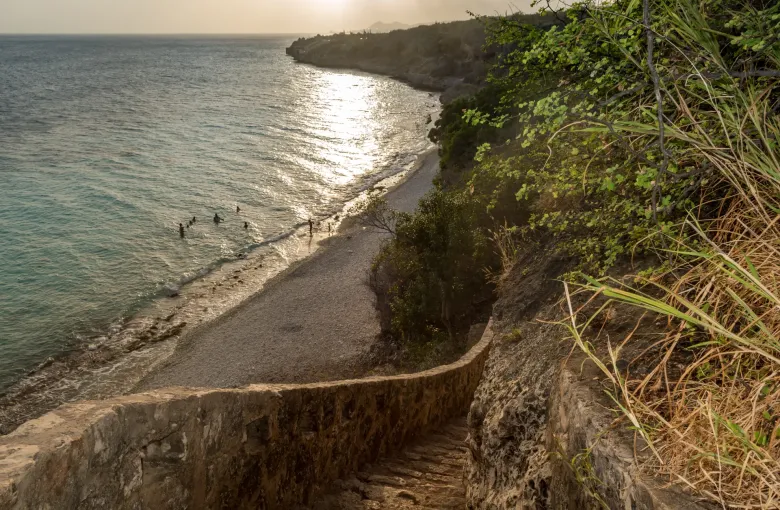
The beach clause is the one visitors forget. A beach that is busy and cheerful at four o'clock is an isolated area at nine.
The luggage instruction, and the reason behind it.
This is the part of Curaçao's advice that has no equivalent on most islands, and it reads oddly until you know why it is there.
The stated reason first: criminals continue to use the islands of the Dutch Caribbean to smuggle illegal drugs from South America to Europe and North America. The island sits close to the South American coast and on a route, and that shapes what happens at the airport.
The instructions follow from it. Never leave luggage unattended when departing the country. Do not discuss or agree to carry a package for anyone. You may be asked to have a body scan at some airports. And Dutch authorities generally screen all baggage and passengers from the Dutch Caribbean.
None of that is a warning about your fellow travelers so much as a description of a system you will pass through. Expect screening on departure and on arrival in Europe, allow time for it, and treat a request to carry something for a stranger as the serious matter the advice makes it.
Identification.
You must always carry a copy of the photo page of your passport with you. That is a legal requirement rather than a precaution, and it is repeated in the packing list because it is the one item on that list you cannot improvise on arrival.
Terrorism, in the source's own proportion.
The advice records a high threat of terrorist attack globally affecting UK interests, and then says of this island specifically that although there's no recent history of terrorism in Curaçao, attacks cannot be ruled out. That is the whole of the country-specific statement, and it is reproduced at that length on purpose.
If something goes wrong.
The emergency medical number is 912. Call it and ask for an ambulance. It is not the number used by the neighboring islands in this region, and it is worth putting in a phone before you need it. The advice gives the next step too: contact your insurance company quickly if you are referred to a medical facility for treatment.
Travel insurance is the other half of that. The standing advice is to get appropriate travel insurance covering your itinerary, planned activities and expenses in an emergency. A European card is no substitute for it here: the EHIC and GHIC is not valid in Curaçao, so the cost of treatment and of repatriation rests on the policy you bought.
One health risk belongs under the same heading, because avoiding it is a daily habit rather than an arrangement you make once. The National Travel Health Network and Centre publishes its guidance for the Dutch Caribbean as a group and records a dengue risk across these islands. The mosquito that carries it bites in daylight, so repellent, covered skin at dawn and dusk and a room that is screened or air conditioned do more than anything you can arrange after you arrive.
Tell us what you have planned and we will make sure the arrangements match the advice.
Sources
- UK Foreign, Commonwealth and Development Office: Curaçao travel advice, safety and security: that although there is no recent history of terrorism in Curaçao attacks cannot be ruled out; that petty theft and street crime are a concern and that there are violent crimes related to the illegal drugs world but the main tourist areas are generally safe; the listed precautions of avoiding isolated areas including beaches after dark, keeping valuables secure and out of sight, and being on the look-out for bag snatchers; that criminals continue to use the islands of the Dutch Caribbean to smuggle illegal drugs from South America to Europe and North America, that luggage should never be left unattended when departing the country, that a traveler should not discuss or agree to carry a package for anyone, that a body scan may be asked for at some airports and that Dutch authorities generally screen all baggage and passengers from the Dutch Caribbean; that a copy of the photo page of a passport must always be carried; that a UK photocard driving license may be used to drive in Curaçao and that a paper license may need updating or the correct version of an international driving permit; that hire car companies often have stricter requirements such as a year of driving experience and a higher minimum age; that a taxi should be checked as registered and the price agreed before the ride, that most taxis do not have meters and that registered taxis have number plates starting with TX; and that the hurricane season in the Dutch Caribbean normally runs from June to November, that most hurricanes pass well to the north of Curaçao which has no record of a recent major hurricane, and that there are occasional tropical storms. Accessed 21 September 2026.
- UK Foreign, Commonwealth and Development Office: Curaçao travel advice, health: that in an emergency a traveler should call 912 and ask for an ambulance; that at least 8 weeks before a trip a traveler should check the latest vaccine recommendations for Curaçao; that Curaçao has 3 local hospitals, that Curaçao Medical Center is the largest with an extensive emergency room and the only intensive care unit on the island, and that Taams Clinic and The Antillean Adventist Hospital also offer a wide range of medical services and specialists; that in an emergency the attending doctor will decide which hospital is best; and that the European Health Insurance Card and Global Health Insurance Card are not valid in Curaçao, so adequate travel health insurance and accessible funds are needed to cover treatment and repatriation. Accessed 21 September 2026.
- UK Foreign, Commonwealth and Development Office: Curaçao travel advice: the standing instruction that no travel can be guaranteed safe, that a traveler should read all the advice in the guide, and that anyone who chooses to travel should research their destinations and get appropriate travel insurance covering their itinerary, planned activities and expenses in an emergency. Accessed 21 September 2026.
- TravelHealthPro, the National Travel Health Network and Centre: the Caribbean Islands (Netherlands) country page, which covers the Dutch Caribbean islands as a group: that there is no risk of yellow fever on these islands but there are certificate requirements; that for Aruba, Bonaire and Curacao proof of vaccination against yellow fever is required under International Health Regulations from travelers aged 9 months or over arriving from countries with risk of yellow fever transmission and for travelers having transited for more than 12 hours through an airport of a country with risk of transmission; that there is a risk of dengue on these islands and that travelers should avoid mosquito bites particularly during daytime hours; that the Zika virus statement is given for Aruba, Bonaire and Sint Maarten; and that rabies has not been reported in this country. Accessed 21 September 2026.
Other Articles
Getting Around Curaçao
Curaçao Visa and Entry Requirements