The one item that is a legal requirement.
Start here, because it is the only thing on this list that is not a comfort decision. The Foreign, Commonwealth and Development Office states that you must always carry a copy of the photo page of your passport with you.
A copy, not the passport itself. Make it before you travel, carry it separately from the passport, and have it on you rather than in a hotel safe. A photograph on a phone is better than nothing and worse than paper when the phone is flat.
Mosquitoes, stated carefully.
TravelHealthPro writes about the Dutch Caribbean islands as a group, and says that there is a risk of dengue on these islands. Its advice is that travelers should avoid mosquito bites, particularly during daytime hours, because the mosquitoes that spread dengue feed in the day rather than at dusk.
That changes what you pack and when you use it. Repellent is a daytime item here, not an evening one. Long sleeves and light long trousers for the hours around midday and mid-afternoon do more than a citronella candle at dinner.
The same source records that rabies has not been reported in this country, so a pre-exposure course is not part of a standard trip. The yellow fever certificate, where it applies, is an entry document rather than a health precaution and is covered in the entry guide.
Sun and wind, which arrive together.
The interior is arid: columnar cactus, thorn scrub, thin shade. The trade wind blows almost continuously from the east, and its effect on a visitor is to hide how much sun they are getting. Skin cools in the wind while it burns.
Pack accordingly. High-factor sunscreen in a quantity that assumes daily use, a hat that survives wind rather than one that looks good in still air, and sunglasses. A light long-sleeved layer does double duty against sun and mosquitoes.
Shoes, water and the coast.
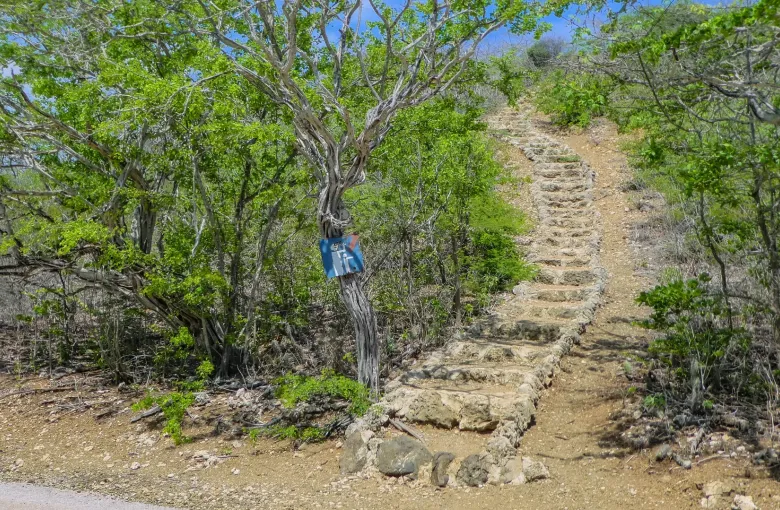
Two kinds of ground. Willemstad is paved, flat and walkable. Everything outside it is limestone: sharp, uneven and hot underfoot. The dive and snorkel sites on the leeward coast are reached down rock, and the north coast is undercut cliff and surf rather than sand. Bring shoes you can walk on rock in, and water shoes if you plan to enter the sea anywhere but a resort beach.
Carry water. There is no published rule about it; it is what a dry, windy, sunny island asks of anyone walking in it.
What not to bother with.
Wet-weather gear for a rainy season, because the island does not have one in the sense that would justify the space. Heavy walking boots, unless you intend the Christoffel Park trails, which are covered in the accessibility guide. And a European health card, which is not valid in Curaçao. The insurance documents named in the money guide are what you actually need.
Tell us what you plan to do and we will tell you what it asks you to bring.
Sources
- UK Foreign, Commonwealth and Development Office: Curaçao travel advice, safety and security: that although there is no recent history of terrorism in Curaçao attacks cannot be ruled out; that petty theft and street crime are a concern and that there are violent crimes related to the illegal drugs world but the main tourist areas are generally safe; the listed precautions of avoiding isolated areas including beaches after dark, keeping valuables secure and out of sight, and being on the look-out for bag snatchers; that criminals continue to use the islands of the Dutch Caribbean to smuggle illegal drugs from South America to Europe and North America, that luggage should never be left unattended when departing the country, that a traveler should not discuss or agree to carry a package for anyone, that a body scan may be asked for at some airports and that Dutch authorities generally screen all baggage and passengers from the Dutch Caribbean; that a copy of the photo page of a passport must always be carried; that a UK photocard driving license may be used to drive in Curaçao and that a paper license may need updating or the correct version of an international driving permit; that hire car companies often have stricter requirements such as a year of driving experience and a higher minimum age; that a taxi should be checked as registered and the price agreed before the ride, that most taxis do not have meters and that registered taxis have number plates starting with TX; and that the hurricane season in the Dutch Caribbean normally runs from June to November, that most hurricanes pass well to the north of Curaçao which has no record of a recent major hurricane, and that there are occasional tropical storms. Accessed 21 September 2026.
- TravelHealthPro, the National Travel Health Network and Centre: the Caribbean Islands (Netherlands) country page, which covers the Dutch Caribbean islands as a group: that there is no risk of yellow fever on these islands but there are certificate requirements; that for Aruba, Bonaire and Curacao proof of vaccination against yellow fever is required under International Health Regulations from travelers aged 9 months or over arriving from countries with risk of yellow fever transmission and for travelers having transited for more than 12 hours through an airport of a country with risk of transmission; that there is a risk of dengue on these islands and that travelers should avoid mosquito bites particularly during daytime hours; that the Zika virus statement is given for Aruba, Bonaire and Sint Maarten; and that rabies has not been reported in this country. Accessed 21 September 2026.
- UK Foreign, Commonwealth and Development Office: Curaçao travel advice, health: that in an emergency a traveler should call 912 and ask for an ambulance; that at least 8 weeks before a trip a traveler should check the latest vaccine recommendations for Curaçao; that Curaçao has 3 local hospitals, that Curaçao Medical Center is the largest with an extensive emergency room and the only intensive care unit on the island, and that Taams Clinic and The Antillean Adventist Hospital also offer a wide range of medical services and specialists; that in an emergency the attending doctor will decide which hospital is best; and that the European Health Insurance Card and Global Health Insurance Card are not valid in Curaçao, so adequate travel health insurance and accessible funds are needed to cover treatment and repatriation. Accessed 21 September 2026.
Other Articles

Curaçao Weather Guide
Curaçao Travel Safety Guide