What this page cannot tell you.
Start with the limit, because a guide that hides it is worse than useless to the reader who needs it. No source in this cluster's register publishes an accessibility standard, an access audit, or a statement about step-free provision in Curaçao. The island's government portal does not answer automated requests at all.
So this page does not rate hotels, does not certify any site as accessible, and does not claim a legal standard exists. It sets out terrain, medical provision and the published rules that bear on a trip, and it says where the gaps are so that you can ask the right questions of an operator directly.
Terrain, honestly.
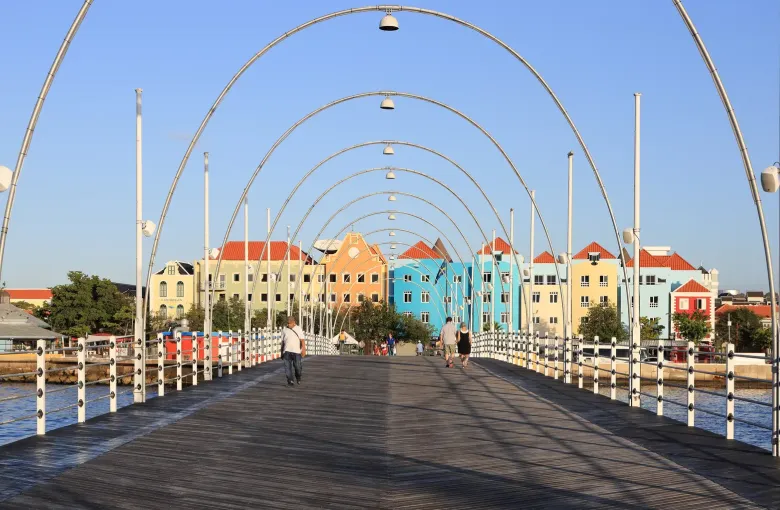
Willemstad is the good news. The old town is flat, the waterfront is a paved promenade, and the distances between Punda's sights are short. The one variable is the Queen Emma pontoon bridge: it floats, it swings open for shipping, and its surface moves underfoot. A free ferry runs when it is open, which is worth knowing as a planned alternative rather than a surprise.
Outside town the ground changes completely. The interior and the coast are limestone: sharp, uneven, and often without made paths. The card at the head of this guide shows a stone stairway on a Christoffel Park trail, and it was chosen for that reason. A photograph of a smooth promenade would imply an access the island's interior does not offer.
The north coast is undercut cliff and heavy surf. The leeward beaches are reached by steps or rock more often than by ramp. Ask, specifically, before assuming any of it.
Medical provision, which is published precisely.
This is the part where the official source is unusually specific, and it matters for anyone traveling with a condition. Curaçao has 3 local hospitals. Curaçao Medical Center is the largest hospital with an extensive emergency room and the only intensive care unit on the island. Taams Clinic and The Antillean Adventist Hospital also offer a wide range of medical services and specialists.
Read "the only intensive care unit on the island" carefully. There is one, and it is at one named hospital. In an emergency, the attending doctor will be able to make an informed decision on the best hospital to send you to if necessary.
The emergency number is 912. Ask for an ambulance.
Insurance is not optional here.
The European Health Insurance Card (EHIC) and Global Health Insurance Card (GHIC) is not valid in Curaçao. The advice is to make sure you have adequate travel health insurance and accessible funds to cover the cost of any medical treatment abroad and repatriation.
For a traveler with a disability or a health condition, two words in that sentence do the work: accessible funds and repatriation. Check that cover explicitly includes the equipment you travel with and any pre-existing condition, and that it covers evacuation.
Two rules that are easier with planning.
The digital immigration card must be completed 48 hours before you arrive, and also by anyone passing through. Do it early rather than at an airport. And you must always carry a copy of the photo page of your passport. A paper copy in a pocket is easier than retrieving a document.
Hire companies set their own conditions, such as a year of driving experience and a higher minimum age, so adapted-vehicle questions belong at booking time.
Tell us exactly what you need and we will put the questions to operators directly rather than guessing on your behalf.
Sources
- UK Foreign, Commonwealth and Development Office: Curaçao travel advice, health: that in an emergency a traveler should call 912 and ask for an ambulance; that at least 8 weeks before a trip a traveler should check the latest vaccine recommendations for Curaçao; that Curaçao has 3 local hospitals, that Curaçao Medical Center is the largest with an extensive emergency room and the only intensive care unit on the island, and that Taams Clinic and The Antillean Adventist Hospital also offer a wide range of medical services and specialists; that in an emergency the attending doctor will decide which hospital is best; and that the European Health Insurance Card and Global Health Insurance Card are not valid in Curaçao, so adequate travel health insurance and accessible funds are needed to cover treatment and repatriation. Accessed 21 September 2026.
- UK Foreign, Commonwealth and Development Office: Curaçao travel advice, safety and security: that although there is no recent history of terrorism in Curaçao attacks cannot be ruled out; that petty theft and street crime are a concern and that there are violent crimes related to the illegal drugs world but the main tourist areas are generally safe; the listed precautions of avoiding isolated areas including beaches after dark, keeping valuables secure and out of sight, and being on the look-out for bag snatchers; that criminals continue to use the islands of the Dutch Caribbean to smuggle illegal drugs from South America to Europe and North America, that luggage should never be left unattended when departing the country, that a traveler should not discuss or agree to carry a package for anyone, that a body scan may be asked for at some airports and that Dutch authorities generally screen all baggage and passengers from the Dutch Caribbean; that a copy of the photo page of a passport must always be carried; that a UK photocard driving license may be used to drive in Curaçao and that a paper license may need updating or the correct version of an international driving permit; that hire car companies often have stricter requirements such as a year of driving experience and a higher minimum age; that a taxi should be checked as registered and the price agreed before the ride, that most taxis do not have meters and that registered taxis have number plates starting with TX; and that the hurricane season in the Dutch Caribbean normally runs from June to November, that most hurricanes pass well to the north of Curaçao which has no record of a recent major hurricane, and that there are occasional tropical storms. Accessed 21 September 2026.
- UK Foreign, Commonwealth and Development Office: Curaçao travel advice, entry requirements: that the authorities in Curaçao set and enforce entry rules; that a passport must be valid for the duration of the stay; that a traveler will be denied entry without a valid travel document or with a passport reported lost or stolen; that a digital immigration card must be completed 48 hours before arrival and must also be completed by anyone traveling through Curaçao; that a visitor may stay for up to 90 days in a calendar year without a visa and may request an extension beyond 90 days at immigration on showing travel insurance for the duration of the extended stay; that a certificate proving yellow fever vaccination is required to enter from a country listed as a transmission risk; and that there are strict rules about goods taken into or out of the country and anything prohibited or subject to tax or duty must be declared. Accessed 21 September 2026.
Other Articles
Curaçao for Senior Travelers
Getting Around Curaçao