What is inscribed, and under whose name.
The UNESCO World Heritage Centre lists the Historic Area of Willemstad, Inner City and Harbour, Curaçao, inscribed in 1997. It appears on the States Parties page for the Netherlands.
That is not a filing error. Curaçao is a country within the Kingdom of the Netherlands, so there is no separate Curaçao state party at UNESCO and the island's properties are recorded under the Kingdom. The Dutch government describes the arrangement directly: each country within the Kingdom has its own government. Reading the entry as though the Netherlands owns a Caribbean town misreads both the list and the constitution.
What the property actually is.
The name is precise and worth taking apart. Inner City and Harbour: what was inscribed is a town and the water it was built around, not a monument standing in isolation.
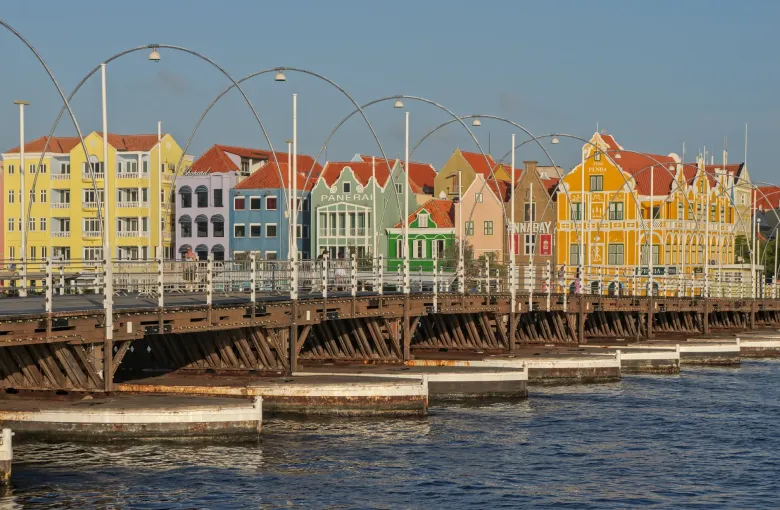
Willemstad is split by Sint Anna Bay. Punda is on one side, Otrobanda (the name means simply "the other side") on the other, and the Queen Emma pontoon bridge floats between them and swings open for shipping. The gabled facades along the Handelskade are the image the island is known by, and they are Dutch urban forms rebuilt in Caribbean color and Caribbean light.
The harbor still works. Ships still come through. A visitor walking Punda at nine in the morning is walking through a capital's working day, not a preserved quarter, and that is the most useful thing to know before arriving.
What is NOT inscribed.
This distinction matters and is routinely got wrong. The Netherlands' tentative list includes Plantations in West Curaçao, submitted in 2011. A tentative listing is a state's declaration of intent to nominate. It is not an inscription, and the plantations of the island's west are not a World Heritage Site.
The same tentative list carries Bonaire Marine Park, also submitted in 2011. Bonaire is a different island of the same kingdom. It is not Curaçao's, and no part of it belongs in a description of this island's heritage.
Visiting.
There is no gate and no ticket, because the property is a town. Walk it. Cross the Queen Emma bridge on foot and be ready for it to be swung open, in which case a free ferry runs. Start on the Punda side for the waterfront facades and cross to Otrobanda for the older residential streets stepping back from the water.
Two pieces of published advice belong here because they apply to walking a city rather than to heritage. Keep valuables secure and out of sight, and remember that you must always carry a copy of the photo page of your passport.
Photograph the buildings freely and ask before photographing people. This is a living town.
Tell us how much time you have and we will shape a visit that does the town justice rather than crossing it off.
Sources
- UNESCO World Heritage Centre: the Netherlands States Parties page, under which Curaçao's properties are filed because Curaçao is a country within the Kingdom of the Netherlands: that the Historic Area of Willemstad, Inner City and Harbour, Curaçao was inscribed on the World Heritage List in 1997; and that the Netherlands tentative list includes Plantations in West Curaçao, submitted in 2011, alongside Bonaire Marine Park, also submitted in 2011, which is a different island of the same kingdom. Accessed 21 September 2026.
- Government of the Netherlands: the governance of Aruba, Curaçao and St Maarten: that each country within the Kingdom has its own government; that Aruba, Curaçao and St Maarten each have their own Governor who represents the King in their respective governments; that the Governor is appointed by the King for six years, after which he or she may be reappointed for one more term, so that a Governor can serve for a maximum of 12 years; that the Governor has no ministerial responsibility and does not participate in the day-to-day business of government; and that Aruba, Curaçao and St Maarten each have a Minister Plenipotentiary in The Hague who, together with the ministers of the Dutch government, make up the Council of Ministers for the Kingdom. Accessed 21 September 2026.
- UK Foreign, Commonwealth and Development Office: Curaçao travel advice, safety and security: that although there is no recent history of terrorism in Curaçao attacks cannot be ruled out; that petty theft and street crime are a concern and that there are violent crimes related to the illegal drugs world but the main tourist areas are generally safe; the listed precautions of avoiding isolated areas including beaches after dark, keeping valuables secure and out of sight, and being on the look-out for bag snatchers; that criminals continue to use the islands of the Dutch Caribbean to smuggle illegal drugs from South America to Europe and North America, that luggage should never be left unattended when departing the country, that a traveler should not discuss or agree to carry a package for anyone, that a body scan may be asked for at some airports and that Dutch authorities generally screen all baggage and passengers from the Dutch Caribbean; that a copy of the photo page of a passport must always be carried; that a UK photocard driving license may be used to drive in Curaçao and that a paper license may need updating or the correct version of an international driving permit; that hire car companies often have stricter requirements such as a year of driving experience and a higher minimum age; that a taxi should be checked as registered and the price agreed before the ride, that most taxis do not have meters and that registered taxis have number plates starting with TX; and that the hurricane season in the Dutch Caribbean normally runs from June to November, that most hurricanes pass well to the north of Curaçao which has no record of a recent major hurricane, and that there are occasional tropical storms. Accessed 21 September 2026.
Other Articles
Curaçao Culture and Etiquette Guide
Curaçao and Diaspora Reconnection