The rule, not the date.
Carnival is the largest thing that happens on this island, and its date is not fixed. It runs to the liturgical calendar: the season builds through January and February and the street parades fall in the days immediately before Ash Wednesday. Ash Wednesday moves with Easter, so Carnival moves with it.
That is why this page prints no date. A rule stays true; a date printed in a guide is wrong by the following year and looks authoritative while it is wrong. Take the year's official dates from the island's own organizers, who set them.
What this page could not find, said plainly.
No source in this cluster's register publishes a Carnival calendar, a program or a route for Curaçao. The island's government portal answers a human-verification wall to automated requests, and the tourist board's own pages return their navigation rather than their content. So the descriptions below are description, and nothing in this section is presented as a quoted fact.
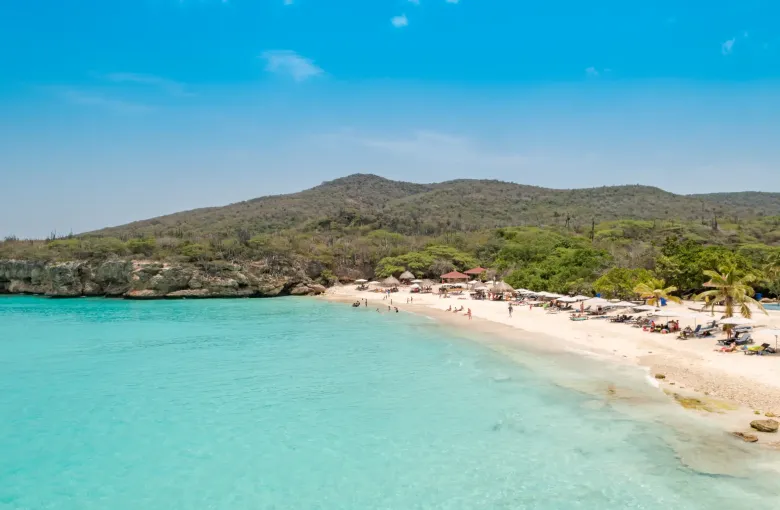
There is a second absence worth naming, because it is visible on the page. The card image at the head of this guide is a photograph of the Willemstad waterfront rather than of Carnival. Exactly one Curaçao Carnival photograph exists in the image library this cluster draws on, and it is in portrait orientation, which fails the standard every card here is held to. A neutral image openly labeled is better than an unrelated one presented as the thing.
The shape of the season.
Carnival here is a season rather than a weekend. Tumba, the island's own competitive musical form, runs in the weeks beforehand, and the winning tune becomes the road march that the parades move to. There are parades for children and parades at night, and the season closes with the burning of King Momo, the figure who carries the year's excesses away with him.
The rest of the calendar is quieter and more constant: King's Day in the Dutch spring, the Seú harvest procession, and the emancipation commemorations that the diaspora guide covers, which are observances rather than festivals.
Being there during Carnival.
Two pieces of published advice apply with more force in a crowd than out of one. Keep valuables secure and out of sight, and be on the look-out for bag snatchers. Neither is Carnival-specific; both matter most where people are packed together.
And plan accommodation early. The island is small, the season is fixed by a calendar everybody shares, and rooms in Willemstad go long before the date arrives.
If you want to be here for Carnival, tell us the year and we will work back from the island's own published dates.
Sources
- UK Foreign, Commonwealth and Development Office: Curaçao travel advice, safety and security: that although there is no recent history of terrorism in Curaçao attacks cannot be ruled out; that petty theft and street crime are a concern and that there are violent crimes related to the illegal drugs world but the main tourist areas are generally safe; the listed precautions of avoiding isolated areas including beaches after dark, keeping valuables secure and out of sight, and being on the look-out for bag snatchers; that criminals continue to use the islands of the Dutch Caribbean to smuggle illegal drugs from South America to Europe and North America, that luggage should never be left unattended when departing the country, that a traveler should not discuss or agree to carry a package for anyone, that a body scan may be asked for at some airports and that Dutch authorities generally screen all baggage and passengers from the Dutch Caribbean; that a copy of the photo page of a passport must always be carried; that a UK photocard driving license may be used to drive in Curaçao and that a paper license may need updating or the correct version of an international driving permit; that hire car companies often have stricter requirements such as a year of driving experience and a higher minimum age; that a taxi should be checked as registered and the price agreed before the ride, that most taxis do not have meters and that registered taxis have number plates starting with TX; and that the hurricane season in the Dutch Caribbean normally runs from June to November, that most hurricanes pass well to the north of Curaçao which has no record of a recent major hurricane, and that there are occasional tropical storms. Accessed 21 September 2026.
- Government of the Netherlands: the governance of Aruba, Curaçao and St Maarten: that each country within the Kingdom has its own government; that Aruba, Curaçao and St Maarten each have their own Governor who represents the King in their respective governments; that the Governor is appointed by the King for six years, after which he or she may be reappointed for one more term, so that a Governor can serve for a maximum of 12 years; that the Governor has no ministerial responsibility and does not participate in the day-to-day business of government; and that Aruba, Curaçao and St Maarten each have a Minister Plenipotentiary in The Hague who, together with the ministers of the Dutch government, make up the Council of Ministers for the Kingdom. Accessed 21 September 2026.
- UNESCO World Heritage Centre: the Netherlands States Parties page, under which Curaçao's properties are filed because Curaçao is a country within the Kingdom of the Netherlands: that the Historic Area of Willemstad, Inner City and Harbour, Curaçao was inscribed on the World Heritage List in 1997; and that the Netherlands tentative list includes Plantations in West Curaçao, submitted in 2011, alongside Bonaire Marine Park, also submitted in 2011, which is a different island of the same kingdom. Accessed 21 September 2026.
Other Articles
Curaçao Culture and Etiquette Guide
Curaçao and Diaspora Reconnection