The short version
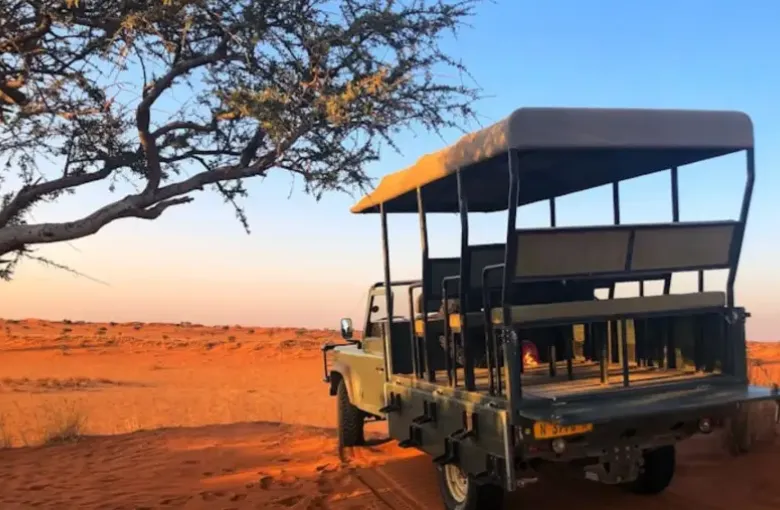
The Makgadikgadi is the bed of an enormous prehistoric lake that has almost entirely dried: a complex of salt pans in north-eastern Botswana, among the largest in the world, and one of the emptiest landscapes you can stand in.
It is also the one major Botswana destination that is arguably better in the green season than the dry one, which makes it the natural partner to a delta trip you cannot take in February.
⚠ It is not a World Heritage Site
Botswana's two are the Okavango Delta and Tsodilo. The Makgadikgadi is not among them. We state that precisely because this is exactly the kind of famous landscape a reader might assume carries the designation.
A vanished lake
For a long period this was Lake Makgadikgadi, a body of water fed by rivers that now go elsewhere — the Okavango among them. Tectonic shifts and a drying climate emptied it, leaving a crust of salt and clay across a vast flat basin. Sowa and Ntwetwe are the two largest pans.
Standing on it in the dry season is a genuinely strange experience: no vegetation, no landmarks, no sound, and a horizon that curves. Guides run quad-bike trips out onto the crust and camps put bedrolls down on the open pan so that you sleep with nothing between you and the sky. If you have been on safari before and want something that is not more animals, this is it.
The green season transformation
When the rains come, roughly December to April, water gathers on the pans and grass covers the surrounding grasslands, and the place is unrecognizable.
- Zebra migration. Tens of thousands of zebra move onto the Makgadikgadi grasslands with wildebeest behind them, in one of the longest overland mammal migrations in Africa — and one of the least watched, because it happens in the low season.
- Flamingos. When Sowa Pan holds enough water, greater and lesser flamingos breed there in very large numbers. It is unpredictable and dependent on rainfall, and spectacular when it happens.
- Nxai Pan, to the north, greens and fills with plains game and the predators that follow them.
Meerkats
The Makgadikgadi is the best place in Botswana to spend time with habituated meerkat groups — wild animals accustomed to researchers and guests, going about their morning while you sit still nearby. It is a genuine highlight and unusually good for children.
They are wild. Do not touch them, and let them use you as a lookout post if they decide to; that is their idea, not yours.
Baines' Baobabs
A cluster of ancient baobabs on the edge of Nxai Pan, painted by the artist Thomas Baines in 1862 and, remarkably, almost unchanged since. Standing in front of them with the painting in mind is one of the more affecting small experiences in Botswana — a hundred and sixty years, and the same trees.
Kubu Island
A granite outcrop covered in baobabs, rising out of Sowa Pan, with stone walling and archaeology that indicate long human use. It is a sacred site as well as a scenic one, treated with respect locally, and access can be restricted. Ask, and follow what you are told.
Practicalities
- Shade does not exist out there. Hat, sunglasses, sunscreen, water, all of it more than you think.
- Do not drive onto a wet pan. The crust conceals mud that will swallow a vehicle to the axles, and recovery is a long way away. This is the classic Makgadikgadi mistake.
- Malaria risk is lower here than in the delta and Chobe, but not absent; see our safety guide.
- Nights on the open pan are cold in winter and the wind is unobstructed.
Visiting with LABUSA Travel
The Makgadikgadi is the piece that makes a green-season Botswana trip worth taking, and it pairs well with Nxai Pan and the Kalahari. Tell us which months you have and we will say honestly whether the pans or the delta should anchor the itinerary.
Other Articles
Best Time to Visit Botswana
Okavango Delta: Visitor and Heritage Guide