The short version
The Okavango is an inland delta: a river that fans out across the Kalahari and evaporates rather than reaching the sea. It is an inscribed UNESCO World Heritage Site — one of two in Botswana, alongside Tsodilo — and it is the reason most visitors come to this country.
How it works, and why it matters to your trip
The Okavango River rises in the Angolan highlands and flows south-east into Botswana, where it meets the flat sands of the Kalahari and spreads out. There is no outlet. The water fans through thousands of channels and around thousands of islands, and then it evaporates and soaks away.
Because the rain that feeds it falls in Angola, the flood takes months to arrive. It reaches its peak in Botswana around June to August — in the middle of the dry season, when the surrounding country has had no rain for weeks. That is the paradox that makes the delta what it is: a wetland at its fullest exactly when everything around it is at its driest, drawing wildlife in from an enormous area.
Water levels vary a great deal year to year, and they determine which camps can offer mokoro, which can offer boating and which are effectively land camps in a given season. Ask about it when you book; a camp's brochure photograph may be from a high-water year.
Water and land
The delta is not one experience but two, and the best itineraries include both.
- Water camps sit in permanent channels and lagoons, and their activities are mokoro trips, motorboat cruises and fishing. Quiet, intimate, and superb for birds, frogs and the texture of the place.
- Land camps sit on larger islands and drier ground, and run game drives and walking safaris. Better for big game and for predators.
- Moremi Game Reserve, covering roughly the eastern third of the delta, is the public reserve at its heart and one of the finest game areas in Africa. It was proclaimed by the Batawana people themselves in 1963 — a community act of conservation, before independence, which is unusual enough to be worth knowing.
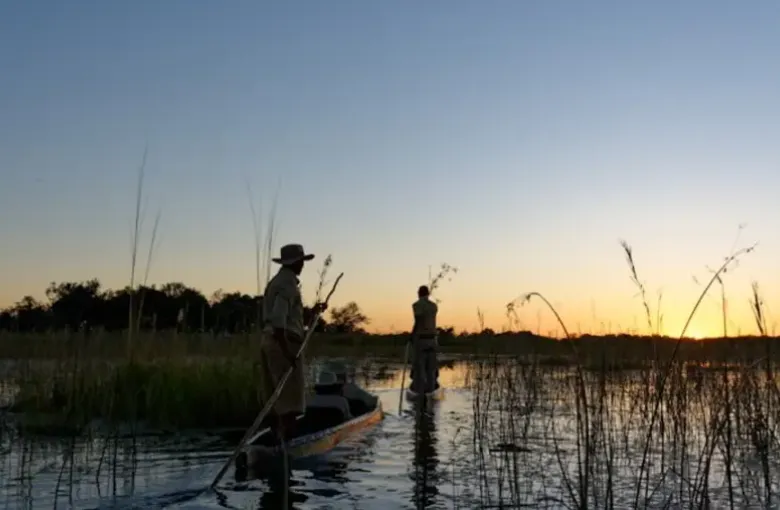
The mokoro
A dugout canoe, poled from behind while you sit low with the water inches away. It is the signature Okavango activity and it is genuinely unlike anything else: silent, slow, at the level of reed frogs and lily flowers, with your poler reading channels and hippo territory as they go.
Most mekoro are now fiberglass rather than carved hardwood, which is a conservation gain. See our accessibility guide for an honest account of boarding one.
Wildlife
Elephant, buffalo, hippo, crocodile, lion, leopard and spotted hyena throughout; cheetah on the drier fringes; and the delta is one of the strongest remaining strongholds for African wild dog, which is a real draw for anyone who has looked for them elsewhere. Red lechwe, the antelope adapted to run through shallow water, are everywhere and are the delta's signature. Birding is exceptional — fish eagles, storks, bee-eaters, and Pel's fishing owl for the patient.
How the concessions work
Most of the delta outside Moremi is divided into private concessions leased by operators, often in partnership with community trusts. That is the machinery behind Botswana's high-value, low-volume policy: a concession has a strict bed limit, so a camp of eight tents may have exclusive traversing rights over a very large area.
The practical effect is that you rarely see another vehicle, and that off-road driving, night drives and walking — not permitted in the national park — are usually allowed on private land. It is also why it costs what it does.
Getting there
Fly to Maun (MUB), then by light aircraft to a camp airstrip, then by vehicle or boat. The flight over the delta is worth a window seat.
Practicalities
- Malaria is present here — the delta is the higher-risk part of the country. See our safety guide.
- Wet feet on any mokoro trip; bring sandals or water shoes.
- The luggage limit is real. Soft bags only.
- Camps are unfenced. Use your escort after dark.
Visiting with LABUSA Travel
We will pair a water camp with a land camp rather than selling you one and calling it the delta, and we will tell you what the water is actually doing in your month rather than showing you a high-flood photograph and leaving you to find out.
Other Articles
Best Time to Visit Botswana
Chobe National Park: Visitor and Heritage Guide