The quick answer
Botswana is one of the safer countries in Africa for a visitor, with a long record of political stability and low violent crime by regional standards. The risks that actually injure travelers here are animals, roads and the sun, in roughly that order — not crime.
Health
Malaria: a matter of where and when
Unlike some neighbors, Botswana's malaria risk is regional and seasonal. It is concentrated in the north — the Okavango Delta, the Panhandle, Chobe and the north-west — and rises during and after the rains. Gaborone and the south are much lower risk.
That nuance is exactly why you should ask a professional rather than a website: prophylaxis advice depends on which parts of the country you are visiting and when. See a travel clinic six to eight weeks before departure.
Whatever you are prescribed, the physical precautions still matter: repellent, long sleeves and trousers from dusk, and the net your camp provides. If you develop a fever during the trip or in the weeks after, tell the doctor you have been in a malaria area.
Other health precautions
Tap water is generally treated and safe in towns; camps provide filtered water. Take the usual care with food outside established kitchens. Review routine and travel vaccinations for your trip, and note that yellow fever certificate requirements can depend on countries you transit.
Medical facilities are good in Gaborone and limited in the bush. Travel insurance with explicit medical evacuation cover is not optional for a Botswana safari — the same remoteness that makes the delta wonderful makes an evacuation slow and expensive.
Wildlife
Most Botswana camps are unfenced, by design. Animals walk through them. This is normal and it is why the rules exist.
- Elephants. Botswana has one of the largest elephant populations in Africa and you will meet them on roads, in camp and at waterholes. Give way, never come between a cow and a calf, and never try to drive past one that is showing you it is unhappy.
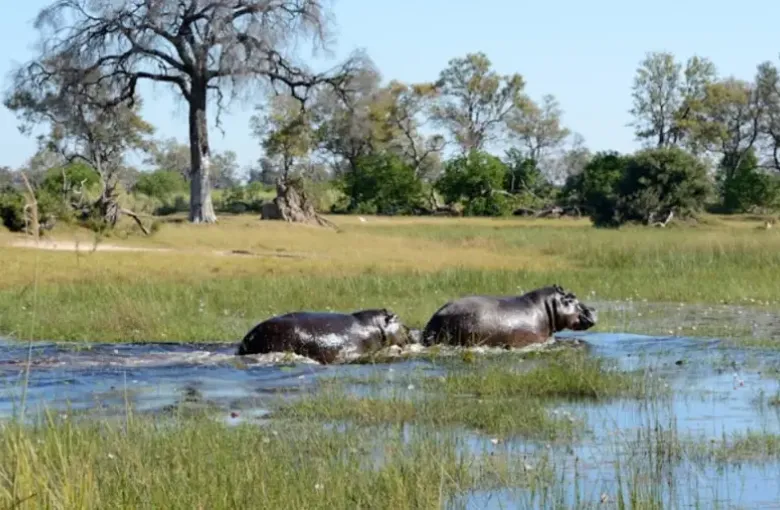
- Hippopotamus and crocodile are the real hazards of the delta and the rivers. Hippos are territorial and fast, and they are the reason a mokoro guide chooses their channel carefully. Do not swim, and do not stand at an unguarded bank.
- In camp after dark, use your escort. Someone walks you to your tent because something else may be using the same path.
- Stay in the vehicle on a game drive unless the guide says otherwise. Animals read a vehicle as one object and a standing person as something else.
- On a mokoro, sit still and follow the poler. They are reading water depth, channels and hippo territory continuously.
Roads
Do not drive outside towns after dark. Unfenced roads, livestock, and elephants that are invisible until they are not. Wear a seatbelt, keep to speed limits (they are enforced), and carry water and fuel margins on long desert routes where there is no traffic to help you.
Heat and sun
October on the pans is genuinely dangerous for anyone who takes it lightly. Drink far more water than feels necessary, cover up, and keep activity to the early morning and late afternoon as the camps do.
Everyday precautions
Petty theft is the ordinary urban risk and the usual care in Gaborone and at transport hubs is enough. Photography of government buildings, military and police installations and border infrastructure can cause real trouble — ask first.
Why this page prints no emergency telephone numbers
Deliberately. Emergency numbers change, differ by service and region, and a wrong number costs minutes at exactly the moment minutes matter.
Instead: write down your camp's and operator's direct numbers before you travel — in a remote area they are the people who will actually reach you. Check your own government's travel advisory service, which publishes current local emergency and consular contacts, and keep your insurer's 24-hour assistance line on your phone and on paper.
Where to check before you go
The CDC for health, and the UK and US advisories for current conditions. Read at least two; they are written for different audiences and emphasize different things.
Traveling with LABUSA Travel
Our Botswana partners are licensed operators with their own safety protocols, and you will have their direct contacts before departure rather than on arrival.
Other Articles
Botswana Visa and Entry Requirements
Botswana Packing List