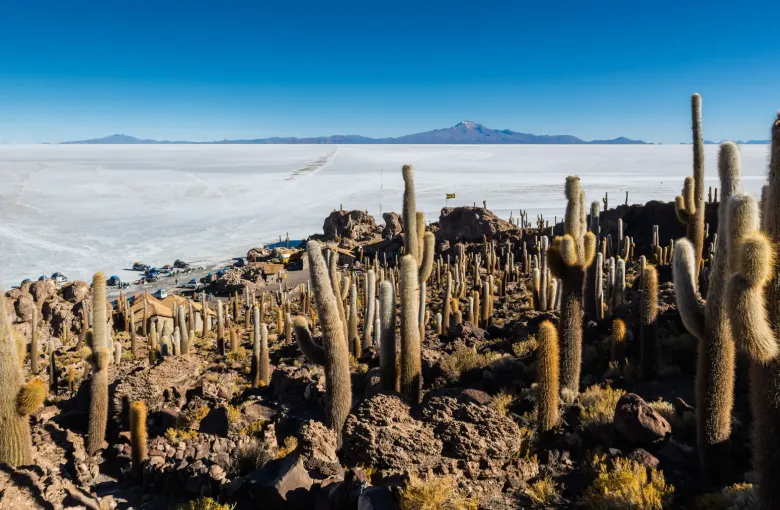
Asking what the weather is like in Bolivia is a little like asking what the weather is like in North America. The country spans a plateau above four thousand meters, a belt of temperate valleys, and tropical lowland that is warm and wet. Elevation, not latitude, does almost all the work.
The altiplano
La Paz, El Alto, Lake Titicaca, Oruro, Potosi and the Salar de Uyuni all sit on or around the high plateau. Days in the dry season are bright and can feel warm in direct sun; the moment the sun goes, the temperature falls hard. Nights below freezing are normal from May to August, and on the salt flat they are routine.
The air is dry and thin, the ultraviolet is fierce, and both of those matter more than the number on a thermometer. Sunburn at this elevation happens faster than most visitors expect, and it happens on overcast days.
The valleys
Sucre, Cochabamba, Tarija and Samaipata sit lower, between roughly two and three thousand meters, and they are the mildest part of the country. Warm days, cool evenings, and far less of the night time cold that defines the plateau. If a highland itinerary is proving hard on you, these towns are where a rest day is genuinely restful.
The lowland east
Santa Cruz, the Chiquitos mission towns, the Beni and the Amazon basin are hot and humid all year, with a pronounced wet season from November to March. This is also the part of the country where the health picture changes: the yellow fever vaccine recommendation and the recorded malaria risk both belong to the low eastern areas rather than to the highlands. What that means in practice is set out in the entry requirements guide.
One local feature worth knowing: a surazo is a cold wind that arrives from the south and can drop lowland temperatures sharply for a day or two, most often between May and August. It catches people who packed only for the tropics.
The Yungas
Between the plateau and the lowlands, the land falls away through the Yungas, a belt of steep, humid, green valleys. It is warmer than La Paz and wetter than almost anywhere else in the country, and the road down is spectacular and slow. These valleys are also the heart of Afro-Bolivian Bolivia, which the diaspora guide covers.
Packing for all three
A trip that takes in La Paz, the Salar and Santa Cruz needs a warm layer, a windproof layer and lightweight clothing at the same time, and no single one of them will do for the whole route. The packing list works through it, and the best time to visit covers the seasonal half of the question.
Sources
- UK Foreign, Commonwealth and Development Office: Bolivia travel advice: the index to the entry, safety, regional and health pages this cluster draws on, the advice against all but essential travel to the Chapare region of Cochabamba Department, the State of Emergency under which police and armed forces may detain a person who does not comply for up to eight hours without charge, and the standing guidance that no travel can be guaranteed safe. Accessed 17 September 2026.
- Centers for Disease Control and Prevention: Bolivia traveler health: a yellow fever vaccination certificate required for all arriving travelers aged one year and over, and separately a vaccine recommendation limited to travelers aged nine months and over going to areas below 2,300 meters east of the Andes, namely the entire departments of Beni, Pando and Santa Cruz and designated areas of Chuquisaca, Cochabamba, La Paz and Tarija, with the vaccine not recommended above 2,300 meters; malaria risk recorded in areas below 2,500 meters and none recorded in the city of La Paz. Accessed 17 September 2026.
Other Articles
Best Time to Visit Bolivia
What to Pack for Bolivia