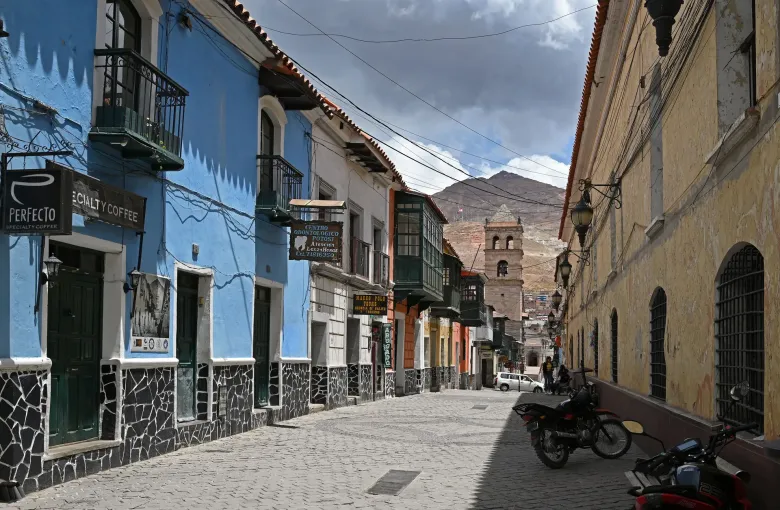
Bolivia is not a country that rewards rushing, and travelers who are content to spend three nights somewhere rather than one tend to have a far better time here than those moving daily. That is an advantage many older travelers already have.
⚠ Altitude, and the conversation to have first
The single most important piece of planning is elevation, and it comes before dates, flights or hotels. Altitude affects people unpredictably and does not track fitness. Heart and lung conditions, blood pressure, diabetes and anything affecting circulation all deserve a specific conversation with your own doctor about the elevations on your itinerary, by name.
Ask about the medication you already take as well as anything new, and ask early enough that the answer can change the plan. Nothing on this page names a medicine or a dose.
Build the trip so it climbs
The order of an itinerary matters more here than almost anywhere. Arriving into Santa Cruz at around four hundred meters, spending time in the lowlands and the Chiquitos mission towns, moving up to Sucre and Cochabamba in the valleys, and only then going to La Paz and the plateau, is a fundamentally gentler trip than landing at El Alto and starting at the top.
If the trip must begin in La Paz, give the first two days to nothing, and consider staying in the lower southern districts of the city rather than the center.
A genuinely good lower itinerary
It is worth saying plainly that a Bolivian trip which never goes above three thousand meters is not a consolation prize. Sucre, the first capital and inscribed in its own right, is beautiful and mild. Samaipata and its sculpted rock sit in pleasant hill country. The Jesuit mission towns of the Chiquitos, six settlements founded between 1696 and 1760 whose churches survive and whose Baroque music tradition is still played, are low, warm, level and among the most rewarding places in the country.
Pacing
- Fewer places, more nights in each. Bolivian road journeys are long and tiring.
- Fly rather than drive the long legs, particularly La Paz to Santa Cruz.
- Avoid overnight buses if sleep matters to you, and it does at altitude.
- Plan afternoons with nothing in them. Thin air makes ordinary days more tiring.
- Hire a vehicle with a driver, which is affordable here and removes most of the daily friction.
Practical points
- Colonial towns are cobbled, steep and uneven. Good footwear, and a walking pole if you use one, matter more than usual.
- Drink far more water than usual. Dehydration at altitude is easy and it makes everything else worse.
- Carry medication in original packaging in hand luggage, with enough to cover delays, and carry a written list of what you take and why, in Spanish.
- Take travel insurance that covers your existing conditions and covers medical evacuation, and read the altitude clauses rather than assuming.
- For an ambulance, call 118. Keep it with your insurer's emergency number and your accommodation address written in Spanish.
Traveling with others
A small group trip with a fixed itinerary, private transport and someone who has confirmed the arrangements takes most of the difficulty out of Bolivia without taking the country away. If that appeals, tell us how you like to travel and we will build the elevation profile around you rather than the other way round.
Sources
- UK Foreign, Commonwealth and Development Office: Bolivia travel advice: the index to the entry, safety, regional and health pages this cluster draws on, the advice against all but essential travel to the Chapare region of Cochabamba Department, the State of Emergency under which police and armed forces may detain a person who does not comply for up to eight hours without charge, and the standing guidance that no travel can be guaranteed safe. Accessed 17 September 2026.
- UK Foreign, Commonwealth and Development Office: Bolivia health: the emergency medical number 118, and the advice on insurance, on medical evacuation and on the inconsistency of public healthcare response times and quality. Accessed 17 September 2026.
- Centers for Disease Control and Prevention: Bolivia traveler health: a yellow fever vaccination certificate required for all arriving travelers aged one year and over, and separately a vaccine recommendation limited to travelers aged nine months and over going to areas below 2,300 meters east of the Andes, namely the entire departments of Beni, Pando and Santa Cruz and designated areas of Chuquisaca, Cochabamba, La Paz and Tarija, with the vaccine not recommended above 2,300 meters; malaria risk recorded in areas below 2,500 meters and none recorded in the city of La Paz. Accessed 17 September 2026.
- UNESCO World Heritage Centre: Jesuit Missions of the Chiquitos, inscribed 1990, six settlements founded between 1696 and 1760 in which a fusion of Catholic and local culture produced a surviving group of mission churches. Accessed 17 September 2026.
Other Articles
Accessible Travel in Bolivia
Getting Around Bolivia