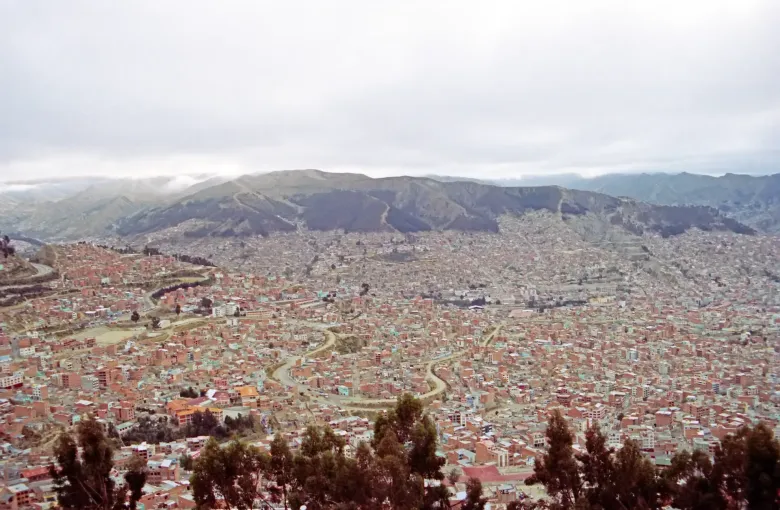
Potosi sits above four thousand meters in the Bolivian highlands, beneath a conical red mountain called Cerro Rico, the rich hill. In the sixteenth and seventeenth centuries the silver taken out of that mountain made this one of the largest cities in the world, larger at its height than London or Paris, and it funded the Spanish empire for generations. The phrase vale un Potosi, worth a Potosi, entered Spanish as a way of saying immeasurably valuable.
What is inscribed, and when
The City of Potosi was inscribed on the World Heritage List in 1987. The inscription is not only the colonial town. It records the industrial monuments of Cerro Rico itself, where water was brought down through a system of aqueducts to drive the mills that crushed the ore, together with the colonial town below, the Casa de la Moneda, the church of San Lorenzo and a number of patrician houses.
In other words the mountain and the machinery are part of what is listed, not a backdrop to it. That framing is the honest one for what this place is.
⚠ What the silver cost
The silver did not extract itself. The Spanish administration ran Potosi on the mita, a system of forced rotational labor that conscripted Indigenous Andean men from across a vast catchment and sent them into the mountain. Enslaved Africans were brought to Potosi as well, to the mines and to the mint, in numbers large enough that their descendants remain a distinct community in Bolivia today, in the Yungas valleys. The diaspora guide follows that thread forward.
The number of people who died in and around these workings over three centuries is not knowable with precision and every serious estimate is very large. A visit to Potosi that treats the town as pretty colonial architecture and stops there has missed what the architecture was paid for with.
The mines today, and a decision to make deliberately
Cerro Rico is still worked, by cooperatives, in conditions that shorten the lives of the people who work in them. Silicosis and accidents are ordinary facts of the industry here. Tours into the working mines are sold openly in Potosi and many visitors take them.
This page does not recommend one. Whether to go into a working mine as a visitor is a decision worth making deliberately rather than treating as a sightseeing stop, and if you do go, going with an operator run by people from the mining community, and buying the gifts of coca and other supplies that are customary, is the minimum. The mountain is also visibly unstable at its summit after five centuries of tunnelling, and that is a practical consideration as well as a symbolic one.
The Casa de la Moneda
The royal mint is the single best thing to see in the city and the place where the story becomes concrete. The building is vast, the wooden mule driven rolling machines survive, and the coins struck here circulated across the world. Visits are by guided tour and the tours are worth the time.
Practicalities
- The altitude is serious. Potosi is one of the highest cities of its size anywhere, above four thousand meters. Do not arrive here directly from sea level and expect to walk uphill through a colonial street grid on the same afternoon. Come up from Sucre, which is considerably lower, and give yourself time.
- Nights are cold all year and the buildings are not built for it. Pack accordingly.
- The town is steep, cobbled and uneven. The accessibility guide is honest about what that means.
- Sucre is roughly three hours away by road and makes the natural pairing: the first capital, much gentler on the body, and inscribed in its own right in 1991.
Sources
- UNESCO World Heritage Centre: City of Potosi, inscribed 1987, recording the industrial monuments of the Cerro Rico where water came down through aqueducts to drive the silver mills, together with the colonial town, the Casa de la Moneda, the church of San Lorenzo and a number of patrician houses. Accessed 17 September 2026.
- UNESCO World Heritage Centre: Bolivia States Party record: the properties Bolivia has inscribed on the World Heritage List, and separately the Tentative List of sites it may nominate in future. Accessed 17 September 2026.
- UK Foreign, Commonwealth and Development Office: Bolivia travel advice: the index to the entry, safety, regional and health pages this cluster draws on, the advice against all but essential travel to the Chapare region of Cochabamba Department, the State of Emergency under which police and armed forces may detain a person who does not comply for up to eight hours without charge, and the standing guidance that no travel can be guaranteed safe. Accessed 17 September 2026.
- Centers for Disease Control and Prevention: Bolivia traveler health: a yellow fever vaccination certificate required for all arriving travelers aged one year and over, and separately a vaccine recommendation limited to travelers aged nine months and over going to areas below 2,300 meters east of the Andes, namely the entire departments of Beni, Pando and Santa Cruz and designated areas of Chuquisaca, Cochabamba, La Paz and Tarija, with the vaccine not recommended above 2,300 meters; malaria risk recorded in areas below 2,500 meters and none recorded in the city of La Paz. Accessed 17 September 2026.
Other Articles
Best Time to Visit Bolivia
Accessible Travel in Bolivia