Dates on this page move. Most of the largest events follow the church calendar and shift with Easter, and local fiestas are set locally. Confirm the year you are traveling before you book anything around one.
The Carnival of Oruro
This is the one. For several days before Ash Wednesday, the mining city of Oruro gives itself over to a procession that runs for kilometers and for the better part of twenty hours, with tens of thousands of costumed dancers and hundreds of thousands of spectators.
Its central dance is the diablada, the dance of the devils, in masks and beaten costumes of enormous weight, and the procession is a pilgrimage to the Virgen del Socavon, the Virgin of the Mineshaft, whose sanctuary stands at the end of the route. Andean belief and Catholic devotion are braided together in it so thoroughly that separating them is not possible and not the point.
Practical notes, because this is not an event to improvise:
- Accommodation in Oruro is booked out months in advance, and prices rise sharply. Many visitors stay in La Paz or Cochabamba and travel in, which means a long day and a full road.
- Seats on the stands along the route are sold in advance. Standing is possible and hard.
- It is cold at night at that elevation, and water and foam are thrown enthusiastically during carnival. Dress for both.
- Roads fill. Allow far more time than the distance suggests.
Copacabana and the Virgen de la Candelaria
The lakeside town of Copacabana holds its main feast in early February, and it fills completely. It is a serious pilgrimage rather than a spectacle for visitors, and it is worth attending in that spirit. If you want Lake Titicaca quietly, this is the week to avoid; the Titicaca guide covers the rest of the year.
Gran Poder, La Paz
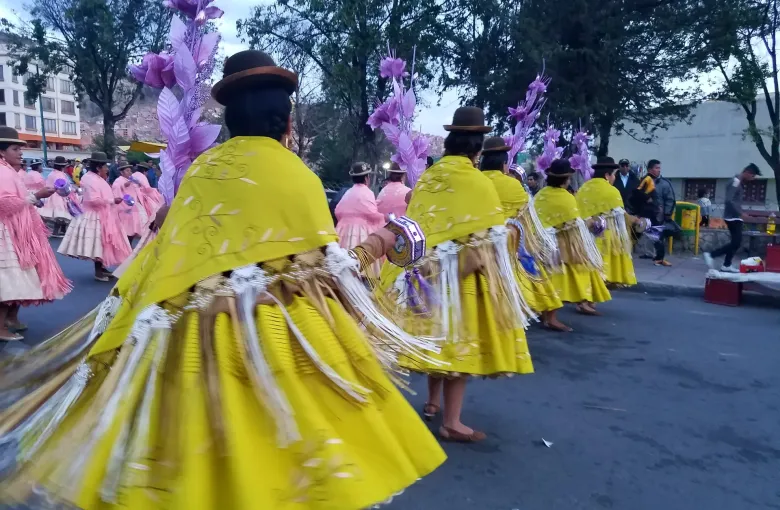
The Fiesta del Señor Jesus del Gran Poder takes over La Paz in late May or June, with folkloric troupes dancing through the city for a full day. It is the biggest event in the capital's calendar and it began in the Aymara neighborhoods of the city, which is part of what it is about.
The rest of the year
- Carnaval de Santa Cruz, at the same time as Oruro and entirely different in character: lowland, hot and closer to a Brazilian carnival.
- Aymara New Year, 21 June, the winter solstice, marked at Tiwanaku and at sites across the altiplano at dawn. It is a public holiday.
- Independence Day, 6 August, with parades countrywide and a busy week around it.
- Todos Santos, 1 and 2 November, when families keep vigil with their dead and bake the bread figures called tantawawas. It is intimate rather than public and should be approached with care.
- Chiquitos Baroque music festival, held every other year in the mission towns east of Santa Cruz, performing music written in the missions themselves. A quiet counterweight to Oruro.
What a fiesta does to a trip
Expect closed roads, full buses, banks and offices shut for more days than the official holiday, and accommodation gone. None of that is a reason to avoid traveling at these times, but it is a reason to know which week you are in. Build slack, and read the travel safety guide on roadblocks, which are a separate matter and behave the same way.
Sources
- UK Foreign, Commonwealth and Development Office: Bolivia travel advice: the index to the entry, safety, regional and health pages this cluster draws on, the advice against all but essential travel to the Chapare region of Cochabamba Department, the State of Emergency under which police and armed forces may detain a person who does not comply for up to eight hours without charge, and the standing guidance that no travel can be guaranteed safe. Accessed 17 September 2026.
- UNESCO World Heritage Centre: Bolivia States Party record: the properties Bolivia has inscribed on the World Heritage List, and separately the Tentative List of sites it may nominate in future. Accessed 17 September 2026.
Other Articles
Culture and Etiquette in Bolivia
Bolivia and Diaspora Reconnection