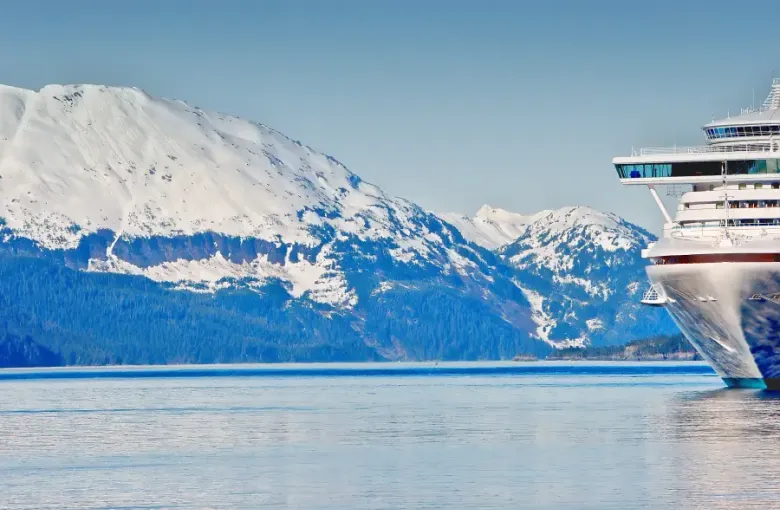
The quick answer
Alaska is more accessible than its wilderness reputation suggests, provided the trip is built the right way round. American accessibility law applies, the cruise ships are among the most accessible travel products anywhere, the railroad is well equipped and the main national park visitor facilities are good. The difficulty is remoteness: small aircraft, small boats, older lodges and unpaved ground.
What works well
Cruising
A large ship solves accommodation, meals, transport and a great deal of sightseeing at once, with accessible cabins, lifts and step-free public areas. For many travelers with mobility needs it is not a compromise but the best possible way to see Southeast Alaska, because the alternative involves small boats and gravel. Book the accessible cabin early; there are few and they go first.
Ask specifically about tendering. Where a ship anchors offshore and ferries passengers in by small boat, that transfer can be impossible in a wheelchair and is at the captain's discretion in any sea state.
The Alaska Railroad
Accessible cars, lifts at the main stations and staff used to assisting. One of the great scenic journeys in North America and one of the easiest things to do here.
National parks
Visitor centers are accessible, and several parks have paved or boardwalk trails near the entrances with real views rather than token ones. Denali's park buses include accessible vehicles, which should be arranged in advance. The National Park Service publishes accessibility information per park; read the park's own page rather than a general one.
The ferries
Alaska Marine Highway vessels have accessible cabins and lifts, though the fleet varies in age and so does the provision. Confirm for the specific vessel on your sailing rather than for the system.
What is genuinely hard
- Bush aircraft. Small planes have high steps, no elevator and tight cabins. Some operators can help and some cannot, and this is the single biggest constraint on a remote itinerary.
- Remote lodges. Frequently older, often on boardwalks or gravel, sometimes with rooms up steps and a walk to the dining room in the dark.
- Wildlife and glacier boats. Smaller vessels may have steep gangways and no accessible toilet.
- Winter. Ice and snow make even good infrastructure difficult, and aurora viewing usually means standing outside in the cold at night.
Questions to ask, and ask for photographs
- Is there a step at the entrance, the room and the dining room?
- What is the clear door width, and is the shower roll-in?
- What is the surface and the gradient between parking and room, and is it lit?
- For a vessel: how do passengers board, and what happens if the ship tenders?
- For a park bus or a coach: is it lift-equipped, and must it be booked separately?
Other requirements
For hearing impairment, the ships and larger operators are well equipped and written information is widely available. For visual impairment, guided experiences work far better than infrastructure does, and several operators are experienced with this. For medical needs, remember that Anchorage has the serious hospitals and a remote lodge is a long flight away, so insurance covering evacuation is important, and bring medication in original packaging with a copy of the prescription.
Planning with LABUSA Travel
We ask operators the questions above and get photographs rather than assurances, and we will tell you plainly which parts of an Alaskan itinerary are going to work for you and which are not.
Sources
- US National Park Service: the authority for access, seasons and current conditions in every Alaskan national park. Accessed 11 August 2026.
- Alaska Marine Highway System: the state ferry network, its routes, vehicle decks and seasonal schedules. Accessed 11 August 2026.
- Travel Alaska, State of Alaska tourism office: the official state visitor information, including regional guides and seasonal planning. Accessed 11 August 2026.
Other Articles

Alaska for Senior Travelers
Glacier Bay: A Visitor Guide