The country is easy to travel and harder to generalize about than almost anywhere, which is a consequence of its size and of who lives in it. Ethnologue counts several hundred living languages here, from Spanish through a long tail of Indigenous, immigrant and signed languages, and that plurality is not a footnote to American culture. It is most of the explanation for it.
Friendly is not the same as familiar
Strangers speak to each other here, in elevators, in lines and at tables, and the warmth is genuine rather than a preamble to anything. It also does not imply a relationship. Visitors from more reserved cultures sometimes read the openness as an invitation to intimacy and then find the boundary further back than expected; visitors from more formal ones sometimes read the first name and the casual greeting as disrespect, when it is the opposite. Both readings are wrong in the same direction.
Directness, and its limits
Americans state opinions and ask questions more directly than many cultures consider polite, and they soften disagreement more than they think they do. Yes tends to mean yes. Enthusiasm in a work or service context is normal rather than performed. The subjects that are genuinely off limits in casual conversation are money, particularly what someone earns or paid, and increasingly politics, which has become a real social hazard rather than a lively topic. Age, weight and health are also private.
The regions are not interchangeable
Conversational pace, formality and personal space differ enough between regions to be worth noticing. The South is warmer in address and more formal in courtesy, and titles are used more. The Northeast is faster, more direct and less inclined to small talk with strangers, which is not coldness. The Midwest is friendly and indirect, which means a mild phrase can be carrying more weight than it appears to. The West is informal to a degree that surprises people from both coasts of Europe. None of this is a rule, and all of it is noticeable.
Tipping is a wage question
It is worth understanding rather than memorizing. In much of the country the base pay for service work is set on the assumption that customers will make up the rest, which is why the expectation feels stronger here than the amounts suggest. Typically eighteen to twenty percent in a restaurant, a dollar or two a drink at a bar, and something for anyone who carries, drives or cleans for you. The money guide covers the detail.
Small courtesies people notice
- Lines. Queueing is taken seriously and cutting is a genuine offense.
- Hold the door for whoever is behind you.
- Personal space is larger than in much of Europe, Latin America and Asia. Around an arm's length in conversation is normal.
- Volume. Americans are louder than they think and quieter than the stereotype in restaurants and on transit.
- Punctuality. On time means on time for business, and within about fifteen minutes for a social invitation.
- Photographs. Ask before photographing people, and particularly before photographing children or ceremonies.
Where more care is owed
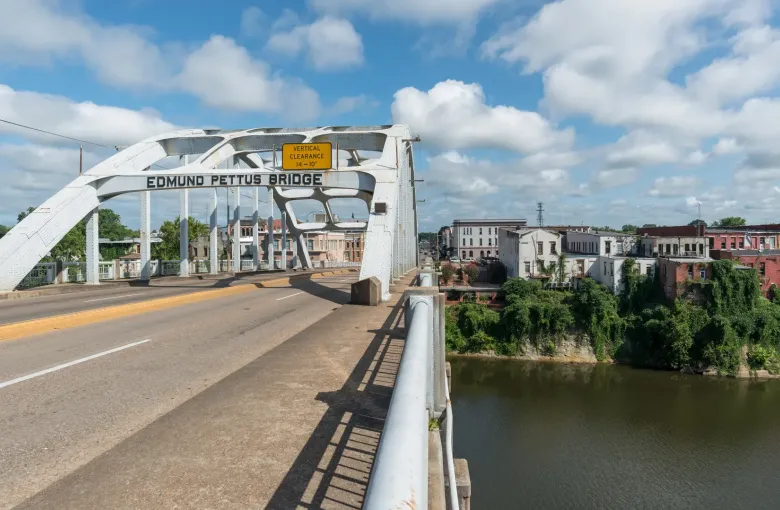
On tribal lands you are a guest of a sovereign nation with its own laws, permits and rules about photography and access, and those rules are not suggestions. At sites of memory, including the places covered in this cluster's civil rights guide and the memorials and burial grounds across the country, the appropriate manner is the one you would bring to any place where something terrible happened to real people. In places of worship, dress and behave as the community does. Asking is always better received than assuming.
Language
English is the working language nearly everywhere, and in large parts of the Southwest, Florida, New York and California, Spanish is a daily one rather than a courtesy. A few words of it are useful and appreciated in those places. Regional vocabulary differs enough to cause confusion in restaurants and shops, and asking is entirely normal.
Sources
- Ethnologue: United States: the language record for the country, covering the number of living languages spoken and the position of English alongside Spanish and a long tail of indigenous, immigrant and signed languages. Accessed 17 September 2026.
Other Articles
United States Money and Costs Guide
Civil Rights Movement Sites: Visitor and Heritage Guide