The fastest way to eat badly in this country is to eat nationally. The chains are the same everywhere by design, and they are not what anyone here would offer a visitor. Eat regionally instead and the United States becomes one of the more interesting places to be hungry.
The regions that are worth planning around
- The Lowcountry and the coastal South. Rice, shrimp, okra and smoked pork, with a West African inheritance that runs through Gullah Geechee cooking and is the foundation of much of what the rest of the country calls Southern food.
- Louisiana. Creole and Cajun are not the same thing. Gumbo, jambalaya, étouffée and boudin, out of French, Spanish, West African and Indigenous cooking, and nowhere else in the country tastes like it.
- Texas and the border. Barbecue built on beef and time rather than sauce, and Tex Mex as a cuisine in its own right rather than a compromise.
- The Southwest. New Mexican cooking is distinct from Mexican and from Tex Mex, and the annual question of red or green chile is a real one.
- The Midwest and the Great Lakes. German, Scandinavian and Polish inheritance, lake fish, and the two cities that argue about pizza.
- New England. Shellfish, chowder and the lobster roll, which is a summer thing eaten near where it was landed.
- The Pacific Northwest and California. Salmon, oysters, orchards, and the produce driven cooking that changed American restaurants.
- Hawaii. Native Hawaiian cooking alongside Japanese, Filipino, Chinese, Portuguese and Korean influence, which is why plate lunch looks the way it does.
Where the food came from
Almost every regional cuisine here is an immigrant one, and often several layered together. Barbecue traditions across the South carry African, Indigenous and European techniques. The Italian American cooking of the Northeast is a cuisine of its own rather than an imitation, and so are Chinese American, Mexican American, Vietnamese American and Cuban American cooking. The Great Migration carried Southern food north into Chicago, Detroit and New York and changed all three. A country that speaks several hundred languages eats accordingly, and that variety is the single best reason to eat here.
How eating out works
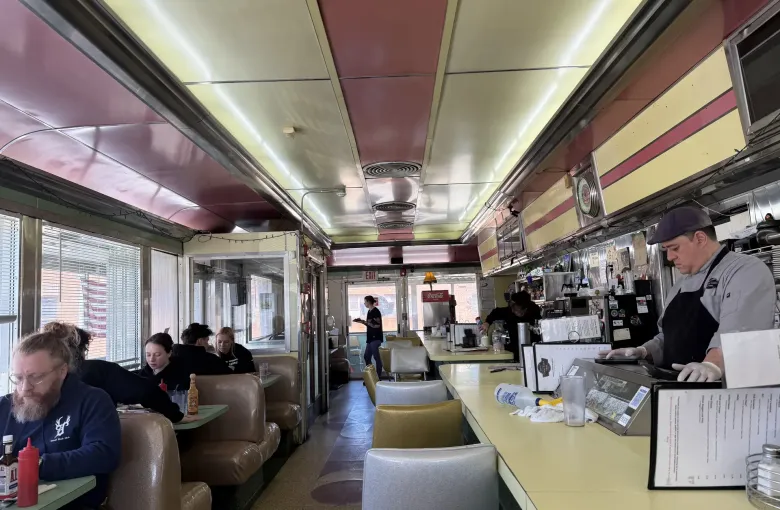
Portions are large and taking the remainder away is normal and expected rather than embarrassing. Water arrives free and unasked. Refills on drip coffee and soft drinks are frequently included. Breakfast is a serious meal in much of the country and a diner at seven in the morning is one of the more characteristic things to do. Table service runs on tipping, which is covered in the money guide, and the bill will not include it unless the party is large.
Eating well on the road
The reliable signals are local: a line of working vehicles outside a barbecue place at noon, a diner with a counter, a taqueria attached to a grocery, a farm stand in season. Farmers markets are excellent almost everywhere and are often the best single meal of a driving day. Supermarkets are a genuine option on a long itinerary, and alternating them with restaurant meals changes what a week costs without changing how it tastes.
Dietary requirements
Vegetarian and vegan options are widely available in cities and along the coasts, and thinner in rural areas and in barbecue and steak country, where the vegetable sides are usually the way through. Allergen awareness is generally good and staff are used to the question. Alcohol laws vary by state and sometimes by county, including which shops may sell what and on which days, which occasionally surprises people crossing a state line on a Sunday.
Sources
- Ethnologue: United States: the language record for the country, covering the number of living languages spoken and the position of English alongside Spanish and a long tail of indigenous, immigrant and signed languages. Accessed 17 September 2026.
Other Articles
United States Culture and Etiquette Guide

United States Money and Costs Guide