Begin with what is not known here.
None of the sources this cluster cites publishes accessibility information for Thailand. There is no sourced statement here about step-free access at airports, about lifts at rail stations, about accessible taxis, about ramps at temples or about paths at heritage sites. A page that produced those from general impression would be indistinguishable from one that had checked, and it would be relied on.
Saying that clearly is the most useful thing this page does. What follows is either reasoning from things that are sourced, or a question worth asking somebody who can answer it.
What can be reasoned rather than asserted.
Some of this cluster's sourced facts have accessibility consequences even though they are not about accessibility.
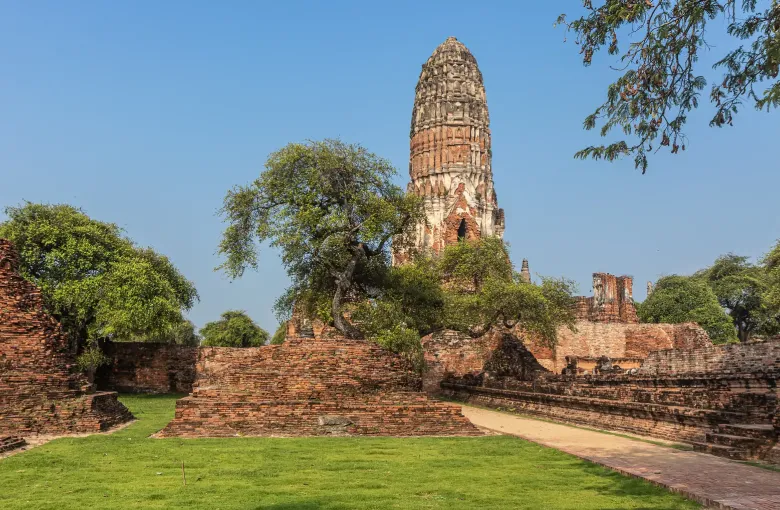
The Ayutthaya guide describes an open, largely unshaded archaeological city walked on uneven brick and laterite, spread across ground between modern roads. That is a description of the site rather than an accessibility assessment, and it is enough to say that the distances and the surfaces are a real factor and should be planned for rather than discovered.
The etiquette guide records that shoes are removed before entering temple buildings. Where removing and replacing footwear is difficult, that is worth knowing in advance, and it is a question a specific temple can answer.
The getting around guide describes tuk-tuks and longtail boats, both of which are boarded rather than rolled onto. Whether a given service can accommodate a wheelchair is a question for the operator on the day rather than something a guide can promise.
Heat is an accessibility question.
This cluster publishes no temperature, and it does not need one to make the point that Thailand is hot and that heat narrows what a day can contain for many travelers. Shade, distances between stops and the availability of somewhere to sit are worth building into an itinerary from the start rather than treating as a contingency.
The guide for senior travelers covers pacing in more detail, and much of it applies here.
Health preparation, which is sourced.
The UK Foreign, Commonwealth and Development Office advises checking vaccination and health information at least 8 weeks before travel, and gives the emergency instruction for Thailand as dial 191 and ask for an ambulance, with 1669 as the local number. Both numbers are worth carrying rather than one.
Anyone traveling with a condition, equipment or medication has more to arrange than that, and eight weeks is the window in which it is arrangeable. Travel insurance that covers a pre-existing condition and the possibility of medical evacuation is the FCDO's own emphasis, and it is the single most consequential item on this page.
The questions that get a real answer.
Ask the airline about the aircraft and the transfer, not just about the booking. Ask the hotel for the doorway and bathroom measurements rather than whether the room is accessible, because the word carries different standards in different places. Ask a site whether its published route has steps, and ask how far it is from the nearest drop-off point.
And ask us. If you are traveling with us we will put those questions to the operators ourselves and tell you what they said, including where they would not commit to an answer.
Sources
- UK Foreign, Commonwealth and Development Office: the Thailand health page: that the emergency medical instruction is to dial 191 and ask for an ambulance, with 1669 given as the local number; and that a traveler should check vaccination and health advice at least 8 weeks before the trip. Accessed 22 September 2026.
- UK Foreign, Commonwealth and Development Office: the Thailand travel advice landing page: that no travel can be guaranteed safe, and that anyone who chooses to travel should research their destination and get appropriate travel insurance. Accessed 22 September 2026.
- UNESCO World Heritage Centre: the Thailand State Party record: that Thailand has nine properties inscribed on the World Heritage List, six cultural and three natural, and six sites on its Tentative List. The cultural properties are Ban Chiang Archaeological Site inscribed in 1992, the Historic City of Ayutthaya in 1991, the Historic Town of Sukhothai and Associated Historic Towns in 1991, Phu Phrabat in 2024, the Ancient Town of Si Thep and its Associated Dvaravati Monuments in 2023, and Wat Phra Mahathat Woramahawihan at Nakhon Si Thammarat in 2026. The natural properties are Dong Phayayen-Khao Yai Forest Complex inscribed in 2005, Kaeng Krachan Forest Complex in 2021 and Thungyai-Huai Kha Khaeng Wildlife Sanctuaries in 1991. Accessed 22 September 2026.
Other Articles
Thailand for Senior Travelers
Getting Around Thailand