The short version
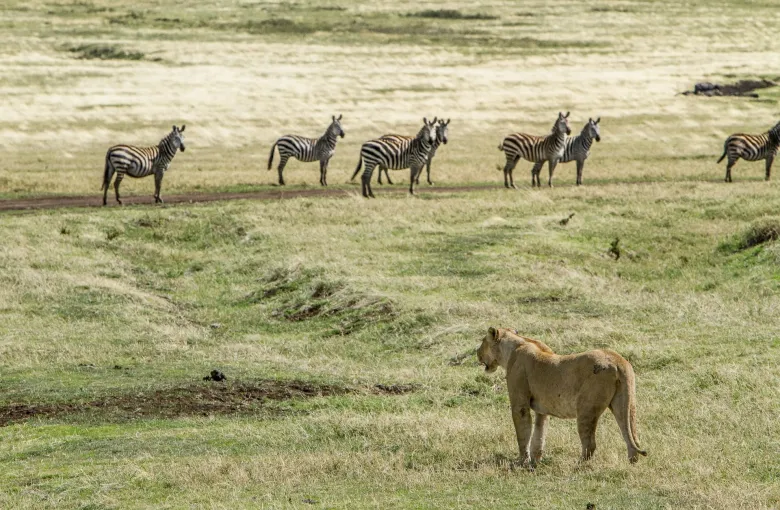
Serengeti National Park was inscribed on the UNESCO World Heritage List in 1981 as a natural property. It covers 1.5 million hectares of savannah, and UNESCO describes it as holding the largest remaining unaltered animal migration in the world.
The migration, in the inscription's own terms
Over a million wildebeest, plus hundreds of thousands of other ungulates, make a 1,000 km annual circular trek spanning Tanzania and Kenya, following pasture and water and followed in turn by their predators. UNESCO puts the ecosystem's wildebeest population at around two million, alongside roughly 900,000 Thomson's gazelles and 300,000 zebras.
The setting is described as "endless plains": some 25,000 square kilometers of flat short grassland dotted with the rocky outcrops known as kopjes, cut by rivers and woodland.
What else lives there
The inscription records one of the largest and most diverse predator and prey systems anywhere. Recorded figures include roughly 4,000 lions, 1,000 leopards, 225 cheetahs, 3,500 spotted hyenas and 300 wild dogs, alongside 70,000 buffalo, 4,000 giraffe, 2,700 elephants and about 200 black rhinoceros.
More than 500 bird species are present perennially or seasonally, five of them endemic to Tanzania, and the park holds what UNESCO calls a globally important ostrich population. Four species on the property are globally threatened or endangered: black rhinoceros, elephant, wild dog and cheetah.
It is one park inside a much larger system
This is the thing most itineraries get wrong. Serengeti National Park sits at the heart of an ecosystem defined by the migration itself, and the property is contiguous with the Ngorongoro Conservation Area. The wider system also takes in Maswa Game Reserve, the Grumeti and Ikorongo reserves, Loliondo, and the Maasai Mara National Reserve across the Kenyan border. UNESCO notes that no barriers hamper the migration across it.
Practically: the herds are somewhere in that system all year, and "the Serengeti in September" is not a location. Where to be, for your dates, is a planning judgment.
Visiting with a group
Give it more days than you think. The distances inside the park are large, the best light is at the ends of the day, and a schedule built to tick off a list produces a lot of driving and not much watching. Game viewing runs on the park authority's rules, including restrictions on leaving the track, which is part of why there is still something to see.
Pair it with Ngorongoro, which is next door and completely different, and read the best time to visit guide before fixing dates around the migration.
Planning with LABUSA Travel
We plan and manage Tanzania journeys for groups: itinerary design, park permits, lodges, internal flights and ground transport, and a single point of contact while you travel. Start with the Tanzania travel guide, or tell us what your group has in mind on the plan your trip form.
Other Articles
Ngorongoro Conservation Area: Visitor and Heritage Guide