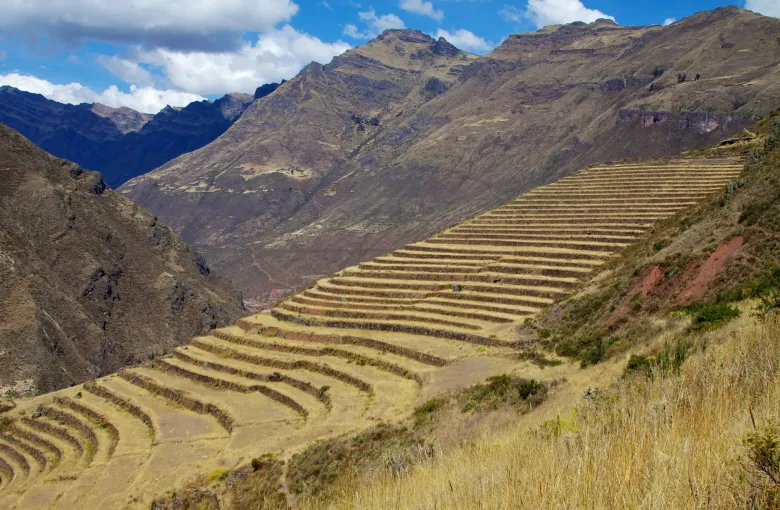
The variable is height, not age
Peru is visited very successfully by travelers in their sixties, seventies and beyond, and the qualities the country asks for are patience, comfortable shoes and a flexible schedule rather than athleticism. The one factor that deserves real planning is the altitude, and it affects people unpredictably: fitness is a poor predictor, and somebody who was fine at 3,400 meters at forty may not be at seventy.
Altitude sickness is a serious risk in Cusco, Puno, the Colca Canyon and Kuelap. Talk to your own clinician before booking, particularly with any heart or lung condition, and have that conversation early enough that it can change the itinerary. This page publishes no medication and no dose; that decision belongs to the person who knows your history.
The one change that improves most itineraries
Standard packages fly from Lima into Cusco and put the first night at 3,400 meters, which is the worst possible introduction. The better sequence is to transfer straight down to the Sacred Valley, at around 2,800 meters, spend the first two or three nights there, and come up to Cusco later in the trip once acclimatized.
The valley is gentler in every way: lower, warmer, flatter, with modern single story hotels in gardens and with Pisac, Ollantaytambo, Moray and Maras all close by. Ask your operator for this explicitly. Many will do it when asked and few will offer it.
Pacing
- Two nights minimum in each place. A one night stop at altitude is almost all travel.
- Half days, not full days. Sites at 3,000 meters are more tiring than the same walking at home.
- Build in rest days, and build in a buffer day before the international flight, because protests can suspend the southern trains without notice.
- Morning starts. Cooler, quieter, and better in the rainy season when rain tends to come in the afternoon.
- Consider a private guide and driver. The difference in cost is smaller than expected and the difference in tiredness is large.
Machu Picchu realistically
The citadel is at more than 2,400 meters on a steep ridge, and the circuits are stairs and uneven original stone without handrails. It is entirely achievable for many older travelers, and it is not a stroll.
What helps: take the train from the Sacred Valley rather than from Cusco, stay the night in Aguas Calientes rather than doing it as a day return, take the bus rather than walking up, go early, take a guide who will set the pace you want, and choose the lower circuit. Trekking poles help more on the descent than the ascent.
It is worth knowing that Machu Picchu is a thousand meters lower than Cusco, so many people feel noticeably better there than they did in the city.
Health and insurance
- Get travel insurance that covers pre existing conditions, covers trekking or high altitude if relevant, and includes medical evacuation. Medical treatment is harder to access outside Lima, and evacuation is expensive.
- Carry medication in original labeled packaging in your carry on, with more than the trip needs and a copy of the prescription. Some medicines available over the counter elsewhere need a local prescription in Peru.
- Carry a short written summary of your conditions and medication in Spanish.
- Consult a travel clinic about eight weeks ahead. The vaccine geography is specific and depends entirely on whether the Amazon is in the itinerary; our Peru packing list sets out where the risks are and are not.
- Note the ambulance number, 106, and ask your accommodation what they would do in an emergency.
Comfort
- Nights in the highlands are cold and heating is not universal. Ask about it when booking.
- Cobbles and uneven stone are everywhere. Supportive shoes with a good sole matter more than they would at home.
- Eat lightly and drink a great deal of water in the first days at altitude.
- Bathrooms at sites are limited and frequently need small change.
What suits this country to unhurried travel
The things Peru does best reward time rather than speed: a morning in a market, an afternoon in one museum, a long lunch, a slow day at Lake Titicaca. Travelers who are not trying to see everything in ten days generally have the better trip, and that is an advantage rather than a compromise.
Verify before you travel
Insurance terms, medical arrangements and site access change. Confirm each with the provider rather than relying on a summary.
Sources
- UK Foreign, Commonwealth & Development Office: Peru health: the ambulance number 106, the eight week lead time before travel, altitude sickness named as a serious risk in Cusco, Puno, the Colca Canyon and Kuelap, the dengue outbreak following floods, and the difficulty of accessing medical treatment outside Lima. Accessed 16 September 2026.
- US Centers for Disease Control and Prevention: Travelers' Health, Peru: the yellow fever recommendation for areas below 2,300 meters in the eastern regions, the record that the vaccine is not an entry requirement and is not recommended for travel limited to Lima, the city of Cusco, the Inca Trail or Machu Picchu, and the malaria transmission map including the absence of transmission in Lima Province, the highland tourist areas and around Lake Titicaca. Accessed 16 September 2026.
- UK Foreign, Commonwealth & Development Office: Peru safety and security: protests and strikes and their effect on the southern railways, street crime in Lima, Cusco and Arequipa, robbery by criminals posing as taxi drivers at Jorge Chavez airport and the bus terminals, express kidnapping, counterfeit notes and the withdrawn intis passed by street changers in Cusco, methanol in spirit drinks, the requirement to carry identification, the prohibition on photographing military sites, the illegality of carrying coca leaf out of the country, driving and overnight bus standards, the rainy season from November to May, and the earthquake and volcanic risk. Accessed 16 September 2026.
- UNESCO World Heritage Centre: the inscription of the Historic Sanctuary of Machu Picchu in 1983 as a mixed property, covering 32,592 hectares of mountain slopes, peaks and valleys around the citadel at more than 2,400 meters, its roughly two hundred structures, its fifteenth century construction and abandonment after the Spanish conquest, and its reintroduction to the outside world in 1911. Accessed 16 September 2026.
Other Articles
Accessible Travel in Peru
Getting Around Peru