What is actually inscribed
In 1983 UNESCO inscribed the Historic Sanctuary of Machu Picchu as a mixed property, recognized for outstanding cultural and natural value. Peru has thirteen properties on the list and only two are mixed; this is one of them.
The property covers 32,592 hectares of mountain slopes, peaks and valleys surrounding its heart, the archaeological monument known as La Ciudadela, the citadel, which stands at more than 2,400 meters above sea level. The site sits where the Peruvian Andes meet the Amazon basin, and that meeting is part of why it is inscribed for nature as well as for architecture.
The citadel is made up of approximately two hundred structures on a steep ridge, crossed by stone terraces. The plan divides the city into a lower and an upper part, separating farming from residential areas, with a large square between them. It was built in the fifteenth century and abandoned when the Inca state was conquered by the Spanish in the sixteenth. It was not known to the outside world until 1911.
UNESCO is candid that much about it remains unresolved, including the exact part it played in Inca astronomy and in the domestication of wild plants. A guide who tells you confidently what every building was for is telling you a theory.
What that means for a visit
Two things follow from the inscription that most itineraries ignore.
First, the landscape is the property. The mountains you photograph the citadel against are inside the boundary, not scenery behind it. Huayna Picchu, the cloud forest on the slopes and the river below are the natural half of a mixed inscription.
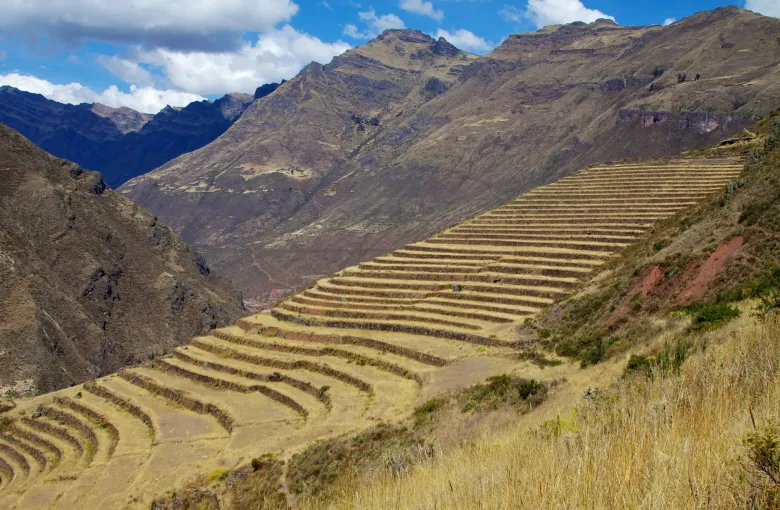
Second, the terraces are architecture. They are not gardening. The agricultural sector is a deliberately engineered system of drainage and soil, and it is the part of the site that explains how a settlement on that ridge was possible at all.
Getting there
Access is by train to Aguas Calientes and then by bus up the mountain road, or on foot over one of the treks. Trains run from Cusco and from Sacred Valley stations such as Ollantaytambo, and the valley departures are shorter.
Book the train and the sanctuary entry together and early. Entry is timed and capacity controlled, and a train seat without a matching entry slot is useless. Southern trains, including these, are occasionally suspended or disrupted by protests, so leave a buffer day before any international flight.
Circuits, and choosing one
Visits follow defined one way circuits rather than allowing free movement, and which circuit a ticket admits you to determines what you actually see. The circuits, their names and their rules change, so confirm the current arrangement with the official ticketing service when you book rather than relying on any description written earlier, including this one.
Huayna Picchu and Machu Picchu Mountain are separate ticketed climbs with their own limited slots and their own times. Both are steep and exposed.
The altitude question, answered the other way round
The citadel is at more than 2,400 meters, which is high, and it is a thousand meters lower than Cusco. Many visitors feel noticeably better here than in the city they came from, which is the opposite of what they were braced for.
The site is still demanding: continuous stairs on original uneven stone with no handrails, at altitude, frequently in strong sun or rain. Take water, take sun protection, and start early.
Practical notes
- Go at the first slot of the day if you can. Light is better and the site is quieter.
- Weather is its own argument for flexibility. Cloud can sit on the ridge for hours and then clear.
- Bag size is restricted and there is a left luggage facility. Tripods and single use plastics are restricted.
- There is no food inside and facilities are at the entrance.
- Guides are required for some circuits. A good one is worth it here more than at most sites, because so little of the meaning is self evident.
- Stay overnight in Aguas Calientes rather than making a day return from Cusco if the pace of the day matters to you.
Verify before you travel
Circuit definitions, ticket categories, capacity limits and train timetables all change, and this is the site in Peru where that happens most often. Confirm everything with the official ticketing service close to travel.
Sources
- UNESCO World Heritage Centre: the inscription of the Historic Sanctuary of Machu Picchu in 1983 as a mixed property, covering 32,592 hectares of mountain slopes, peaks and valleys around the citadel at more than 2,400 meters, its roughly two hundred structures, its fifteenth century construction and abandonment after the Spanish conquest, and its reintroduction to the outside world in 1911. Accessed 16 September 2026.
- UNESCO World Heritage Centre: Peru's State Party record: thirteen properties inscribed on the World Heritage List, nine cultural, two natural and two mixed, and the ratification of the Convention on 24 February 1982. Accessed 16 September 2026.
- UK Foreign, Commonwealth & Development Office: Peru safety and security: protests and strikes and their effect on the southern railways, street crime in Lima, Cusco and Arequipa, robbery by criminals posing as taxi drivers at Jorge Chavez airport and the bus terminals, express kidnapping, counterfeit notes and the withdrawn intis passed by street changers in Cusco, methanol in spirit drinks, the requirement to carry identification, the prohibition on photographing military sites, the illegality of carrying coca leaf out of the country, driving and overnight bus standards, the rainy season from November to May, and the earthquake and volcanic risk. Accessed 16 September 2026.
Other Articles
Best Time to Visit Peru
Peru Packing List