The short version
Etosha is built around a salt pan so large it is visible from space — the dry bed of an ancient lake, roughly 4,800 square kilometers of blinding white nothing — and the waterholes strung around its edge. In the dry season those waterholes are the only water for a very long way, and the game comes to them.
⚠ It is not a World Heritage Site
Namibia has two — the Namib Sand Sea (which is what makes Sossusvlei a World Heritage subject) and Twyfelfontein. Etosha is not among them. We say so because with two real ones in the country it is easy to let the designation drift onto the most famous park, and Etosha does not need it.
Why Etosha is different from other African parks
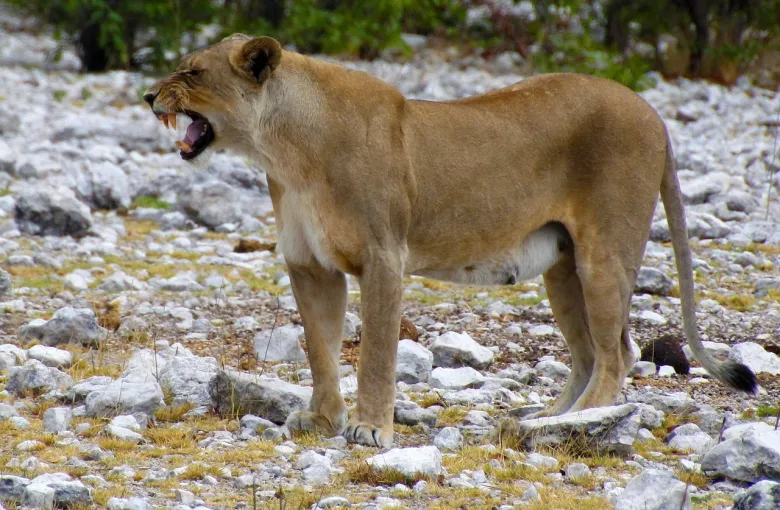
In most great parks you drive around looking for animals. In Etosha you park at a waterhole and wait, and the animals arrive: elephant, giraffe, zebra, oryx, springbok, kudu, black rhino, and the lions that follow them.
That changes the whole character of a visit. It rewards patience over ground covered, it is excellent for photography because you can set up and stay, and — not incidentally — it makes Etosha unusually workable for travelers who cannot manage a bumpy full-day game drive. See our accessibility guide.
The floodlit waterholes
The main rest camps — Okaukuejo, Halali and Namutoni — each have a waterhole immediately outside the fence, floodlit through the night, with seating.
Okaukuejo's is the famous one, and it is one of the finest wildlife experiences in Africa: black rhino come in after dark, often several at once, along with elephant and lion. You can sit there at two in the morning in complete silence and watch. Many visitors rate it above anything they saw by day.
Self-drive
Etosha is a genuinely good self-drive park: the roads are graded gravel and manageable in a 2WD, the map is simple, and the waterholes are signposted. Rules are strict and sensible — stay in your vehicle except at designated points, keep to the speed limit, and be back inside a camp gate before it closes at sunset. Gate times are not flexible.
When to go
The dry season, roughly June to October, is the classic window and improves as it goes on, peaking in September and October when the last water is at the waterholes. The park is at its most crowded then, which in Etosha means a few vehicles at a waterhole rather than none.
The green season is beautiful and much harder for game viewing: animals disperse because water is everywhere. The pan itself can hold water and draw flamingos in numbers, which is a sight in its own right and entirely unpredictable.
The pan
The pan is usually a dry, cracked, shimmering white plain. There are designated lookout points where you can get out; a couple of places allow you to stand on the pan edge itself. It is disorientating in a way photographs do not convey — no scale, no landmarks, and a horizon that dissolves in heat haze.
Practicalities
- Malaria risk exists in and around Etosha, particularly in the wet season; the desert and the south do not carry it. See our safety guide.
- Fill up with fuel and water before entering, though the main camps have both.
- Bring binoculars. Waterhole viewing is at distance.
- Book camp accommodation early. Staying inside the park is what gets you the floodlit waterholes at night.
Visiting with LABUSA Travel
We will get you inside the park rather than at a lodge outside the gate, because the night waterhole is the reason to be here — and we will build in enough nights that you can afford to sit still.
Other Articles
Best Time to Visit Namibia
Accessible Travel in Namibia