Start with what Namibia is not, and then with what it is
Namibia is not a transatlantic heritage destination. It is landlocked in the relevant sense — its coast is desert and the Atlantic slave trade did not run from here — and there is no Namibian equivalent of Cape Coast Castle. Anyone offering to trace an African American ancestor to a Namibian community is selling a story rather than a history.
What Namibia holds instead is a colonial history so severe, and so recent, that it changes how you see everything else in the country.
1. ⚠ The Herero and Nama genocide, 1904–1908
Between 1904 and 1908, in what was then German South West Africa, imperial Germany waged a war of extermination against the Herero and the Nama. Following the Battle of Waterberg, survivors were driven into the Omaheke desert and the waterholes were sealed or guarded. Those who did not die there were put into concentration camps, of which Shark Island, off Lüderitz, was the worst.
The large majority of the Herero people and a large proportion of the Nama were killed. It is widely described as the first genocide of the twentieth century. In 2021 the German government formally acknowledged it as genocide, and the questions of reparations, of who negotiates for the affected communities, and of what acknowledgment is worth without them remain live and contested in Namibia today.
We are stating this plainly and near the top because a great deal of Namibia travel writing does not. The German colonial architecture in Swakopmund and Lüderitz is genuinely handsome and it is routinely presented as quaint. It is the built inheritance of that period. Both things are true, and a visitor is better served by knowing.
Where it is legible
- Shark Island, Lüderitz — the concentration camp site. It is now partly a campsite, which many Namibians find unconscionable, and the debate about how it should be treated is ongoing.
- Okahandja — where the Herero chiefs are buried, and the focus of the annual commemoration. See our festivals guide for how to attend properly.
- Swakopmund and Lüderitz — the colonial townscapes, and in Swakopmund a cemetery containing graves from the period.
- The Independence Memorial Museum, Windhoek — the national telling of the colonial period and the liberation struggle, and the right place to begin.
2. Deep history that predates all of it
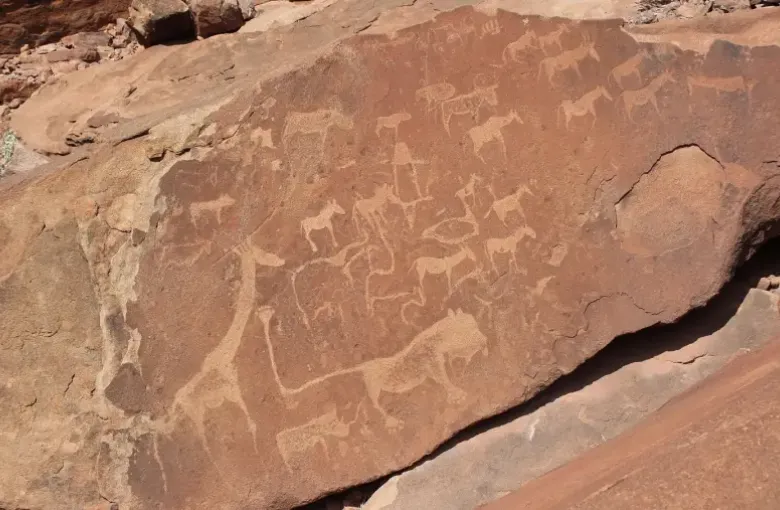
Twyfelfontein holds one of the largest concentrations of rock engravings in Africa, made over thousands of years by ancestors of the San, and is an inscribed UNESCO World Heritage Site — one of Namibia's two, alongside the Namib Sand Sea. Standing there is a useful corrective to a history that starts in 1884: people have been making meaning in this landscape for a very long time. See our Twyfelfontein guide.
3. The liberation struggle, and independence last
After the First World War Namibia passed from Germany to South African administration, and after 1948 apartheid was extended to it. The liberation war fought by SWAPO from the 1960s, the massacre of Namibian refugees at Cassinga in Angola in 1978, and the long international legal battle over South Africa's occupation ended with independence on 21 March 1990 — the last country in mainland Africa to become free.
For a traveler interested in the political history of Black self-determination, Namibia is the final chapter of the African independence story, and it is within living memory. The people who fought it are still here.
What we will not do
We will not imply a documented ancestral link between an African American traveler and a Namibian community. We do not offer DNA-to-village matching. We will not use the language of the Atlantic trade, which is not this country's history. And we will not sell the colonial townscapes as charm without their context.
Traveling with LABUSA Travel
If this history is why you are going, tell us. We will build an itinerary around the Independence Memorial Museum, Okahandja, the coast and Twyfelfontein, with Namibian guides who can speak to it — and we will be clear at every point about what is documented, what is contested, and what is still being argued about in Namibia now.
Other Articles
Twyfelfontein: Visitor and Heritage Guide
Namibia Culture and Etiquette Guide