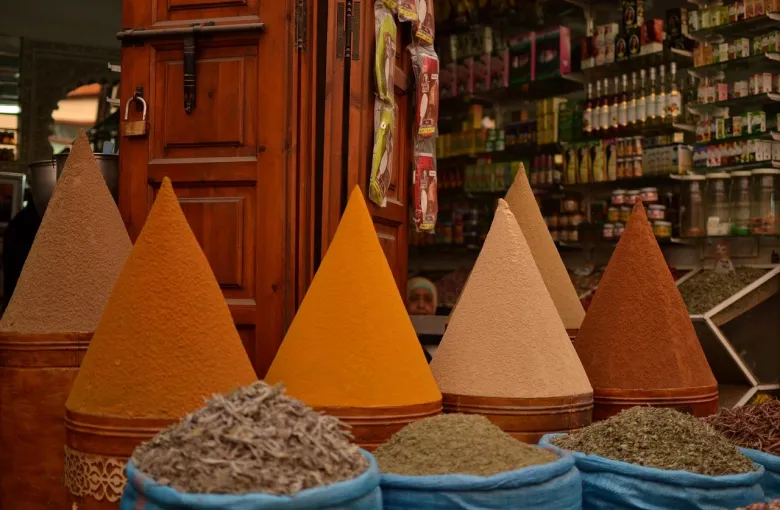
Morocco is easier to travel than most of the region
The imperial cities are joined by a genuinely good rail network, the coaches are comfortable and punctual, and taxis are everywhere. For the classic circuit you do not need to drive, and most visitors are better off not doing so.
Trains
The national operator is ONCF. Its network links Tangier, Rabat, Casablanca, Meknes, Fez, Marrakesh and Oujda, and for city-to-city travel on that spine it is the most comfortable option by some distance.
Al Boraq is the high-speed service between Tangier and Casablanca by way of Kenitra and Rabat: the first high-speed rail line in Africa, running at up to 320 kilometers per hour and cutting a journey that used to take most of a morning to a little over two hours. An extension southward toward Marrakesh is under construction. We do not publish an opening date for it, because those move.
Practical notes: first class is worth the modest difference for a reserved seat, tickets for popular services sell out at holidays, and stations in the larger cities are modern, staffed and step-free.
Coaches
CTM and Supratours are the two national operators, and they go where the trains do not: Chefchaouen, Essaouira, Merzouga, the Atlas towns and the deep south. They are air-conditioned, reserved-seat and reliable, they leave from their own terminals rather than the general bus station, and luggage is checked into the hold for a small fee. Book ahead in season.
There is also a large informal network of older local buses. They are cheap, slow and not recommended for a visitor with a schedule.
The two taxis, which are genuinely different things
- Petits taxis are small, city-colored (a different color in each city), licensed for short hops inside the urban area, and carry up to three passengers. They have meters. Insist on the meter, politely and at the start; a fixed price offered before you get in is almost always higher.
- Grands taxis are older sedans running fixed intercity routes, shared between six passengers, leaving when full. They are inexpensive, fast and a completely normal way to travel between towns. You can also hire the whole car, which is what most visitors do.
Unlicensed app-based cars operate in some cities and are not properly insured or regulated. Use licensed taxis.
Driving
Driving in Morocco is legal, straightforward on the toll motorways, and harder than it looks everywhere else. The toll road network between the main cities is modern and easy. Away from it, expect mountain roads with no barrier, overloaded vehicles overtaking on blind bends, animals and handcarts on the carriageway, and unlit hazards after dark.
- Do not drive at night between towns if you can avoid it. This is the single most useful piece of road advice in the country.
- Do not drive into a medina. The old cities are not designed for cars and in many places will not admit one. Park outside and walk.
- Speed enforcement is active and fines are collected on the spot.
- Parking attendants in high-visibility vests are a normal institution. A few dirhams on arrival and departure is the convention.
For most itineraries a car with a driver is better value than it sounds: it costs less than it would at home, it removes the navigation and the night driving, and the driver knows which mountain road is currently passable.
Flying
Domestic flights connect Casablanca with Marrakesh, Agadir, Ouarzazate, Dakhla and the south. For the imperial cities they are slower than the train once you count the airport. For the far south they save a day.
Planning with LABUSA Travel
We generally put groups on the train between the big cities and in a private vehicle for the mountains and the desert, which is the combination that works.
Sources
- Moroccan National Tourist Office: official destination, region and practical visitor information. visitmorocco.com. Accessed 11 August 2026.
- CTM: the national intercity coach network, routes and terminals. ctm.ma. Accessed 11 August 2026.
- Office National Des Aéroports: Morocco’s airports, including Casablanca Mohammed V. onda.ma. Accessed 11 August 2026.
- UK Foreign, Commonwealth & Development Office: Morocco travel advice, including safety, road conditions and entry requirements. gov.uk. Accessed 11 August 2026.
Other Articles
Morocco Travel Safety Guide
Best Time to Visit Morocco