An honest assessment
Morocco is a rewarding destination for travelers with reduced mobility, and it is not an easy one. The country is candidly two things at once: a modern state with new trams, new stations and new hotels built to current standards, and a set of medieval walled cities that were built for pedestrians and pack animals and cannot be retrofitted.
The medina is the hardest accessibility case in this whole estate of guides, and we would rather say so plainly than let you find out on arrival.
What the medinas are actually like
- Streets are narrow, uneven stone, often sloping and sometimes stepped.
- Vehicles cannot enter most of them. That includes taxis and, in many places, wheelchairs pushed by a companion cannot get through the busiest alleys at busy times.
- Riads are converted courtyard houses. They are beautiful, and they typically have narrow entrances, steep stairs, split levels and no elevator.
- Handcarts, mopeds and mules share the same lanes.
None of that makes the medina off limits. It does mean that a medina visit should be planned as a short, targeted excursion with help, rather than as the base you return to every night.
What modern Morocco does well
- Trams. The Casablanca and Rabat-Salé systems are new, level-boarding and straightforward.
- Trains. The main stations on the Tangier to Marrakesh spine are modern, with elevators and staff assistance. Al Boraq’s stations are the newest in the country. Request assistance when you book.
- Airports. Casablanca Mohammed V and Marrakesh Menara provide assistance on request through your airline.
- New-build hotels outside the old cities frequently have accessible rooms, elevators and level entrances, which riads generally do not.
- Private vehicles with drivers are inexpensive relative to Europe or North America, which changes what is possible more than any single facility does.
Sites, realistically
- The Hassan II Mosque, Casablanca. Modern, level, spacious, and the guided route is manageable. The best major site in the country for step-free access.
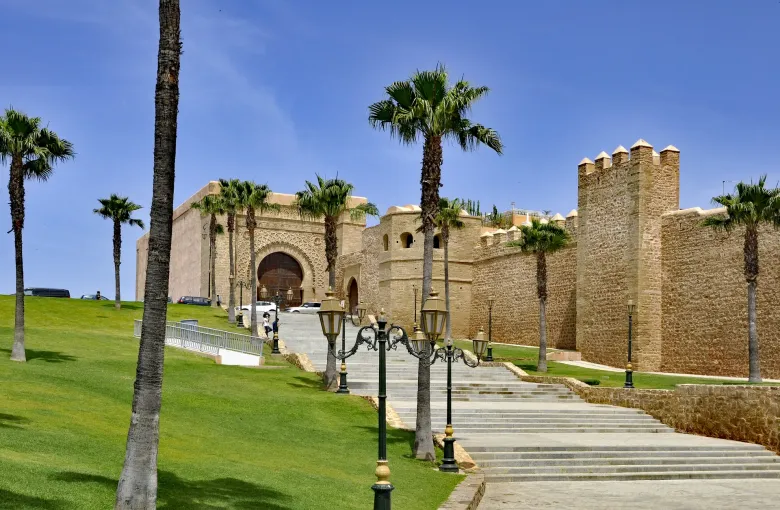
- Rabat. The Hassan Tower esplanade and the Mohammed V mausoleum are broad, paved and largely level. The Kasbah of the Udayas has ramps in parts and steps in others.
- Volubilis. Open Roman site on packed ground: uneven, but flat and without the crowding of a medina.
- Jemaa el-Fna. Large, flat and paved, though extremely crowded after dark.
- Fez medina. The most difficult of the major sites, with steep gradients as well as crowds.
- Gardens. Majorelle in Marrakesh and the Andalusian gardens in Rabat are level and calm, and are a genuinely good use of a morning.
The desert, which is more workable than it sounds
You do not have to ride a camel to see the Sahara. 4x4 vehicles reach the edge of the dune fields and the fixed camps directly, and several camps near Merzouga and Zagora are set up for guests who arrive by vehicle. The dunes themselves are not accessible, but the landscape, the light and the night sky are. Discuss this before booking rather than on the day.
Questions to ask before you book
- How many steps are there from the street to the room, and to the bathroom?
- Is there an elevator, and does it reach every floor you need?
- What is the door width, and is there a step into the shower?
- How far is the nearest point a vehicle can reach, and who carries the luggage?
- Is the guided route step-free, and is there a rest point?
Ask for photographs rather than assurances. “Accessible” is not a regulated term here.
Practical notes
- Bring your own equipment and spares. Repairs and rentals are limited outside the largest cities.
- Medical facilities are good in Casablanca, Rabat and Marrakesh and thinner elsewhere. Insure for repatriation.
- Moroccans generally offer help readily and directly; accepting it is the norm.
- Accessible public restrooms are scarce. Plan around hotels and museums.
Traveling with LABUSA Travel
Tell us what you need before we plan anything, and we will build a route that works rather than one you have to fight. We would rather rearrange an itinerary early than apologize for it later.
Sources
- Moroccan National Tourist Office: official destination, region and practical visitor information. visitmorocco.com. Accessed 11 August 2026.
- Office National Des Aéroports: Morocco’s airports, including Casablanca Mohammed V. onda.ma. Accessed 11 August 2026.
- UK Foreign, Commonwealth & Development Office: Morocco travel advice, including safety, road conditions and entry requirements. gov.uk. Accessed 11 August 2026.
Other Articles
Morocco for Senior Travelers
Getting Around Morocco