Ghana’s festivals are not performances laid on for visitors. They are the working calendar of living traditional states — durbars, purification rites, harvest thanksgivings and remembrances that would happen whether or not anyone came to watch. Being present at one is a privilege, and it comes with obligations.
Before you plan around one
Most Ghanaian festival dates are not fixed to the Gregorian calendar. They are set by traditional authorities, often announced closer to the time, and can move. This page therefore describes when in the year each festival falls and does not publish future dates. Confirm with the Ghana Tourism Authority or your operator before you book flights around one.
Why festivals matter here
Ghana’s traditional states — Asante, Ga, Anlo Ewe, Fante and many others — are not historical curiosities. Chiefs and queen mothers hold real standing, and the festival calendar is how those states mark time, renew authority, remember migrations and give thanks for harvests. A festival is simultaneously a religious occasion, a political one and a family reunion.
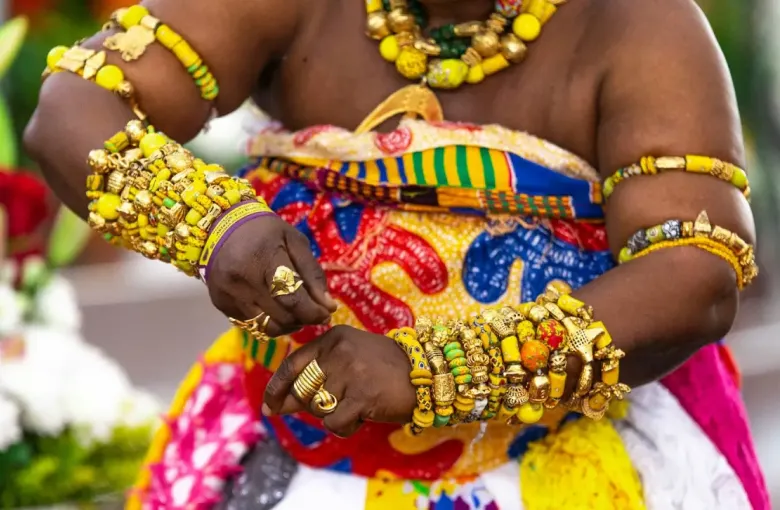
For a visitor, a festival compresses into one day what would otherwise take a fortnight to understand: the regalia, the drumming and its meanings, the order of precedence, the relationship between a chief and his people. It is also the single most demanding setting in which to get your etiquette right.
The major festivals
Homowo — Greater Accra, August to September
The Ga festival whose name translates as "hooting at hunger", commemorating a famine endured during migration and the harvest that ended it. The season opens months earlier with gbemlilaa, a ban on drumming and noise usually imposed around May, and builds to the sprinkling of kpokpoi and a great deal of celebration. Accra is the place to be.
Akwasidae — Kumasi, every sixth Sunday
The Asante festival that most rewards a deliberate visit. Adae and Akwasidae bring the splendor of the Asante kingdom into public view: the Asantehene, in full gold regalia, receives the homage of his people at Manhyia. It recurs on the traditional Akan calendar roughly every six weeks rather than annually, which makes it far easier to catch than a once-a-year festival — ask locally for the next date.
Fetu Afahye — Cape Coast, from 1 September
The festival of the Oguaa (Cape Coast) traditional area, beginning on the first of September each year and including state purification rites and the paramount chief’s yam festival. If you are already traveling the heritage corridor, this is the festival that sits directly on your route — see the Cape Coast Castle guide.
Hogbetsotso — Volta Region, November
Celebrated by the Anlo people, beginning in November at Anloga, the traditional and ritual capital of the Anlo state. It commemorates the exodus of the Ewe-Dogbo people from the rule of the tyrant king at Notsie in present-day Togo — an escape achieved, the tradition holds, by walking backwards so the footprints pointed the wrong way.
Chale Wote — Jamestown, Accra
Not a traditional festival at all, and the reason many younger travelers come. Chale Wote is a street art festival that has grown into the largest gathering of contemporary creative work in the country, taking over the streets of historic Jamestown with murals, installations, performance, music and fashion. It is loud, crowded, young and completely unlike everything else on this page.
Emancipation Day and PANAFEST — July to August
The two that matter most for diaspora travelers. Emancipation Day marks the abolition of slavery, running through the last week of July and climaxing on 1 August; Ghana was the first African nation to commemorate it. Observances center on Cape Coast and Assin Manso, including the Reverential Night. PANAFEST, the Pan-African Historical Theatre Festival, is built on the premise that the arts are tools of communication and healing, and took on Emancipation Day as an additional ceremony in 1998.
If your reason for traveling to Ghana is reconnection rather than sightseeing, this window deserves consideration alongside December — see the Year of Return and diaspora reconnection.
December, and what it does to everything
December is not a single festival but a season. Since 2019 the month has become Ghana’s peak: a dense calendar of concerts, parties, weddings, homecomings and events, with Accra full of returning Ghanaians and first-time diaspora visitors. Flights and hotels book out far earlier and price higher than at any other time of year.
If December is what you want, treat it as a booking deadline rather than a preference. If it is not, the shoulder either side of it is markedly easier. The best time to visit Ghana sets out the trade-off.
Attending well
A festival is the setting where visitor etiquette matters most, and where getting it wrong is most visible.
- Go with someone who knows the protocol. A local guide will tell you where to stand, when to sit, whom to greet and in what order.
- Dress for it. Smart and modest; ask what colors are appropriate. Some occasions call for specific ones.
- Ask before photographing anyone, and never photograph a chief, regalia or a ritual without explicit permission. A durbar is not a photo opportunity.
- Do not walk in front of a procession, or cut through a line of dignitaries.
- Stand when elders and chiefs enter.
- Bring cash in small denominations for contributions and for drummers and performers.
- Be patient. Ceremonies run on their own time. Turning up for the hour you booked and leaving misses the point.
Ghana culture and etiquette covers greetings, the right-hand convention and photography consent in more detail.
Planning around a festival
- Book accommodation early in the host town. Cape Coast during Fetu Afahye and Anloga during Hogbetsotso fill up.
- Expect roads and transport to be affected in and around the host town.
- Confirm the date twice — once when you plan and once close to travel.
- Do not build the whole trip on one date. Plan a journey you would enjoy regardless, and treat the festival as the bonus it should be.
A cultural journey through Ghana
The Echoes of Africa Tour 2027 travels in January rather than around a specific festival, which is a deliberate choice: it means the heritage corridor is traveled in the dry season, at a pace that leaves room to be present. If you would rather build a journey around Homowo, Akwasidae, Emancipation Day or December, that is exactly the kind of custom group itinerary we plan — tell us the occasion and we will work backwards from it.
Common questions
What is the biggest festival in Ghana?
It depends what you mean. Homowo in Greater Accra and Hogbetsotso in the Volta Region are among the largest traditional festivals; Chale Wote in Jamestown is the largest contemporary arts festival; and December is the busiest season overall, though it is not a single festival.
Why does this page not give festival dates?
Because most Ghanaian festival dates are set by traditional authorities on traditional calendars and are often confirmed closer to the time. A date published months ahead may move. Confirm with the Ghana Tourism Authority or your operator before booking around one.
Can visitors attend Ghanaian festivals?
Generally yes, and visitors are usually welcomed. Go with a local guide who knows the protocol, dress smartly and modestly, ask before photographing anyone, and follow direction on where to stand and when to sit.
Which festival is most relevant to diaspora travelers?
Emancipation Day and PANAFEST, in the last week of July through 1 August, centered on Cape Coast and Assin Manso. Ghana was the first African nation to commemorate Emancipation Day.
Other Articles
Best Time to Visit Ghana