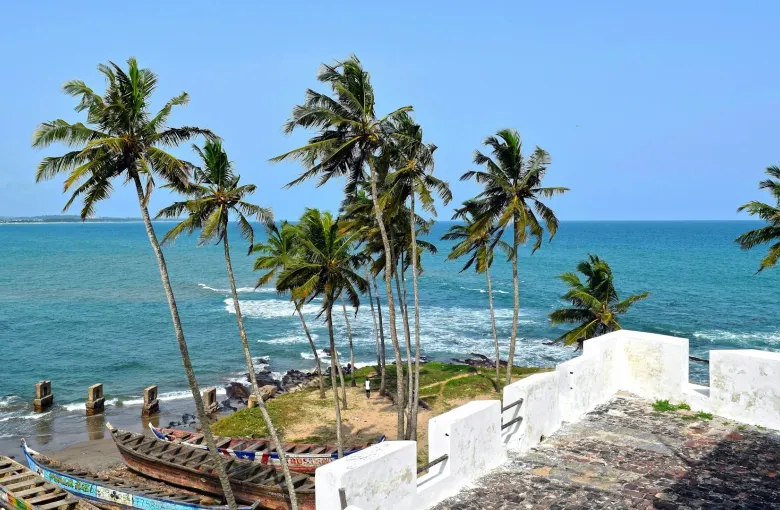
Cape Coast Castle is a white fortress above a working fishing beach, and it is one of the most significant surviving sites of the trans-Atlantic slave trade anywhere in the world. Visiting it is not sightseeing. This guide is about what is there, what happens on a visit, and how to arrive ready for it.
At a glance
- Where: Cape Coast, Central Region, roughly three hours west of Accra by road
- Founded: 1653, and rebuilt and extended repeatedly thereafter
- Status: part of the UNESCO World Heritage inscription Forts and Castles, Volta, Greater Accra, Central and Western Regions, listed in 1979
- Custodian: Ghana Museums and Monuments Board; a museum has operated here since 1974
- Opening: published as 09:00–16:30 daily — confirm before you travel
- Guided tour: around 45 minutes, and worth more time than that
What Cape Coast Castle is
Cape Coast Castle is one of three castles — with St George’s at Elmina and Christiansborg at Osu in Accra — among the dozens of fortified trading posts strung along roughly 500 kilometers of the Ghanaian coast between Keta in the east and Beyin in the west. Founded between 1482 and 1786, they began as links in trade routes established by the Portuguese and were built, seized, rebuilt and occupied at different times by Portuguese, Spanish, Danish, Swedish, Dutch, German and British traders.
Cape Coast became the headquarters of British administration on the Gold Coast. That administrative importance is exactly why the site is so complete, and why the contrast within it is so hard to take: governor’s quarters, a chapel and airy sea-facing rooms sit directly above the dungeons.
Its role in the trans-Atlantic slave trade
For roughly two centuries, Cape Coast Castle functioned as a holding site. Men and women were confined in dungeons beneath the castle — separately, in darkness, for weeks — before being taken through a passage to the shore and onto ships bound for the Americas and the Caribbean. That passage is the Door of No Return.
Reading that in a paragraph and standing in the room are different things, and there is no version of this page that can bridge the gap. What we can say is that the castle does not soften it, and that this is the right decision.
What a visit involves
Visits are guided, and the guiding matters — the guides at Cape Coast are, for many travelers, the reason the visit lands as it does. A tour typically covers:
- The male and female dungeons, including the scale of the space against the numbers held in it
- The condemned cell, used for those who resisted
- The Door of No Return, and the beach beyond it
- The Dalzel Tower, the ramparts, and the cannons and mortars of the castle’s defenses
- The museum, which sets the site in the wider history of the trade
The published tour length is about 45 minutes. Most people want longer, and the time that matters most is usually the unstructured time afterwards — on the ramparts, or looking at the sea.
Preparing yourself
Travelers of African descent frequently describe Cape Coast as the most significant hour of their lives. Others find themselves unexpectedly undone by it. Both are ordinary responses, and neither needs managing or explaining to anyone.
A few things genuinely help:
- Do not schedule anything demanding afterwards. Leave the rest of the day soft
- Go in the morning if you can — it is usually quieter, and you will have the day to sit with it
- Eat beforehand. The dungeons are cool and airless and low blood sugar does not help
- Bring water and tissues, and let yourself step outside if you need to
- Decide in advance how you feel about photography — see below
- Travel with people who will let you be quiet, which is one of the underrated arguments for a supported group
Visiting respectfully
The dungeons are a place where people died. Many visitors treat them as a memorial, and some leave offerings. Follow your guide’s direction on where to walk and where not to. Keep your voice down. Do not pose for photographs in the dungeons or at the Door of No Return — take the photograph if it matters to you, but the difference between documenting a place and performing in it is obvious to everyone present, including the Ghanaian staff who work there every day.
The wider point is covered in Ghana culture and etiquette: you are a guest in a country where this history is not an exhibit but an inheritance.
Practical notes
- Getting there: Cape Coast is roughly a three-hour drive west of Accra on the coast road; most heritage itineraries stay overnight rather than attempt a day trip
- Accessibility: the castle has stone stairs, uneven surfaces, low doorways and unlit passages. Parts of it are not accessible to visitors with limited mobility. Ask at the site about what can be adapted
- What to wear: closed walking shoes with grip; something you are comfortable sitting quietly in. See the Ghana packing list
- Opening hours are published as 09:00–16:30 daily by the Ghana Museums and Monuments Board, but hours and admission arrangements change — check before you travel
- Time of year: the castle is open year-round; the drier months make the journey along the coast easier. See best time to visit Ghana
Cape Coast beyond the castle
Cape Coast is a university town and a fishing town with a life entirely its own, and the beach below the castle is a working beach, not a monument. Give the town an evening if your itinerary allows. Kakum National Park’s rainforest canopy walkway is close enough to pair with a castle visit, and many travelers deliberately schedule it for the day after rather than the same afternoon.
Assin Manso and Elmina
Cape Coast is one point on a corridor, and understanding the corridor is what makes the visit coherent.
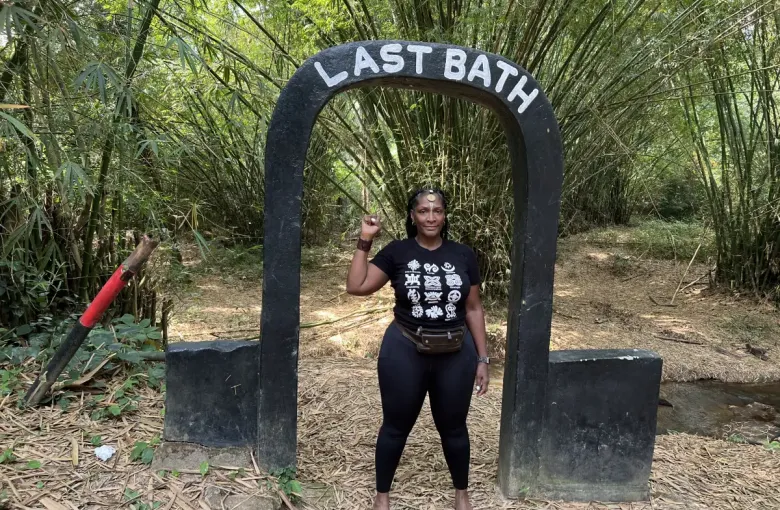
Assin Manso, inland, is where captives taken from the interior were brought to the river to be washed before the final march to the coast — the “Last Bath”. It is a quieter site than the castles and, for many travelers, the more affecting one. Elmina, about 20 minutes west along the coast, holds St George’s Castle, built in 1482 and the oldest of the group. Why this corridor has become central to diaspora travel is the subject of our guide to the Year of Return and diaspora reconnection. Visiting Cape Coast and Elmina in sequence shows you two different European powers, two architectures and one system.
Cape Coast on the Echoes of Africa Tour
The Ghana segment of the Echoes of Africa Tour 2027 is built around this corridor. After arrival and two nights in Accra, the itinerary covers a guided Accra and Cape Coast heritage tour taking in the Assin Manso Ancestral River and the Cape Coast and Elmina castles, with an overnight stay in Cape Coast rather than a rushed return to the capital. That overnight is deliberate: this is not a stop that works well squeezed into a day.
Common questions
Is Cape Coast Castle a UNESCO World Heritage Site?
It is part of one. The UNESCO inscription, made in 1979, covers the whole ensemble — Forts and Castles, Volta, Greater Accra, Central and Western Regions — rather than Cape Coast Castle individually.
How long does a visit take?
The guided tour is published at about 45 minutes. Allow two hours or more so you have time for the museum and, more importantly, time afterwards.
Is it suitable for children?
That is a judgment for the adults who know the child. The subject matter is unflinching and the dungeons are dark and confined. Many families do visit, and some prepare children in advance and agree a signal for stepping outside.
Should I visit Cape Coast or Elmina?
If you can, both — they are about 20 minutes apart and they tell different halves of the story. If you must choose one and your interest is the British period and the Door of No Return, choose Cape Coast.
Other Articles
Elmina Castle: Visitor and Heritage Guide
Ghana, the Year of Return and Diaspora Reconnection