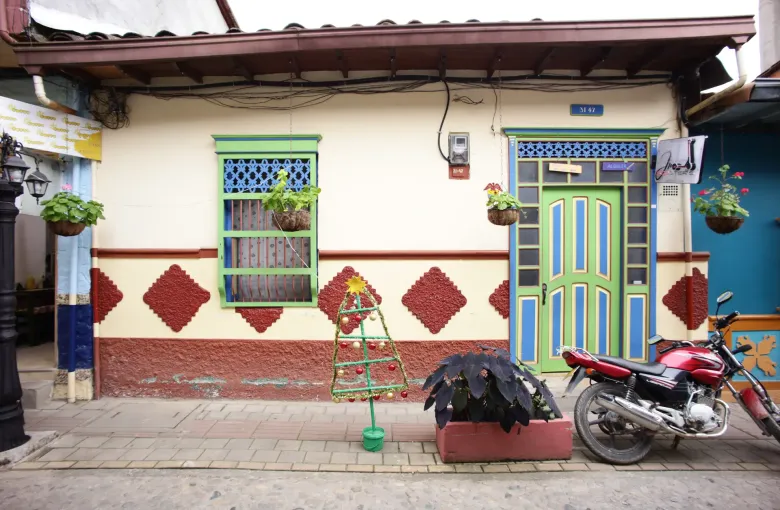
The currency is the Colombian peso, written COP. It is freely convertible, there is no parallel market, and the rate you are quoted is the rate. The difficulty is not the currency, it is the arithmetic: Colombian prices carry a lot of zeros and it takes a day to stop misreading them.
This page publishes no exchange rate. Any figure printed here would be wrong within weeks, and a wrong rate is worse than none. Check on the day, from your own bank or a rate service.
Getting used to the zeros
A coffee is a four figure sum. A restaurant bill of 60,000 pesos is an ordinary one. A taxi across a city runs into the tens of thousands. None of that is expensive; it is a currency with a different number of digits, and the practical risk is handing over a note with one zero too many in the first two days. Count once before you pay, and count what comes back.
Cards work, and they are the safer instrument
Cards are widely accepted in cities, hotels, restaurants, supermarkets and larger shops. Carry modest cash for markets, small towns, rural buses, taxis and anywhere off the main routes, and use cards for the rest. Less cash on you is the simplest protection against the street crime described in the safety guide.
Tell your bank you are traveling, and carry a second card kept somewhere other than your wallet. If a card is swallowed or blocked, having only one is what turns an annoyance into a problem.
⚠ ATMs, and why this section is longer than it looks
The cited advisory records that criminals carrying out short opportunistic abductions, express kidnappings, frequently select their target from around ATMs and often at night, and that the victim is then made to withdraw cash or move money in a series of transfers. That makes the cash machine the single most specific transactional risk in the country.
- Use machines inside banks, shopping centers, supermarkets and airports, during opening hours.
- Never use a street machine after dark.
- Take the cash, put it away, and leave. Do not stand at the machine counting.
- Draw larger amounts less often, and leave what you are not using in the hotel safe.
- Set a sensible daily limit with your bank before you travel. A limit is the one thing that puts a ceiling on a bad evening.
- Cover the keypad, and do not accept help from a stranger at the machine.
Do not change money with someone who approaches you in the street. Use a bank or an established exchange house, and keep the receipt.
Tipping
In restaurants a voluntary service charge of around ten percent is often added and shown on the bill, sometimes introduced with a question at the table. It is normal to accept it and entirely acceptable to decline. Read the bill rather than assuming either way. Taxis are rounded up rather than tipped by percentage; hotel porters and guides are at your discretion.
Practical points
- Keep small notes. Taxis, market stalls and rural buses rarely want a large one.
- Cash is still king outside the cities. Draw before you leave one.
- Airport exchange desks are convenient and rarely the best value. Change a little on arrival and more later.
- If you are carrying a substantial sum in or out of the country, check the declaration threshold before you fly. The entry requirements guide covers the customs rules.
Sources
- UK Foreign, Commonwealth & Development Office: Colombia safety and security: scopolamine and other drugs used to subdue victims through food, drinks, cigarettes, aerosols and paper flyers, the use of dating applications to select foreign nationals traveling alone, express kidnappings by criminals often posing as taxi drivers and often working from around ATMs at night, and the advice to avoid protests, strikes and demonstrations. Accessed 17 September 2026.
- UK Foreign, Commonwealth & Development Office: Colombia entry requirements: ninety days without a visa for tourism at the discretion of the immigration officer, the requirement to show an onward or return ticket valid within that period, the yellow fever certificate required when arriving from countries with a transmission risk, the tourist card bought at the boarding gate for San Andres, Providencia and Santa Catalina, and the rule that dual nationals enter and leave on the Colombian passport. Accessed 17 September 2026.
Other Articles
Getting Around Colombia
Colombian Food and Drink