Seasons first, because everything below depends on it. Chile is in the southern hemisphere: summer is December to February, fall March to May, winter June to August, spring September to November.
The north: a hyper-arid desert
The northern coast of the Atacama is described by UNESCO as an arid and hostile habitat, and the conditions as those of a hyper-arid coastal desert in the rugged Coastal Cordillera. That is not a figure of speech. Rain is not a variable you plan around here in the way it is anywhere else.
What you plan around instead is the daily swing and the sun. Days are warm and nights get genuinely cold, and the gap between them is larger than most visitors dress for. The light is direct and the air is dry, so sunburn and dehydration arrive faster than the temperature suggests.
The altiplano above it
The high plateau behaves like mountain country. It is colder, the sun is fiercer, and the afternoons can turn over quickly. Altitude sickness is a risk in parts of Chile and this is where visitors meet it. Acclimatize before you go higher, never during. Arrive and rest, drink considerably more water than you would at home, eat lightly at first and go easy on alcohol.
This page publishes no medication and no dose. That decision belongs to your own clinician, and the conversation is better had before you book than in a pharmacy at altitude.
The center: Mediterranean
Santiago and the valleys around it run on a Mediterranean pattern: hot dry summers and mild damp winters, with the rain concentrated in the colder half of the year. It is the climate that makes the central valleys Chile's farmland and its wine country, and the reason the vines look the way they do.
Two local effects worth knowing. Santiago sits in a basin below the Andes, and in winter that basin traps air, so still cold days can be hazy. And the coast is markedly cooler than the city at the same moment, because of the cold current offshore: an hour and a half of driving can cost you several degrees and gain you fog.
The south: wet, and that is the point
South of the central valleys the rain increases steadily until it becomes the defining feature. The lakes, the forests and the archipelago of Chiloe are green because of it. Summer is the driest part of a wet year rather than a dry season.
Pack for rain as a normal condition rather than an event. A gray damp day on Chiloe is the ordinary case, and the wooden architecture and the food both make more sense in it than in sunshine.
Patagonia: the wind
The defining feature of the far south is not cold but wind, and it is strongest in spring and summer, which is when you are most likely to be there. It is strong enough to decide how far you walk and whether a boat sails.
Temperatures stay cool even at the height of summer, and the weather changes several times within a single day. Sun, sleet and a clear evening in one afternoon is unremarkable. A warm jacket that is not windproof does very little here, which is the single most common packing failure in the region and the reason the packing list is built around a shell.
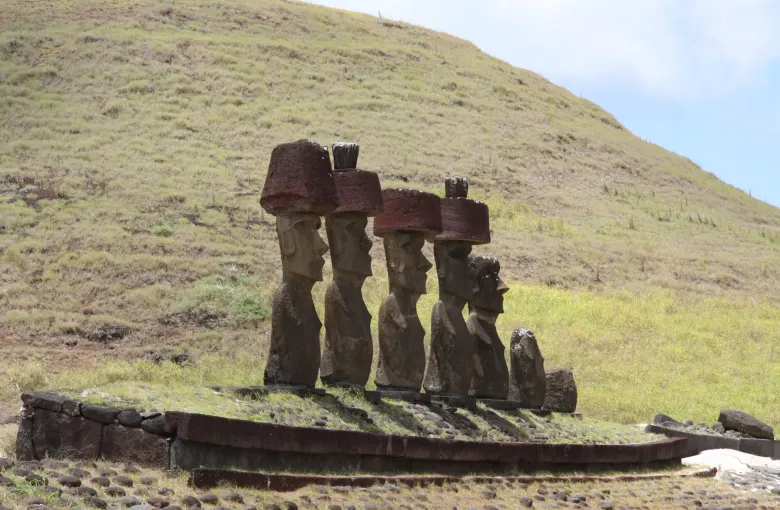
Rapa Nui
Subtropical, mild and humid, warmed by the ocean in every direction. There is no dry season to aim for. There are confirmed cases of dengue fever there, so insect precautions belong in the bag regardless of the month.
What to take from this
Layers everywhere, a windproof shell if the south is on the itinerary, and serious sun protection if the north is. The commonest error is packing for Chile as though it had one climate, which is how people arrive in Punta Arenas dressed for Santiago.
Sources
- UNESCO World Heritage Centre: Settlement and Artificial Mummification of the Chinchorro Culture in the Arica and Parinacota Region, inscribed 2021 under criteria (iii) and (v), recording a society of marine hunter-gatherers on the northern coast of the Atacama Desert from approximately 7400 BP to 2840 BP. Accessed 16 September 2026.
- UK Foreign, Commonwealth & Development Office: Chile health: the emergency ambulance number 131, the eight week lead time for vaccine advice, altitude sickness as a risk in parts of Chile, confirmed cases of dengue fever on Rapa Nui, and hantavirus as present in Chile. Accessed 16 September 2026.
- UNESCO World Heritage Centre: Rapa Nui National Park, inscribed 1995 under criteria (i), (iii) and (v), a property of 6,666 hectares in the Easter Island province of the Valparaiso Region. Accessed 16 September 2026.
Other Articles
Best Time to Visit Chile
What to Pack for Chile