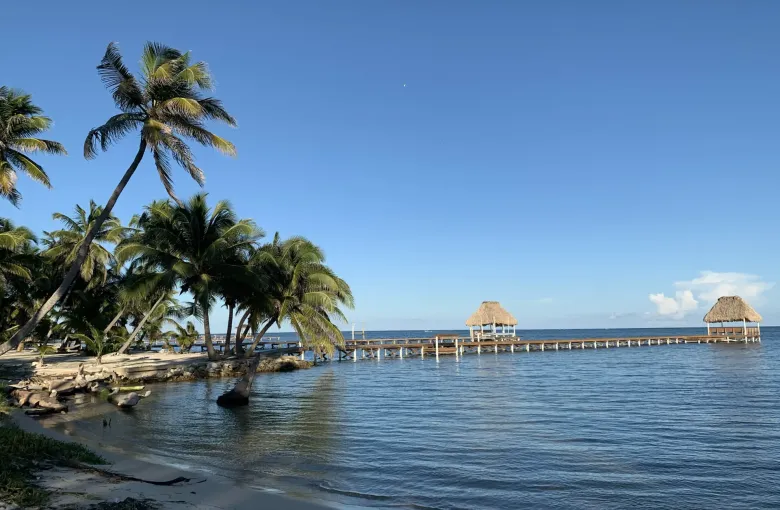
Thirty days, and it is shorter than you think.
You can visit Belize without a visa for 30 days. Read that against the rest of the region and the reason it matters becomes clear: neighboring destinations in this series run to six weeks, to ninety days, and in one case to six months. Thirty is the shortest of them, and it is the one most often assumed to be longer.
Extending is routine and it is priced. It costs 200 Belize dollars for each additional 30 days, and you obtain it by going to the nearest office of the Belize Immigration and Nationality Department and requesting a new stamp. That is an errand to build into an itinerary, not a formality to handle at the airport on the way out.
The passport rule has two halves and they do not agree.
The country's rule is three months. Your passport must have an expiry date more than 3 months after the date you arrive, counted from arrival rather than from departure.
The same advice then adds that some airlines may refuse boarding if the expiry date is not more than 6 months after the date you arrive. So the legal requirement is three months and the practical requirement may be six, depending entirely on who is flying you. If your passport falls between the two, the country will admit you and a carrier may decline to take you, which is a problem best discovered at home.
The workable reading is to treat six months as the planning figure and three months as the fallback you can argue from.
The departure tax is a border tax, not an airport tax.
This one is frequently repeated with its scope removed. If you leave Belize by land, or by water crossing to Guatemala or Mexico, you pay a departure tax of 40 Belize dollars or 20 US dollars at the border. Leaving by air, the tax is usually already included in the airfare.
Two things follow. If your trip is a flight in and a flight out, you will probably never see it. If it involves an overland or boat crossing, carry it, because it is payable at the crossing itself.
And a caution about that figure: it is one price stated in two currencies, not an exchange rate. The currency and money guide explains why this cluster publishes no rate at all.
Arrival paperwork, and travelers under eighteen.
Arriving travelers complete an immigration and customs declaration form. The authorities recommend completing the digital form before travel, and paper declarations are still accepted during the phased transition to a fully digital system, so at the time of writing either will work.
The rule most likely to strand a group is the one about young travelers. Children aged 17 and under traveling on their own, or with an adult who is not their parent, must carry a notarized letter proving parental responsibility or consent to travel. A child traveling with one parent also needs a notarized letter of authority from the other parent. Notarization takes time at home and cannot be arranged at the airport.
On health paperwork there is nothing to carry: TravelHealthPro states that There are no certificate requirements under International Health Regulations for Belize. That is worth saying because it differs from several destinations nearby, where a yellow fever certificate is an entry condition.
If you would like us to check a group's documents against this list before anyone books, send us the details.
Sources
- UK Foreign, Commonwealth and Development Office: the Belize entry requirements page: that you can visit Belize without a visa for 30 days; that extending a stay costs 200 Belize dollars for each additional 30 days and is done at the nearest office of the Belize Immigration and Nationality Department by requesting a new stamp; that a passport must have an expiry date more than 3 months after the date you arrive, while some airlines may refuse boarding if the expiry date is not more than 6 months after arrival; that leaving by land, or by water crossing to Guatemala or Mexico, carries a departure tax of 40 Belize dollars or 20 US dollars payable at the border, while leaving by air usually has the tax included in the airfare; that arriving travelers complete an immigration and customs declaration form, with the authorities recommending the digital form before travel while paper declarations are still accepted during a phased transition; and that children aged 17 and under traveling alone or with an adult who is not their parent must carry a notarized letter proving parental responsibility or consent, with a child traveling with one parent also needing a notarized letter of authority from the other. Accessed 21 September 2026.
- TravelHealthPro, the National Travel Health Network and Centre: the Belize country page: that there are no certificate requirements under International Health Regulations; that in 2023 the WHO declared Belize malaria-free and that there is no risk of malaria in Belize, with bite avoidance still recommended; that there is a risk of dengue in this country and that the mosquitoes which spread it mainly feed during daytime hours and are more common in towns, cities and surrounding areas; that there is a risk of chikungunya, spread by mosquitoes which bite mainly during daytime hours; that Zika virus is spread by mosquitoes which predominantly feed during daytime hours; and that the capital is Belmopan, the official language is English and the monetary unit is the Belize dollar. Accessed 21 September 2026.
- UK Foreign, Commonwealth and Development Office: the Belize travel advice landing page: that no travel can be guaranteed safe, and that anyone who chooses to travel should research their destinations and get appropriate travel insurance. Accessed 21 September 2026.
Other Articles
Belize Currency and Money Guide
Belize Travel Safety Guide