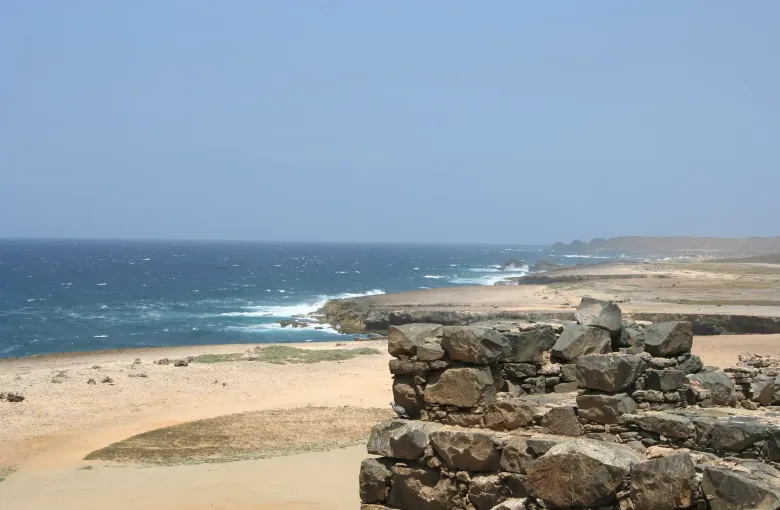
The designation, and its date.
The Aruba Conservation Foundation states that the spectacular Spaans Lagoen is an official Ramsar site as of 1980. It adds that the island has since seen a major increase in its protected wetlands area, through the expansion of Spaans Lagoen itself and the addition of four new Ramsar sites.
Forty five years of continuous protection is a long record for a small island, and it makes this wetland the oldest international designation Aruba holds.
⚠ Ramsar is a different treaty, and this is the distinction the page exists for.
Ramsar is the Convention on Wetlands. Its list is an inventory of wetlands of international importance, and it is a separate instrument from the World Heritage Convention with a separate list and separate criteria.
That distinction matters here more than it would almost anywhere else, because Aruba holds no World Heritage inscription at all and is not a State Party to that Convention in its own right. A reader who sees an international designation on a small island will reasonably reach for the familiar word. This one is not that word, and the site loses nothing by being described accurately.
What the Foundation publishes about the wetland.
It lists Spaans Lagoen among the protected areas in its care, alongside Parke Nacional Arikok, the Sasarawichi dunes and Arashi beach, several salinas, and a set of marine protected areas. It describes the island's wider natural context in the same breath: 34 endemic species, and 282 species of bird alone recorded on the island.
It also notes that certain areas have been recognized as a Key Biodiversity Area or an Important Bird and Biodiversity Area. Those are conservation designations made by non-governmental bodies rather than treaty listings, and the Foundation is careful to name them separately. So is this page.
A note on the name.
The Aruba Conservation Foundation writes it as Spaans Lagoen, and that is the name this guide uses throughout, because it is the name the managing body gives the designated site. You will also see the English rendering Spanish Lagoon, including on photographs of the same water. The two refer to one place.
Visiting.
No source in this register publishes access arrangements, opening hours, a visitor center or a trail for Spaans Lagoen specifically. The Foundation publishes hours for its visitor center at San Fuego and a booth at Vaderpiet, both of which relate to the national park rather than to the wetland.
So this guide does not tell you how to get in, because it does not know. Ask the Aruba Conservation Foundation, which manages it, or your operator. Our guide to Parke Nacional Arikok covers the park and its published hours.
What this guide will not tell you.
No area figure for the wetland, no species list specific to it, no birdwatching seasons, no boat or kayak arrangements, and no photographs of wildlife presented as a likelihood. The Foundation publishes island wide figures rather than site specific ones, and this page keeps them at the scale they were published.
Photograph by Caribiana, CC BY-SA 4.0, via Wikimedia Commons.
Sources
- Aruba Conservation Foundation: Parke Nacional Arikok: that the park encompasses 34 square kilometers of protected nature area; that the Foundation manages nearly 25 percent of the island as well as four Marine Protected Areas; that 34 endemic species live there, among them the rattlesnake known locally as the Cascabel and the burrowing owl; that 282 species of bird alone have been recorded on the island; that the endemic and endangered Shoco, Prikichi and Cascabel are among the species the Foundation protects, along with the vesper mouse described by Hummelinck; that there is a Visitor Center at San Fuego; that Spaans Lagoen has been an official Ramsar site since 1980; and that four new Ramsar sites have since been added. Accessed 19 September 2026.
- UNESCO World Heritage Convention: Kingdom of the Netherlands States Party record: the inventory of properties inscribed on the World Heritage List under that State Party, together with the sites entered on its Tentative List, a Tentative List being an inventory of properties a State Party intends to consider for nomination. Accessed 19 September 2026.
Other Articles
The Best Time to Visit Aruba

Accessible Travel in Aruba