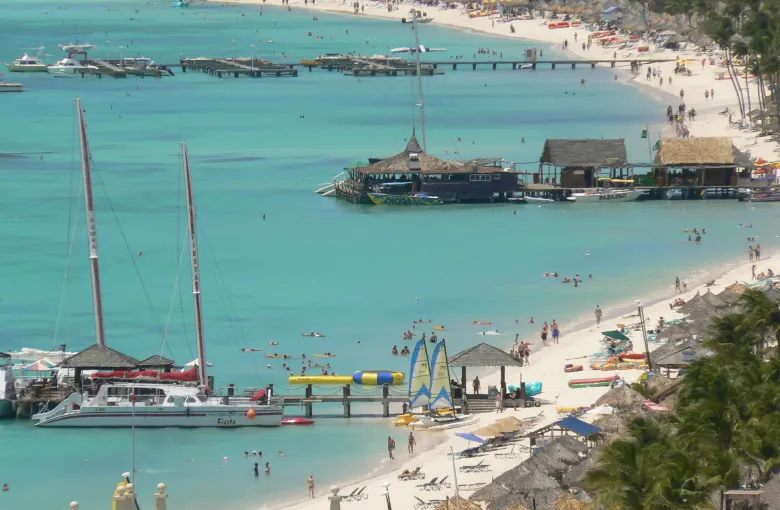
Protecting your belongings, in the advice's own terms.
The Foreign, Commonwealth and Development Office describes a risk of petty theft and says there are occasionally incidents of street crime. That is a measured pair of phrases rather than a warning about violence, and this guide does not upgrade it.
The precautions the same source gives are short and specific. Avoid walking in remote areas at night. Do not take valuables or cash to the beach. Do not leave bags in your vehicle. Make sure purses and bags are closed and not easy to grab.
The beach line is the one most often ignored, because it conflicts with how people actually spend a day here. Decide in advance what goes to the beach and what stays behind, rather than deciding at the moment you leave the room.
⚠ The drug transit route, and why it is in a safety guide at all.
The advice states that Aruba is used as a drug passageway from South America to Europe and North America, and that there can be drug-related violent crime. That is a geographic fact about the island's position rather than a description of ordinary streets, and it is the reason the next paragraph is worded as strongly as it is.
The same page states that there are severe penalties for all drug offenses, and gives two instructions with it: do not leave bags unattended, and do not agree to carry a package for anyone. Read those as a pair. The second is the way an ordinary traveler ends up inside the first.
Carrying identification is a legal requirement.
The advice states that it is a legal requirement to carry ID, and adds that you should always keep a copy of your passport with you. That is a small thing to arrange before you travel and an awkward one to arrange afterward. Our packing list treats it as an item rather than an afterthought.
Terrorism, stated carefully.
The Foreign, Commonwealth and Development Office writes that although there is no recent history of terrorism in Aruba, attacks cannot be ruled out. Both halves of that sentence are the source's, and the second half is the standard formulation the office uses everywhere. It is not a statement about this island in particular.
⚠ Hurricanes, and the two words that carry the sentence.
The advice states that the hurricane season in the Caribbean normally runs from June to November, that most hurricanes pass to the north of Aruba, which has no record of a recent major hurricane, and that there are occasional tropical storms.
Most, and occasional. Keep both. A reader who takes only the middle clause has been told the island is out of the weather, and the source does not say that. What it supports is that a storm here is less likely than on an island in the usual track, and that storms still occur.
The same page directs readers to monitor local news and official meteorological reports. Our weather guide explains why this is the one island in the region where that paragraph reads differently.
Medical care, and the card that does not work here.
The health advice gives the emergency medical number as 911, and says to ask for an ambulance. It also states that the European Health Insurance Card and the Global Health Insurance Card is not valid in Aruba, and asks travelers to hold adequate travel health insurance and accessible funds covering treatment abroad and repatriation.
That combination is the single most consequential thing on this page for a European visitor, because Aruba belongs to the Kingdom of the Netherlands and the assumption that European cover follows is a reasonable one to make and a wrong one. No source in this register names a hospital, so neither does this guide. Arrange the insurance before you go.
Vaccinations, on a timetable that has to start before you book anything else.
The health advice asks travelers to check the latest vaccine recommendations at least 8 weeks before your trip, which is the sort of deadline that is only useful if you meet it. The United States Centers for Disease Control and Prevention asks that you be up-to-date on all routine vaccines before every trip, and recommends hepatitis A for unvaccinated travelers one year old or older going to Aruba, and hepatitis B for unvaccinated travelers of all ages.
Those are recommendations to take to a clinician rather than requirements to show at a border, and this guide presents them as neither more nor less than that. The same health advice also notes that the legal status of some medicines prescribed at home differs in other countries, which makes a prescription a customs question as well as a medical one.
Driving, drinking and taxis.
Three rules from the same advice belong here as much as in a transport guide. A driver needs an international driving permit obtained before travel. Drink driving is a serious offense, with a threshold the source describes only by comparison. Taxis are not metered and the fare is agreed in local currency before you set off.
Our transportation guide covers each of those in full, including the figure this site will not calculate for you.
What this guide will not tell you.
No crime statistics, no neighborhood to avoid by name, no swimming or current advice, and no assessment of how safe you personally will be. The official advice does not publish those for this island, and the ones a travel page usually invents are precisely the ones a reader acts on.
Sources
- UK Foreign, Commonwealth and Development Office: Aruba travel advice, safety and security: that it is a legal requirement to carry identification; that the island is used as a drug passageway from South America to Europe and North America and that there are severe penalties for all drug offenses; that a driver needs the correct version of the international driving permit, that it cannot be bought outside the United Kingdom, and that hire companies may require 2 years of driving experience; that a driver found with just over half of England legal limit of alcohol in their system may face a fine and possible imprisonment; that taxis are not metered and that the fare should be agreed in local currency with the driver before setting off; that the hurricane season in the Caribbean normally runs from June to November; that most hurricanes pass to the north of the island, which has no record of a recent major hurricane; and that there are occasional tropical storms. Accessed 19 September 2026.
- UK Foreign, Commonwealth and Development Office: Aruba travel advice, health: that the emergency medical number is 911 and a caller should ask for an ambulance; that vaccine recommendations should be checked at least 8 weeks before a trip; and that the Global Health Insurance Card is not valid on the island. Accessed 19 September 2026.
- United States Centers for Disease Control and Prevention: Travelers health, Aruba: that a traveler should be up to date on all routine vaccines before every trip; that hepatitis A is recommended for unvaccinated travelers one year old or older going to the island; and that hepatitis B is recommended for unvaccinated travelers of all ages. Accessed 19 September 2026.
- UK Foreign, Commonwealth and Development Office: Aruba travel advice: the United Kingdom government advice page for the island. Accessed 19 September 2026.
Other Articles

Getting Around Aruba
Aruba Entry Requirements