The one range this guide can show you.
The National Hurricane Center publishes that the Atlantic hurricane season runs from June 1 to November 30, and that tropical cyclone activity sometimes occurs before and after these dates. The Foreign, Commonwealth and Development Office gives the Caribbean season in rounder terms, as June to November.
Those are the only dates on this page. Everything else a weather guide usually carries is a figure, and no source in this register publishes a figure for this island.
⚠ Why the hurricane paragraph here is written differently.
On most Caribbean guides the season is the dominant seasonal risk and the paragraph is a warning. For Aruba the official wording is more careful, and it is worth quoting in full rather than summarizing. The Foreign, Commonwealth and Development Office writes that most hurricanes pass to the north of Aruba, which has no record of a recent major hurricane, and then that there are occasional tropical storms.
Both qualifiers are doing work. Most describes a tendency and not a rule. Occasional describes something that happens rather than something that does not. A reader who keeps only the first half of that passage has been told the island is outside the weather, which the source does not say.
What it does support is a planning judgment rather than a promise. Storm disruption is a lower probability here than on an island directly in the usual track, and it is not zero, and the difference between those two statements is the whole point of reading the sentence carefully.
What this guide will not tell you.
No average temperature in any month. No rainfall total. No sea temperature, no humidity figure, no wind speed, and no dry season or wet season boundary. The national tourism website publishes a cookie notice and nothing more, and neither government source here carries climatology for the island.
There is a reason that matters more than tidiness. A number with no source behind it reads exactly like a number with one, and once it is on the page nobody can tell which sort it was. For the week you are traveling, read a current forecast from a meteorological service.
What you can plan around without a number.
Two things in this register are seasonal in effect even though neither is a weather figure. Flexible bookings and disruption cover are worth more inside the published season than outside it. And if you are traveling in that window, read the forecast in the days before you fly rather than relying on a reputation.
Our packing list works from what the sources actually require rather than from a climate table, which is a more useful way to pack for an island whose figures nobody here can show you. Our safety guide covers the hazards that are not seasonal at all.
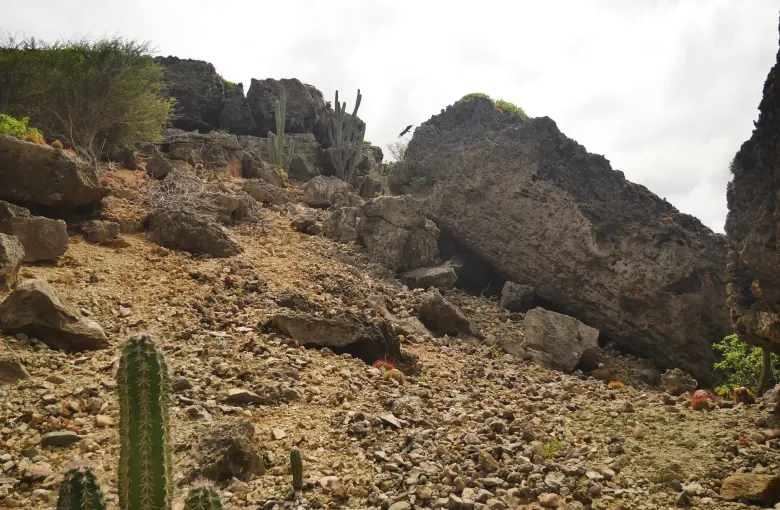
Photograph by Terry Robinson, CC BY-SA 2.0, via Wikimedia Commons.
Sources
- National Hurricane Center: Tropical cyclone climatology: that the Atlantic hurricane season runs from June 1 to November 30, and that tropical cyclone activity sometimes occurs before and after these dates. Accessed 19 September 2026.
- UK Foreign, Commonwealth and Development Office: Aruba travel advice, safety and security: that it is a legal requirement to carry identification; that the island is used as a drug passageway from South America to Europe and North America and that there are severe penalties for all drug offenses; that a driver needs the correct version of the international driving permit, that it cannot be bought outside the United Kingdom, and that hire companies may require 2 years of driving experience; that a driver found with just over half of England legal limit of alcohol in their system may face a fine and possible imprisonment; that taxis are not metered and that the fare should be agreed in local currency with the driver before setting off; that the hurricane season in the Caribbean normally runs from June to November; that most hurricanes pass to the north of the island, which has no record of a recent major hurricane; and that there are occasional tropical storms. Accessed 19 September 2026.
Other Articles
The Best Time to Visit Aruba
Aruba Packing List