⚠ What this page is not going to claim.
Guides with this title on other destinations describe a program: an ancestry route, a citizenship pathway, a commemoration with a date. No source in this register publishes anything of that kind for Aruba, and this page does not invent one.
The national tourism website for the island returns a cookie notice and nothing more, so the body that would normally publish such a program cannot be read from here at all. That is a gap in what we can verify rather than a statement about the island, and the honest thing is to name it and move on to what the island's own institutions do publish.
The layer that comes first.
The National Archaeological Museum Aruba states that its permanent exhibit conveys information on the origin and culture of the first inhabitants of the island, and gives an insight into the cultures that lived here in pre-historical and early historical times.
That is the deepest layer any institution in this register documents, and it is presented by the island's own national museum rather than by a foreign one. If you are here to understand where the place came from, it is the obvious first stop. Our guide to the museum covers its address, its published hours and the caution that goes with them.
The colonial layer, which you will mostly meet as buildings.
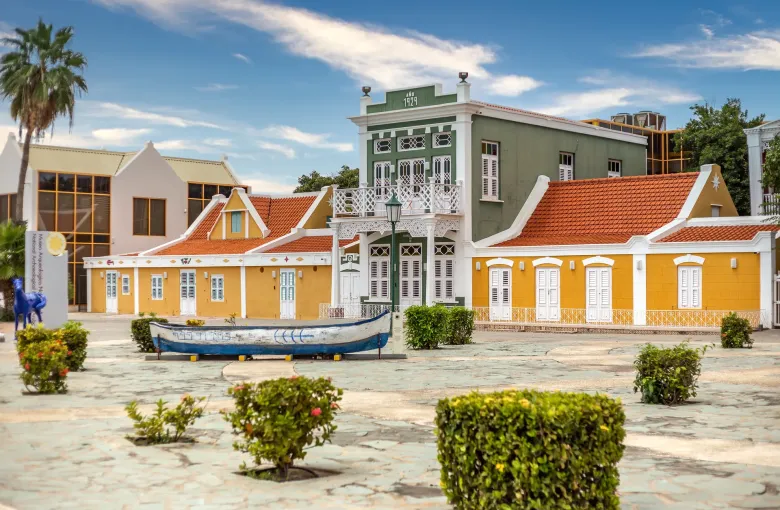
The same museum describes the Ecury Complex it occupies as Dutch colonial architecture from the late 19th and 20th century, a cluster of single and two-story historic buildings in downtown Oranjestad bought by the Aruban Government in 1997 and restored from 2006.
The photograph on this page shows another survival of that period, the Willem III Tower at Fort Zoutman in Oranjestad, with cannons on the ground below it. This guide describes it as a photograph rather than as a monument with a history attached, because no source in this register documents the fort. If you want that history, the museum a few streets away is the place to ask.
The layer that is still being made.
The Centrale Bank van Aruba records that the florin dates from the moment Aruba obtained its Status Aparte within the Kingdom of the Netherlands in 1986, and the Foreign, Commonwealth and Development Office describes the island today as an autonomous country within the Kingdom of the Netherlands.
A currency and a constitutional standing are heritage in the most practical sense. They are what an island decided about itself within living memory, and they are the reason a visitor's paperwork here is the island's own rather than the Kingdom's. Our entry requirements guide shows what that means at an airport.
The land itself.
The Aruba Conservation Foundation manages the conservation of nearly 25% of the island as well as four Marine Protected Areas, and names species found nowhere else, among them a rattlesnake known locally as the Cascabel. Spaans Lagoen has been protected under the wetlands convention since 1980.
For a place whose built heritage is mostly two centuries old, the natural heritage is the older story. Our guide to Parke Nacional Arikok and our guide to Spaans Lagoen cover both.
Where to ask the questions this page cannot answer.
Genealogical and community questions are answered by institutions rather than by travel pages. The national museum is the starting point this register can name. Beyond that, ask your operator to put you in touch with people who work on the island's history, and be direct about what you are looking for. Our trip planning page is where that conversation starts.
Photograph by Bigarumama, CC BY-SA 4.0, via Wikimedia Commons.
Sources
- National Archaeological Museum Aruba: Museum information: that the museum occupies the Ecury Complex in Oranjestad at Schelpstraat 42; that the complex is Dutch colonial architecture from the late 19th and 20th century; and that the permanent exhibit presents the origin and culture of the first inhabitants of the island. Accessed 19 September 2026.
- Centrale Bank van Aruba: The Aruban florin: that the florin dates from the moment Aruba obtained its Status Aparte within the Kingdom of the Netherlands in 1986; that the florin is pegged to the U.S. dollar at one dollar to 1.79 florins; that the Central Bank Ordinance governs the currency; and that the coinage has included a square 50-cent piece. Accessed 19 September 2026.
- UK Foreign, Commonwealth and Development Office: Aruba travel advice, entry requirements: that Aruba is an autonomous country within the Kingdom of the Netherlands; that a passport must be valid for the duration of the stay; that a holder of a full British citizen passport can visit for up to 3 months without a visa; that an embarkation card must be completed up to 7 days before arrival and proof of approval to travel shown to the airline before boarding; that the embarkation and disembarkation card is the form travelers fill in; that it is illegal to overstay the entry period or to work without a work permit; and that there are strict rules about goods that may be taken into or out of the island. Accessed 19 September 2026.
- Aruba Conservation Foundation: Parke Nacional Arikok: that the park encompasses 34 square kilometers of protected nature area; that the Foundation manages nearly 25 percent of the island as well as four Marine Protected Areas; that 34 endemic species live there, among them the rattlesnake known locally as the Cascabel and the burrowing owl; that 282 species of bird alone have been recorded on the island; that the endemic and endangered Shoco, Prikichi and Cascabel are among the species the Foundation protects, along with the vesper mouse described by Hummelinck; that there is a Visitor Center at San Fuego; that Spaans Lagoen has been an official Ramsar site since 1980; and that four new Ramsar sites have since been added. Accessed 19 September 2026.
Other Articles
The National Archaeological Museum Aruba
Aruba Culture and Etiquette