The quick answer
Zambia has three seasons, not four: cool and dry from roughly May to August, hot and dry through September and October, and warm and wet from November to April. The Zambia Meteorological Department is the national authority for forecasts and severe weather warnings.
Why a tropical country is not unbearably hot
Zambia sits well inside the tropics, and a visitor reading only the latitude would expect relentless heat. Most of the country is saved by altitude: it occupies a high plateau, and elevation takes the edge off both the temperature and the humidity. Lusaka in July can be genuinely chilly after dark.
The exceptions are the valleys. The Luangwa and the Zambezi valleys sit much lower than the plateau, and they are hotter and stickier than the capital in the same month — sometimes dramatically so. When a camp warns you that October is fierce, it is the valley speaking, not the country as a whole.
The three seasons
Cool and dry: May to August
Clear skies, low humidity, very little rain. Comfortable days and cold mornings. This is the season most people mean by “the best weather”, and the one that catches visitors out, because they pack for Africa and not for a dawn game drive at altitude. Early mornings in June through August can approach freezing in the valleys, and an open vehicle moving at speed makes it feel colder still.
Hot and dry: September and October
The build-up. Temperatures climb steadily, the landscape becomes dusty and bare, and the middle of the day is genuinely demanding. Wildlife concentrates at water, which is why this is the finest game viewing of the year and why activity schedules shift to early morning and late afternoon. Rain arrives toward the end of this window in most years.
Warm and wet: November to April
The rains are usually convective — a dramatic afternoon storm rather than all-day drizzle — and they green the country completely. Humidity rises, bird life is spectacular, and dirt roads deteriorate quickly. Access, not rainfall, is what closes camps: many bush roads in South Luangwa and the Lower Zambezi become impassable, and a number of camps shut for the season.
The falls make their own weather
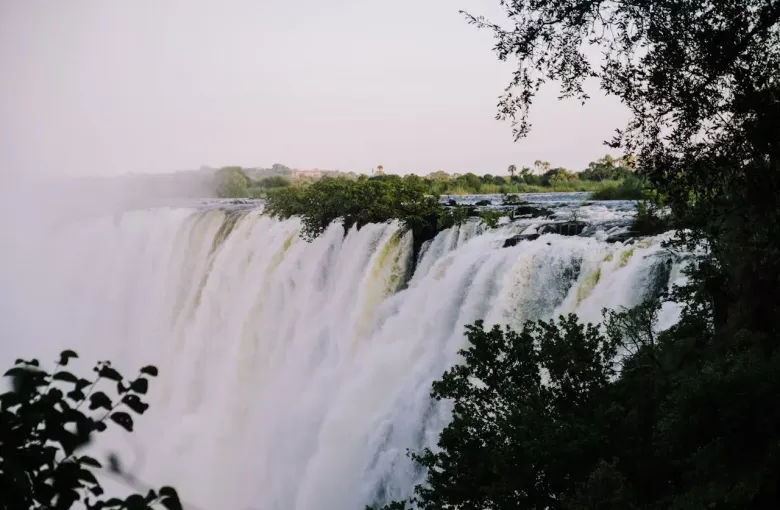
Victoria Falls generates a microclimate that has nothing to do with the regional forecast. At high water the spray rises hundreds of feet and falls back as steady rain on the viewpoints and the rainforest path beside them — the local name, Mosi-oa-Tunya, “the smoke that thunders”, describes exactly this. In the high-water months you will be soaked regardless of what the sky is doing, and a waterproof for your camera matters more than one for you.
At low water, in October and November, the spray largely disappears and the Zambian side can show bare rock. Same place, same viewpoint, entirely different visit.
What this means for packing
- Layers, always. The daily temperature range is wide in the dry season — cold at dawn, warm by mid-morning.
- A real fleece or jacket for May to August, not a light sweater.
- A rain shell for the falls in any month, and a dry bag for electronics between February and May.
- Sun protection year-round. Altitude and clear skies are a strong combination even in the cool season.
Our Zambia packing list works through this in detail, including the restriction on camouflage clothing that catches visitors out.
Checking a forecast
Use the Zambia Meteorological Department for national forecasts and warnings. For a specific camp, ask the camp: valley conditions and plateau conditions can differ sharply on the same day, and operators watch their own airstrips closely.
Other Articles
Best Time to Visit Zambia
Zambia Packing List