What the advice actually says.
In full: The Caribbean hurricane season normally runs from June to November. Trinidad and Tobago is rarely affected by hurricanes, but can have severe storms. Both halves matter. The season exists; this country is usually outside it; severe storms still happen.
The instruction attached is to monitor local and international weather updates from the United States National Hurricane Center and the World Meteorological Organization. That is a sensible habit anywhere in the region and it is the only forecasting advice an official source gives for these islands.
Hurricane Flora, and why one storm is worth a paragraph.
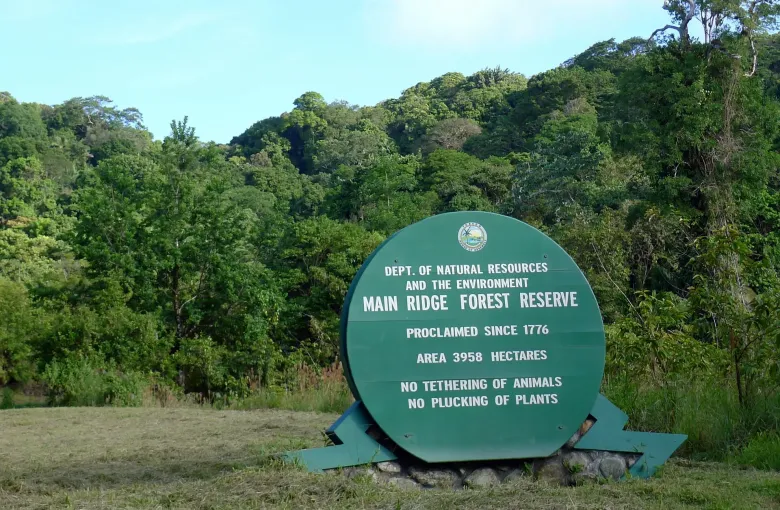
It would be easy to read rarely as never and stop thinking. The correction comes from this cluster's heritage source rather than its weather one, which is part of why it is convincing. UNESCO's file on the Tobago Main Ridge Forest Reserve records that after the 1963 hurricane Flora, many of the flora and fauna populations dwindled or disappeared, and that the White-tailed Sabrewing Hummingbird is one of the species that has been recovering since the incident.
A single storm reshaped the ecology of an entire ridge, and six decades later a bird is still described as recovering from it. That is what rarely looks like when it happens. Take insurance that covers weather disruption and read the forecast like anyone else in the region.
The hazard that is genuinely domestic.
Ask what the local geological risk is here and the answer is not a volcano. The advice states that earthquakes are a risk in Trinidad and Tobago and that the last serious earthquake was in 2018, which caused damage to some buildings and communication networks. It points travelers to the United States Federal Emergency Management Agency for what to do before, during and after one.
That is a meaningful difference from the neighboring islands. Saint Vincent and the Grenadines has a volcano on its own territory that erupted explosively in 2021. Trinidad and Tobago does not. Anything you read that places a volcano on either of these islands has come from somewhere else.
The volcano that is real, and is not here.
One is named in the advice and it is worth understanding precisely. Travelers are asked to monitor the alert level of Kick'em Jenny, described as an underwater volcano located off the coast of Grenada and about 200km from Trinidad, which erupts every few years. Follow the advice of local authorities if there is increased activity.
Two hundred kilometers is the number to hold onto. For a visitor on land it is a maritime matter rather than a daily one, and it is the same volcano that appears in the Saint Vincent and Grenada guides at a different distance and with a different meaning.
What this page will not tell you.
No temperature, no rainfall figure, no month-by-month table. No source in this cluster's register publishes one for this country, and a plausible number without a source behind it is exactly the kind of thing a reader would act on and should not. What is published is above, in the words of the bodies that published it.
If you would like a trip planned around the drier stretch of the year or around a particular month, tell us and we will work from what is actually known.
Sources
- UK Foreign, Commonwealth and Development Office: Trinidad and Tobago travel advice, safety and security: that there is a high level of violent crime including gang-related attacks and shootings and that instances of homicides and armed robberies are common; the named areas in which to be cautious, including downtown Port of Spain east of Charlotte Street, Carenage, Sea Lots, Belmont, Laventille, Morvant, Barataria, Cocorite and the interior of the Queens Park Savannah; that a significant portion of violent crime is gang-related and the listed precautions, including avoiding walking at night, keeping valuables out of sight in a moving vehicle, and using well-lit ATMs during daylight; that criminals have used drugs, deception and sexual solicitation including via dating apps to facilitate robbery and sexual assault; that robberies and opportunistic crime may occur during the carnival period; that providers of recreational and adventure tourism may not meet UK safety standards; that it is an offense for anyone, including children, to dress in camouflage clothing or bring any into the country; that possession of up to 30g of cannabis or 5g of cannabis resin has been decriminalised, that smoking cannabis in public spaces or while operating a vehicle is not allowed, and that being stopped with those amounts can bring a fine of up to 50,000 Trinidad and Tobago dollars; that in March 2025 consensual same-sex activity was reinstated as a crime punishable by up to 5 years imprisonment, that it is also illegal for LGBT+ foreign nationals to enter the country, and that neither of these laws has been enforced in recent times; that entering private property without permission can bring a fine of up to 750,000 Trinidad and Tobago Dollars or imprisonment for up to 25 years and that legal occupants may use defensive and even deadly force against trespassers; that a UK photocard driving license may be used for up to 90 days and that an international driving permit is needed beyond that; that driving standards are mixed, that high-speed accidents on the main highways often result in fatalities, that some roads are narrow, winding and unlit and that pedestrians often walk on the roads; that Trinidad and Tobago is rarely affected by hurricanes but can have severe storms; that earthquakes are a risk and that the last serious earthquake was in 2018; and that travelers should monitor the alert level of Kick em Jenny, an underwater volcano located off the coast of Grenada and about 200km from Trinidad, which erupts every few years. Accessed 21 September 2026.
- UNESCO World Heritage Centre: Tobago Main Ridge Forest Reserve, Tentative List reference 5646, submitted 17 August 2011 under criteria five, six, seven, nine and ten as a mixed property: that the Main Ridge runs lengthways across two thirds of Tobago and encompasses 3958 hectares of tropical rainforest, reaching a height of 604 meters; that the reserve provides habitat for twelve to sixteen species of mammals, twenty-four non-poisonous snakes, sixteen lizards and two hundred and ten species of birds, the most outstanding being the White-tailed Sabrewing Hummingbird, rare and endemic to Tobago, which was declared an Environmentally Sensitive Species by the Environment Management Authority in 2005 and has been recovering since the 1963 hurricane Flora; that the ridge is also home to the ocellated gecko, an animal not found anywhere else in the world; and that the reserve is on record as the oldest legally protected forest reserve geared specifically towards a conservation purpose, established on April 13th, 1776 by an ordinance stating in part that the reserve is for the purpose of attracting frequent showers of rain upon which the fertility of lands in these climates doth entirely depend, its passage attributed to Soame Jenyns, a member of the British parliament influenced by the English scientist Stephen Hales. Accessed 21 September 2026.
Other Articles
The Best Time to Visit Trinidad and Tobago
Tobago Main Ridge Forest Reserve: Visitor and Heritage Guide