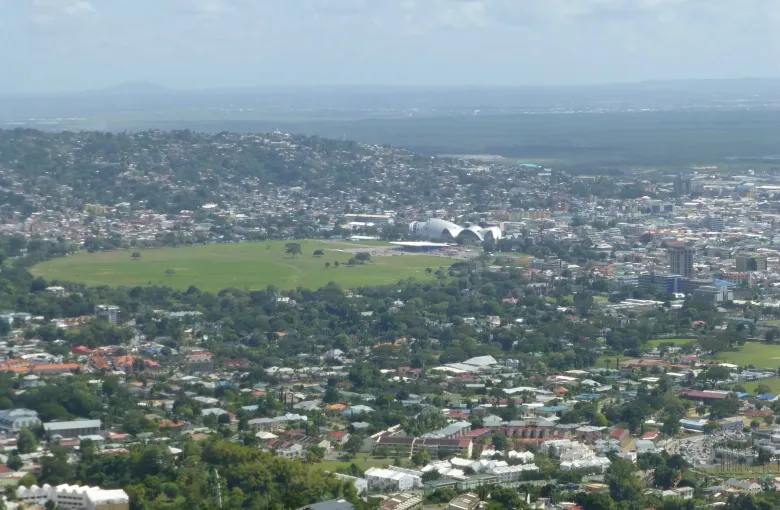
The sentence that makes this country different.
Every other destination guide in this part of the world opens with the same paragraph: the Atlantic hurricane season runs from June to November, plan around it. For Trinidad and Tobago the United Kingdom's Foreign, Commonwealth and Development Office says something else entirely. Its published advice is that Trinidad and Tobago is rarely affected by hurricanes, but can have severe storms.
That is a genuine difference in kind, and it comes from geography. These two islands sit at the southern edge of the region, far enough down that the storm tracks that define a Caribbean calendar mostly pass to the north. It means the months an adviser elsewhere would tell you to avoid are, here, ordinary months.
Rarely is not never, and this cluster does not pretend otherwise. The proof is in an unexpected place: UNESCO's own file on the Tobago Main Ridge Forest Reserve records that after the 1963 hurricane Flora, many of the flora and fauna populations dwindled or disappeared. One storm, more than sixty years ago, still shows in what lives on that ridge. Plan without dread, not without insurance.
What actually sets the shape of the year.
If the weather does not decide your dates, Carnival does. The National Carnival Commission records that Carnival here is celebrated before the commencement of the Lenten season, and that in 1943 Carnival on the street was restricted to the Monday and Tuesday. Those two days are the two immediately before Ash Wednesday.
Ash Wednesday moves with Easter, so Carnival moves with it, which is why this page gives you the rule rather than a date. The rule does not go stale. The Commission publishes each year's official calendar, and that is the place to read the dates from, because it is the body that sets them.
Everything else follows from that one fixed point. The weeks before are the season: panyards rehearsing, mas camps working, calypso and steelband competitions building toward the final weekend. If you want the country at full volume, that is when. If you want the rainforest, the turtles and the reefs with room to breathe, almost any other month will give you them.
Read this before you fix anything.
There is a security measure in force that a visitor should know about before choosing dates, and both halves of it are given here because either half alone would mislead. The Foreign, Commonwealth and Development Office records that the government introduced a State of Emergency on 3 March following persistent violent crime and criminal activity, that it gives authorities additional powers of search, arrest and detention, and that no curfew or restrictions on movement have been imposed.
The source gives no year for that date, so this page gives none either. What it means for timing is simple: read the live advice page before you book rather than relying on any guide, including this one, and follow the instructions of police and local authorities while you are there.
What this page will not tell you.
It will not give you an average temperature, a rainfall figure or a best month, because no source in this cluster's register publishes one for this country and a number invented to fill a gap is worse than the gap. It will not give you a Carnival date, for the reason set out above. What it gives you is the rule, the season, and the one page to read first.
If you would like dates chosen around Carnival, around the turtle nesting season or around nothing at all, tell us what matters and we will build the trip around it.
Sources
- UK Foreign, Commonwealth and Development Office: Trinidad and Tobago travel advice, safety and security: that there is a high level of violent crime including gang-related attacks and shootings and that instances of homicides and armed robberies are common; the named areas in which to be cautious, including downtown Port of Spain east of Charlotte Street, Carenage, Sea Lots, Belmont, Laventille, Morvant, Barataria, Cocorite and the interior of the Queens Park Savannah; that a significant portion of violent crime is gang-related and the listed precautions, including avoiding walking at night, keeping valuables out of sight in a moving vehicle, and using well-lit ATMs during daylight; that criminals have used drugs, deception and sexual solicitation including via dating apps to facilitate robbery and sexual assault; that robberies and opportunistic crime may occur during the carnival period; that providers of recreational and adventure tourism may not meet UK safety standards; that it is an offense for anyone, including children, to dress in camouflage clothing or bring any into the country; that possession of up to 30g of cannabis or 5g of cannabis resin has been decriminalised, that smoking cannabis in public spaces or while operating a vehicle is not allowed, and that being stopped with those amounts can bring a fine of up to 50,000 Trinidad and Tobago dollars; that in March 2025 consensual same-sex activity was reinstated as a crime punishable by up to 5 years imprisonment, that it is also illegal for LGBT+ foreign nationals to enter the country, and that neither of these laws has been enforced in recent times; that entering private property without permission can bring a fine of up to 750,000 Trinidad and Tobago Dollars or imprisonment for up to 25 years and that legal occupants may use defensive and even deadly force against trespassers; that a UK photocard driving license may be used for up to 90 days and that an international driving permit is needed beyond that; that driving standards are mixed, that high-speed accidents on the main highways often result in fatalities, that some roads are narrow, winding and unlit and that pedestrians often walk on the roads; that Trinidad and Tobago is rarely affected by hurricanes but can have severe storms; that earthquakes are a risk and that the last serious earthquake was in 2018; and that travelers should monitor the alert level of Kick em Jenny, an underwater volcano located off the coast of Grenada and about 200km from Trinidad, which erupts every few years. Accessed 21 September 2026.
- UK Foreign, Commonwealth and Development Office: Trinidad and Tobago travel advice: that the Trinidad and Tobago government introduced a State of Emergency on 3 March following persistent violent crime and criminal activity, which gives authorities additional powers of search, arrest and detention; that no curfew or restrictions on movement have been imposed and that travelers should follow the instructions of police and local authorities; and the standing instruction to research your destinations and get appropriate travel insurance. Accessed 21 September 2026.
- National Carnival Commission of Trinidad and Tobago: the national Carnival authority history pages: that Carnival in Trinidad and Tobago is celebrated before the commencement of the Lenten season; that from 1783 for half a century the French developed their Carnival, a season of festivities extending from Christmas to Ash Wednesday consisting of dinners, balls, concerts and hunting parties; that Africans started to participate from 1833 after the Emancipation Bill was passed and brought Canboulay to the festivities; that Canboulay was first played on August 1st, Emancipation Day, but subsequently took place after midnight on Dimanche Gras, the Sunday before Carnival; that in early celebration by the masses activities were held over the three days preceding Ash Wednesday, but that in 1943 Carnival on the street was restricted to the Monday and Tuesday and celebrations were banned for the duration of the Second World War; that the steelband developed from 1935 to 1945 as Tamboo Bamboo and metal bands were transformed, that around 1935 some bands began using metal containers in place of bamboo, that the accidental discovery was made that a change of pitch occurred when the surfaces were hammered and stretched, and that the first pan or ping pong appeared with enough notes to carry a simple melody; and that calypso, called a poor man's newspaper in times when literacy was not widespread, traces its roots to African traditions of improvised songs, with the name variously attributed to kaiso, a Hausa word for bravo, the French carrousseaux, the Spanish calliso and the Carib carieto. Accessed 21 September 2026.
Other Articles
Trinidad and Tobago Weather Guide

Trinidad and Tobago Festivals and Celebrations