The short version
Almost all of Saudi Arabia carries no territorial restriction at all. The UK Foreign, Commonwealth & Development Office advises against all travel to one strip of the country and advises against all but essential travel to a second, wider strip beside it, and both are defined by distance from a single frontier. Everything else on this page is about law and conduct rather than about danger.
Where the line actually runs
The FCDO advises against all travel to within ten kilometres of the border with Yemen, and against all but essential travel to areas between ten and eighty kilometres from that border. That is the whole of the territorial restriction. It is not a province list, which matters, because a province can lie partly inside the band and mostly outside it.
The reason is stated plainly: following the 2015 conflict between Saudi-led coalition forces and the Houthi movement in Yemen, there are still occasional military clashes along the border, with military and civilian casualties. The Houthis have attacked Saudi territory further north as well, including Abha International Airport, infrastructure at Yanbu and Jazan, and Saudi shipping in the Red Sea. The authorities can close airports near the border at short notice, so a routing that touches the south west can change under you.
What that leaves
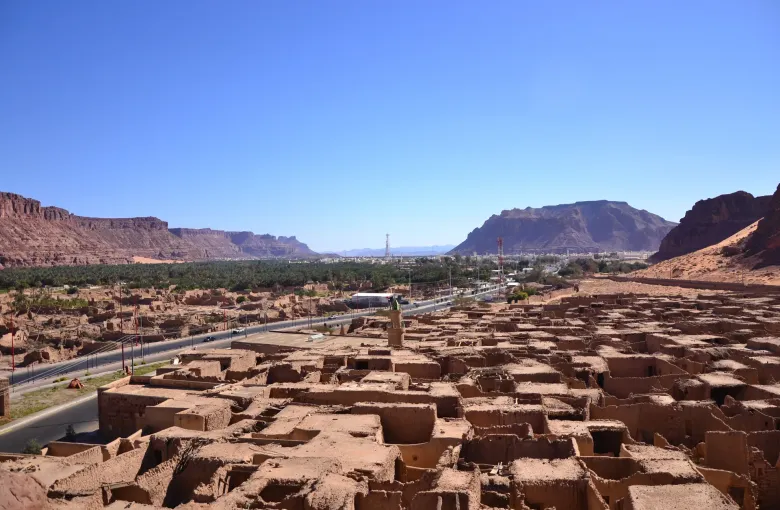
Riyadh, Jeddah, AlUla, Diriyah, Al-Ahsa, the Red Sea coast north of Yanbu and the whole of the centre and east carry no territorial advice. A LABUSA itinerary is built entirely within that ground, and we will say so directly if a request touches the restricted bands rather than quietly routing around it.
Terrorism
The FCDO's wording is that terrorists are likely to try to carry out attacks in Saudi Arabia. That phrasing is used for a great many countries and it is not a statement about the south west in particular. In practice it means the ordinary discipline of any city trip: be alert in crowded places, follow instructions at checkpoints and around government buildings, and do not photograph military or security installations.
The laws that catch visitors out
Alcohol. Do not bring alcohol into Saudi Arabia and do not arrive under the influence of it. This is not a formality, and duty free bought in transit is still alcohol carried into the country.
Dress. The rule as the FCDO states it is that men and women must wear loose-fitting clothing that covers the elbow and below the knees. It applies to both, which surprises people who have only heard the half about women.
Same-sex relations are illegal, although the FCDO notes that legal action is uncommon. We state that as the law it is. What a traveler does with that information is theirs to decide, and we will give an honest answer to a direct question rather than a reassuring one.
Health, and the one place the two maps agree
The only part of Saudi Arabia with malaria transmission is the Asir and Jazan regions near the Yemen border, the same ground the advisory covers. The US Centers for Disease Control and Prevention records no malaria transmission in Jeddah, Mecca, Medina, Riyadh or Ta'if. An itinerary that respects the advisory has already dealt with the malaria question. Heat is the real health risk on a normal trip; see the weather guide.
Read this next to visa and entry requirements and culture and etiquette.
Sources
- UK Foreign, Commonwealth & Development Office: Saudi Arabia travel advice: the FCDO advises against all travel to parts of Saudi Arabia and against all but essential travel to further parts. Accessed 14 September 2026.
- UK Foreign, Commonwealth & Development Office: Saudi Arabia regional risks: the ten and eighty kilometre bands along the border with Yemen, and the Houthi attacks on Abha, Yanbu and Jazan. Accessed 14 September 2026.
- UK Foreign, Commonwealth & Development Office: Saudi Arabia safety and security: terrorism, the dress code, the alcohol ban and the law on same-sex relations. Accessed 14 September 2026.
- UK Foreign, Commonwealth & Development Office: Saudi Arabia health: vaccination advice, and heat stroke and dehydration in the summer months. Accessed 14 September 2026.
- US Centers for Disease Control and Prevention: Travelers’ Health, Saudi Arabia: the recommended vaccines, and malaria transmission confined to the Asir and Jazan regions near the Yemen border. Accessed 14 September 2026.
Other Articles

Getting Around Saudi Arabia
Saudi Arabia Visa and Entry Requirements