The short version
Historic Jeddah, the quarter locally called Al-Balad, was inscribed by UNESCO in 2014 under criteria (ii), (iv) and (vi). It is an outstanding reflection of the Red Sea architectural tradition, a style once common on both coasts of that sea and now barely preserved anywhere outside this property.
What you are looking at
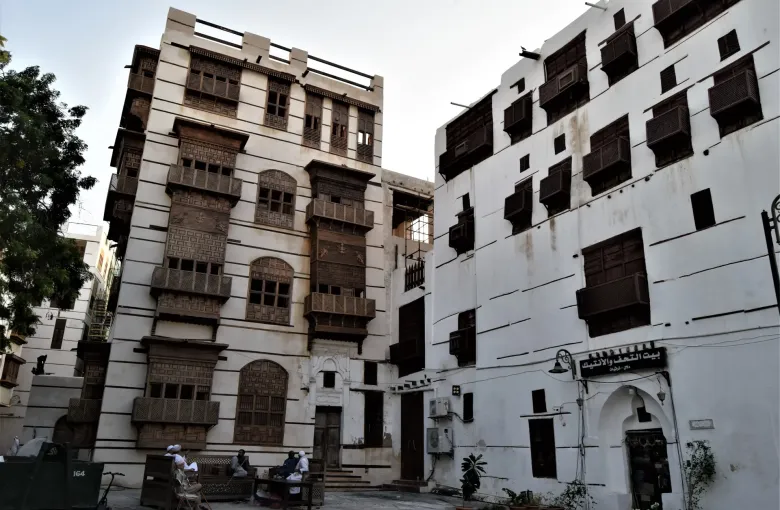
The signature is the tower house hung with large wooden roshan: the deep carved screens that shade a window, catch the sea breeze and give a family privacy without giving up the air. They were built in the late nineteenth century by the city's mercantile elite. Around and below them sit lower coral stone houses, mosques, ribats, suqs and small public squares, and it is the combination rather than any single building that UNESCO inscribed.
Why a port became this wealthy
Because of everyone passing through it. Jeddah has been the official port for pilgrims arriving in Arabia by sea since the third Caliph Othman ibn Affan designated it, and the quarter's entire character follows from that role. The pilgrimage gave Jeddah a permanently cosmopolitan population: Muslims from across Asia, Africa and the Middle East lived and worked here, and the city grew on their presence.
The final flourish came late. The opening of the Suez Canal in 1869 and the arrival of steamships rewired Indian Ocean trade and ran a great deal of it past this coast, and the grandest of the tower houses date from exactly that moment.
What to expect on the ground
Al-Balad is a living quarter under long-running restoration, not a cleared archaeological site. Some houses are immaculate, some are propped up, and some are closed. Walk it in the evening, when the heat drops and the lanes fill. The carved timber is the thing to look at, and it repays standing still.
A note on the name
The inscription's own title is Historic Jeddah, the Gate to Makkah, and that phrase describes the city's historical function as the port of arrival for pilgrims. We use it because it is the property's name.
See also the communities who built Jeddah, and the food guide, because a port city's cooking is the most direct record of who passed through it.
Sources
- UNESCO World Heritage Centre: the inscription of Historic Jeddah, the Gate to Makkah, in 2014 under criteria (ii)(iv)(vi). Accessed 14 September 2026.
- UNESCO World Heritage Centre: Saudi Arabia’s State Party record: eight properties inscribed on the World Heritage List. Accessed 14 September 2026.
Other Articles
Saudi Arabia and Diaspora Reconnection
Hegra: Visitor and Heritage Guide