What this page is
The framework item this page fills is about diaspora and reconnection. In most destinations that means people who left. In Saudi Arabia the more useful story runs the other way: this is a country whose most cosmopolitan city was built by people who arrived.
Jeddah, and why its population looked like that
Historic Jeddah's UNESCO inscription puts it plainly. The quarter's symbolic role was as the gate to Makkah for Muslim pilgrims reaching Arabia by sea, from the moment the third Caliph Othman ibn Affan made it the official port. That association with the annual pilgrimage gave Historic Jeddah a permanently cosmopolitan population: Muslims from Asia, Africa and the Middle East resided and worked there, and the city's growth and prosperity came from their presence.
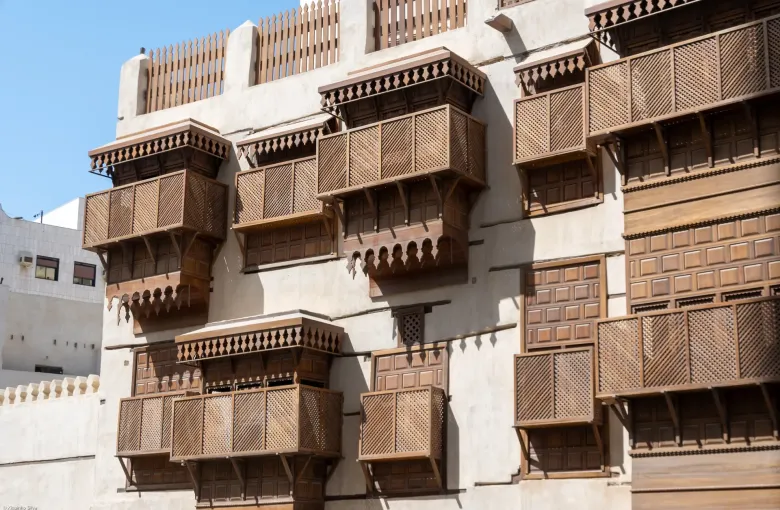
The buildings record it. The coral-stone tower houses with their carved wooden screens were put up by a mercantile elite whose trade ran the length of the Indian Ocean, and the final flourish came after the Suez Canal opened in 1869 and steamships rewired the route. A family that passed through Jeddah in that period was part of an enormous, documented movement of people.
What that means for a visit
Walking Al-Balad is the most direct thing you can do. The quarter is under long-running restoration and it is a living place rather than a museum, so some of it is immaculate and some of it is propped up, and the mix is honest. The suqs, the small squares and the ribats are the fabric that a transient population actually used.
The modern country
Contemporary Saudi Arabia has one of the largest expatriate populations in the world, and in the cities that is simply the texture of daily life: the food, the languages in a shopping street, the people running a business. For a traveler with family who worked here in the twentieth century, that is a living connection rather than a historical one, and the practical questions are usually about neighbourhoods and workplaces rather than about archives.
What we can and cannot do
We can build an itinerary around Jeddah and the Red Sea coast, put you in the right quarter with someone who knows it, and give you the time that kind of visit needs rather than an hour between sites. We do not do genealogical research, and we will not promise access to records or to individuals that we cannot arrange.
We also do not organise Hajj or Umrah. That is a pilgrimage with its own visa category and its own specialist operators, and it is not what this is.
See Historic Jeddah and the food guide.
Sources
- UNESCO World Heritage Centre: the inscription of Historic Jeddah, the Gate to Makkah, in 2014 under criteria (ii)(iv)(vi). Accessed 14 September 2026.
- UNESCO World Heritage Centre: Saudi Arabia’s State Party record: eight properties inscribed on the World Heritage List. Accessed 14 September 2026.
Other Articles
Historic Jeddah: Visitor and Heritage Guide
Saudi Arabia Culture and Etiquette Guide