The emergency number, first.
The number is 911, for the police and for an ambulance alike. It is the only emergency number published anywhere in this guide's register, and the Foreign, Commonwealth and Development Office gives it both for a road accident and for a medical emergency.
Crime, stated rather than softened.
The official advice records that there have been incidents of serious crime including murder, armed robbery and sexual assault, and sets out precautions to protect your personal safety. The list is short enough to read in full:
- make sure your accommodation is secure, which applies equally if you are staying on a yacht;
- take care when walking alone off main roads;
- take particular care around large gatherings, including street and beach parties, especially after dark or during the festival season;
- avoid isolated areas, including beaches, after dark;
- use only licensed taxis;
- do not carry large amounts of cash or jewelry;
- leave valuables and travel documents in your hotel safe or a safety deposit box;
- keep car doors locked while driving.
Most of that is ordinary travel practice. The two worth deliberately planning around are the after-dark items, because they are about where you are rather than what you carry.
In the water.
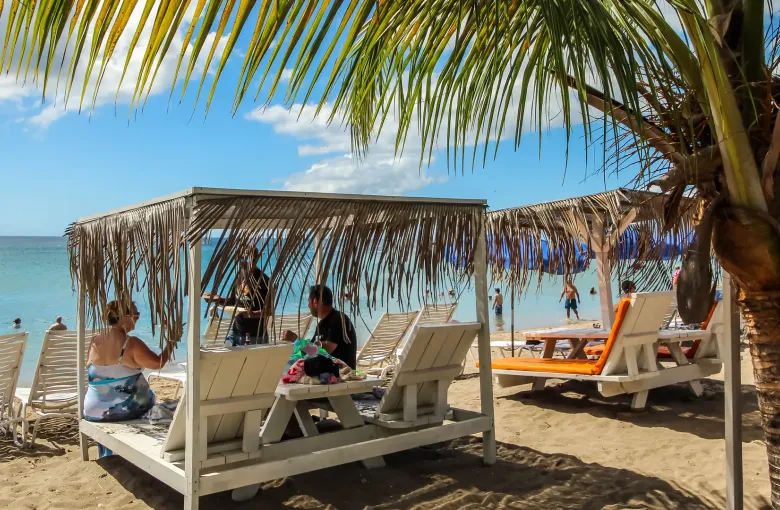
Take care when swimming: currents can be deceptively strong and not all beaches have lifeguards and warning flags. Monitor beaches carefully and follow any warnings.
Deceptive is the operative word. A bay that looks calm from a towel is not the same thing as a bay that is supervised.
Natural hazards you should know the names of.
Earthquakes are a risk in St Kitts and Nevis, and the advice directs travelers to guidance on what to do before, during and after one.
Mount Liamuiga is a potentially active volcano and is likely to erupt in the future. Activity is monitored by the University of the West Indies Seismic Research Centre. Our weather and hazards guide covers both alongside the hurricane season.
During hot and dry periods a single spark can start a wildfire. Report any fire to the emergency services immediately, and note that starting one, or attempting to, can bring up to 10 years in prison.
Two legal points travelers ask about.
The advice notes that there are fines for smoking marijuana in some public places or without a license, and that a license is required for its use. Treat the local law as the only law that applies to you here, whatever is permitted where you live.
On driving, drink-driving is illegal and the penalties on conviction are a fine of 2,000 EC dollars and 12 months imprisonment for a first offense, rising to 4,000 EC dollars and 2 years imprisonment for subsequent offenses. That is a custodial sentence attached to a first offense, which is stricter than many visitors assume.
For LGBT+ travelers.
The Foreign, Commonwealth and Development Office states that attitudes towards the LGBT+ community are mostly conservative in the Caribbean, and that showing affection in public, for example holding hands or kissing, is uncommon for opposite-sex and same-sex couples alike and may receive unwanted and negative attention.
That is written as an observation about public behavior generally rather than as a statement of law, and it is reproduced here in the same terms. Our culture and etiquette guide covers the same ground from the other direction.
Health cover, which belongs on a safety page.
Medical treatment here is expensive and serious cases may require emergency evacuation. Make sure your insurance covers treatment and repatriation, and contact your insurer quickly if you are referred for treatment. The main government hospital on St Kitts is the Joseph N France General Hospital, and for Nevis it is the Alexandra Hospital in Charlestown.
The preparation that reduces the odds of needing any of that starts weeks earlier. The US Centers for Disease Control and Prevention asks travelers to be up to date on all routine vaccines before every trip, and for Saint Kitts and Nevis specifically recommends hepatitis A for unvaccinated travelers one year old or older and hepatitis B for unvaccinated travelers of all ages. It also asks you to check the vaccines and medicines list with a doctor at least a month before you go.
Take that to your own doctor rather than acting on it here. Our health and vaccination notes set out the full recommendation, and our entry requirements guide covers the separate yellow fever certificate that is a condition of entry rather than a recommendation.
Sources
- UK Foreign, Commonwealth and Development Office: St Kitts and Nevis travel advice, safety and security: that there have been incidents of serious crime including murder, armed robbery and sexual assault, with precautions including securing accommodation, taking care when walking alone off main roads, taking particular care around large gatherings including street and beach parties especially after dark or during the festival season, avoiding isolated areas including beaches after dark, using only licensed taxis, not carrying large amounts of cash or jewelry, and leaving valuables and travel documents in a hotel safe; that a driver must have a St Kitts and Nevis driving license, available as a temporary license from the Inland Revenue Department valid for either 3 months at 62.50 EC dollars or one year at 125 EC dollars, with a home license and passport shown to obtain it, and that hire companies often set stricter requirements such as a year of driving experience or a minimum age of 25; that after an accident a driver should phone the police on 911 and not move the vehicle; that drink-driving is illegal, with penalties on conviction of a fine of 2,000 EC dollars and 12 months imprisonment for a first offense and 4,000 EC dollars and 2 years imprisonment for subsequent offenses; that minor roads have potholes and unmarked speed bumps, rural roads can be narrow with blind corners, pedestrians often walk on the roads, drivers do not always use their indicators, and road signs and hazards may not be easy to see; that licensed taxis carry or display identification and can be identified by the yellow license plate bearing T or TA, that unlicensed taxis often have no insurance to carry passengers, that taxis are not metered, that there are standard fares for most destinations which should be agreed with the driver before setting off, and that fares can often be paid in US dollars as well as EC dollars; that currents can be deceptively strong and not all beaches have lifeguards or warning flags; that attitudes towards the LGBT+ community are mostly conservative in the Caribbean and public affection is uncommon for opposite-sex and same-sex couples alike; that starting a wildfire, or attempting to, can bring up to 10 years in prison; that earthquakes are a risk; and that Mount Liamuiga is a potentially active volcano likely to erupt in the future, monitored by the University of the West Indies Seismic Research Centre. Accessed 18 September 2026.
- UK Foreign, Commonwealth and Development Office: St Kitts and Nevis travel advice, health: that the emergency medical number is 911 and a caller should ask for an ambulance; that vaccine recommendations should be checked at least 8 weeks before a trip; that the main government hospital on St Kitts is the Joseph N France General Hospital and the main government hospital for Nevis is the Alexandra Hospital in Charlestown, that both can provide many forms of treatment and that serious cases may require emergency evacuation; that medical treatment is expensive, that a private facility should be asked first whether it accepts medical travel insurance, and that adequate insurance or accessible funds should cover treatment and repatriation. Accessed 18 September 2026.
- United States Centers for Disease Control and Prevention: Travelers health, Saint Kitts and Nevis: that a traveler should be up to date on all routine vaccines before every trip, among them chickenpox, diphtheria-tetanus-pertussis, influenza, measles-mumps-rubella, polio and shingles; that hepatitis A is recommended for unvaccinated travelers one year old or older going to Saint Kitts and Nevis, with infants 6 to 11 months also vaccinated by a dose that does not count toward the routine series; that hepatitis B is recommended for unvaccinated travelers of all ages; and that the vaccines and medicines list should be checked with a doctor at least a month before a trip. Accessed 18 September 2026.
Other Articles
Getting Around Saint Kitts and Nevis
Saint Kitts and Nevis Entry Requirements