What the season is, and what it is not.
The National Hurricane Center publishes that the Atlantic hurricane season runs from June 1 to November 30, and adds that tropical cyclone activity sometimes occurs before and after these dates.
Both halves belong together. The first gives you a planning window; the second stops you treating it as a guarantee. Read a current forecast in the week before you fly, and let the season decide how flexible your bookings need to be rather than whether you go.
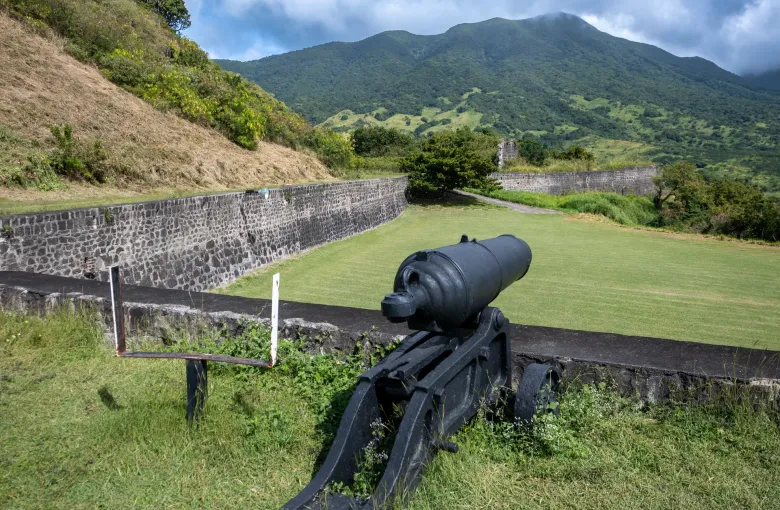
The volcano, which the advice names directly.
The UK Foreign, Commonwealth and Development Office states that Mount Liamuiga is a potentially active volcano and is likely to erupt in the future. Volcanic activity on St Kitts and Nevis is monitored by the University of the West Indies Seismic Research Centre.
That is not a reason to change a trip. It is a reason to know the name of the mountain you are looking at, and to know who publishes its status if anything changes while you are there. Mount Liamuiga is also the island's summit hike, so the sentence is about the same place many visitors go to walk.
Earthquakes, stated plainly.
The same advice says that earthquakes are a risk in St Kitts and Nevis, and directs travelers to advice on what to do before, during and after one. If there is an earthquake, follow instructions from the local authorities.
This is the kind of hazard a visitor almost never meets and should still have read about once. It takes two minutes and it is the only preparation available.
Wildfires, and the penalty attached.
During especially hot and dry periods a single spark can start a wildfire, and any fire should be reported to the emergency services immediately. The advice attaches an unusually sharp consequence to the other side of that: starting a wildfire, or attempting to, can bring up to 10 years in prison.
Worth knowing before anyone lights anything on a dry hillside.
Why there is no temperature on this page.
No source in this guide's register publishes a temperature, a rainfall total or a sea temperature for these islands. Both national tourism websites fail to answer this environment at all, so there is nothing to take from them either.
We would rather leave the number out than publish one you cannot trace back to anybody. For the week you are traveling, a current forecast from a meteorological service will tell you more than a monthly average ever could. Our best time to visit guide covers how to use the season when you are choosing dates, and our safety guide sets these hazards alongside the rest of the picture.
Sources
- National Hurricane Center: Tropical cyclone climatology: that the Atlantic hurricane season runs from June 1 to November 30, and that tropical cyclone activity sometimes occurs before and after these dates. Accessed 18 September 2026.
- UK Foreign, Commonwealth and Development Office: St Kitts and Nevis travel advice, safety and security: that there have been incidents of serious crime including murder, armed robbery and sexual assault, with precautions including securing accommodation, taking care when walking alone off main roads, taking particular care around large gatherings including street and beach parties especially after dark or during the festival season, avoiding isolated areas including beaches after dark, using only licensed taxis, not carrying large amounts of cash or jewelry, and leaving valuables and travel documents in a hotel safe; that a driver must have a St Kitts and Nevis driving license, available as a temporary license from the Inland Revenue Department valid for either 3 months at 62.50 EC dollars or one year at 125 EC dollars, with a home license and passport shown to obtain it, and that hire companies often set stricter requirements such as a year of driving experience or a minimum age of 25; that after an accident a driver should phone the police on 911 and not move the vehicle; that drink-driving is illegal, with penalties on conviction of a fine of 2,000 EC dollars and 12 months imprisonment for a first offense and 4,000 EC dollars and 2 years imprisonment for subsequent offenses; that minor roads have potholes and unmarked speed bumps, rural roads can be narrow with blind corners, pedestrians often walk on the roads, drivers do not always use their indicators, and road signs and hazards may not be easy to see; that licensed taxis carry or display identification and can be identified by the yellow license plate bearing T or TA, that unlicensed taxis often have no insurance to carry passengers, that taxis are not metered, that there are standard fares for most destinations which should be agreed with the driver before setting off, and that fares can often be paid in US dollars as well as EC dollars; that currents can be deceptively strong and not all beaches have lifeguards or warning flags; that attitudes towards the LGBT+ community are mostly conservative in the Caribbean and public affection is uncommon for opposite-sex and same-sex couples alike; that starting a wildfire, or attempting to, can bring up to 10 years in prison; that earthquakes are a risk; and that Mount Liamuiga is a potentially active volcano likely to erupt in the future, monitored by the University of the West Indies Seismic Research Centre. Accessed 18 September 2026.
Other Articles
The Best Time to Visit Saint Kitts and Nevis
What to Pack for Saint Kitts and Nevis