Why this page names no dish.
Both national tourism websites fail to answer this environment at all. Not a refusal page, not a redirect: no connection. No other source in this guide's register describes the food of these islands.
So this guide does not name a dish, because it cannot name one and cite anybody. Every list of Kittitian and Nevisian specialties you will find elsewhere may well be accurate. We have no way to check it, and a confident sentence we cannot trace reads exactly like one we can.
What the sugar history has to do with what you eat.
The one food-adjacent fact this register does carry is a large one. The Brimstone Hill Fortress National Park Society records that the plantation system, based upon sugar production and slavery, had its beginnings in St Christopher and the other early colonies, and that the island was the first in the Caribbean to be permanently settled by both the English and the French.
Sugar shaped the landscape you will drive through, the railway that still runs across the north of St Kitts, and the estates that several restaurants and hotels now occupy. That is history rather than a menu, and it is the honest thing to read before dinner at a great house. Our history and heritage guide sets it out in full.
Paying, in practice.
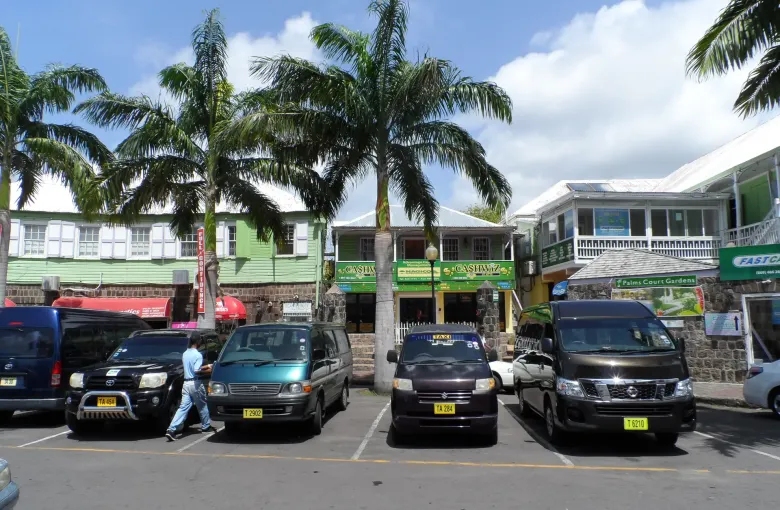
The currency is the East Caribbean dollar. For taxis specifically, the official advice notes that fares can often be paid in US dollars as well as EC dollars, and that you should agree the fare before you set off because taxis are not metered.
Carry local currency rather than assuming every counter takes yours, and ask the price before you order anything that does not have one written down. Our money guide covers the currency question, including why it publishes no exchange rate.
Bringing food in, and taking anything out.
There are strict rules about goods you can take into or out of St Kitts and Nevis, and anything that may be prohibited or subject to tax or duty must be declared. That covers agricultural produce and food items as much as anything else.
If you are carrying something unusual, declare it rather than guessing. The rule as published is about declaration, not about whether the item is ultimately allowed.
Water, sun and the ordinary sense of it.
The health advice for these islands is general rather than food-specific: check vaccine recommendations at least 8 weeks before you travel, and note that the US Centers for Disease Control and Prevention recommends hepatitis A for unvaccinated travelers one year old or older going to Saint Kitts and Nevis.
Hepatitis A is the vaccine most often associated with food and water, so that recommendation is the closest thing to food advice any official source here gives. Our health and vaccination notes cover the rest of what is recommended.
Sources
- UK Foreign, Commonwealth and Development Office: St Kitts and Nevis travel advice, safety and security: that there have been incidents of serious crime including murder, armed robbery and sexual assault, with precautions including securing accommodation, taking care when walking alone off main roads, taking particular care around large gatherings including street and beach parties especially after dark or during the festival season, avoiding isolated areas including beaches after dark, using only licensed taxis, not carrying large amounts of cash or jewelry, and leaving valuables and travel documents in a hotel safe; that a driver must have a St Kitts and Nevis driving license, available as a temporary license from the Inland Revenue Department valid for either 3 months at 62.50 EC dollars or one year at 125 EC dollars, with a home license and passport shown to obtain it, and that hire companies often set stricter requirements such as a year of driving experience or a minimum age of 25; that after an accident a driver should phone the police on 911 and not move the vehicle; that drink-driving is illegal, with penalties on conviction of a fine of 2,000 EC dollars and 12 months imprisonment for a first offense and 4,000 EC dollars and 2 years imprisonment for subsequent offenses; that minor roads have potholes and unmarked speed bumps, rural roads can be narrow with blind corners, pedestrians often walk on the roads, drivers do not always use their indicators, and road signs and hazards may not be easy to see; that licensed taxis carry or display identification and can be identified by the yellow license plate bearing T or TA, that unlicensed taxis often have no insurance to carry passengers, that taxis are not metered, that there are standard fares for most destinations which should be agreed with the driver before setting off, and that fares can often be paid in US dollars as well as EC dollars; that currents can be deceptively strong and not all beaches have lifeguards or warning flags; that attitudes towards the LGBT+ community are mostly conservative in the Caribbean and public affection is uncommon for opposite-sex and same-sex couples alike; that starting a wildfire, or attempting to, can bring up to 10 years in prison; that earthquakes are a risk; and that Mount Liamuiga is a potentially active volcano likely to erupt in the future, monitored by the University of the West Indies Seismic Research Centre. Accessed 18 September 2026.
- UK Foreign, Commonwealth and Development Office: St Kitts and Nevis travel advice, entry requirements: that a passport must have an expiry date at least 6 months after the date of arrival; that a holder of a full British citizen passport can visit without a visa for up to 6 months; that all visitors must obtain an Electronic Travel Authorisation before travel, applied for online or via the official mobile app; that the immigration form should be completed online before travel to speed up arrival, and can also be completed on arrival using a personal device or the free public wifi; that a traveler arriving by sea must contact the St Kitts and Nevis Port Authority at least 24 hours beforehand and contact either the Nevis Air and Sea Ports Authority or the St Christopher Air and Sea Ports Authority; that arrival and departure tax is usually included in the ticket price of most commercial flights, with a departure tax payable at the Airport Finance Office for LIAT flights leaving Robert L Bradshaw International Airport; that a yellow fever vaccination certificate is required of anyone coming from a country listed as a transmission risk; that an extension of stay must be applied and paid for through the Immigration Department; and that it is illegal to overstay a visa or to work without a work permit. Accessed 18 September 2026.
- Brimstone Hill Fortress National Park Society: History of the fortress: that St Christopher was the first Caribbean island to be permanently settled by both the English and the French, who shared it between 1627 and 1713, and was a springboard for English and French colonialism in the Caribbean; that the native Amerindians were virtually exterminated and African people brought in as slaves, and that the plantation system based on sugar production and slavery had its beginnings there; that the Fortress was constructed intermittently between the 1690s and 1790s and is the remains of a large, complete military community of the 18th century; that its Citadel is one of the earliest and finest surviving examples of the style of fortification known as the polygonal system; that Brimstone Hill is nearly 800 feet high with steep and precipitous slopes, its walls fashioned from the hard volcanic rock of the hill itself and its mortar produced on site from local limestone; that the site looks out over forested mountains, cultivated fields, the township of Sandy Point and neighboring islands; that it is a National Park under the National Conservation and Environment Protection Act of 1987, managed by a voluntary Society founded in 1965; and that during the 23rd session of the World Heritage Committee, held in Morocco from 29 November to 4 December 1999, the Brimstone Hill Fortress National Park was inscribed on the World Heritage List. Accessed 18 September 2026.
Other Articles
Culture and Etiquette in Saint Kitts and Nevis
Festivals in Saint Kitts and Nevis