The sentence this whole guide turns on.
The Brimstone Hill Fortress National Park Society, which manages the country's World Heritage property, publishes its own history of the island. It states that the plantation system, based upon sugar production and slavery, which came to characterize Caribbean society, had its beginnings in St Christopher and the other early colonies.
Read that again with the geography attached. Not a place the plantation system reached. A place it started.
Settlement, and what it displaced.
St Christopher was the first Caribbean island to be permanently settled by both the English and the French, who shared it between 1627 and 1713, and it was a model and a springboard for English and French colonialism in the Caribbean and elsewhere.
The Society's account of what that cost is unflinching and is reproduced here in its own terms: the native Amerindians were virtually exterminated, and African people brought in as slaves.
Those two clauses sit in the middle of a page about a fortress, written by the organization responsible for it. They are not a visitor's interpretation of the site. They are the site's own description of its foundations.
Why a fortress is the best surviving witness.
The Caribbean islands produced great wealth and were well worth defending. Fortifications were the earliest colonial structures, and every island had its network of coastal defenses, but the scale of Brimstone Hill signified the actual and symbolic importance of St Christopher in the 17th and 18th centuries.
The fortress was built intermittently between the 1690s and 1790s, from stone quarried out of the hill itself, by people whose labor is the reason it stands. Our guide to the fortress covers the structure and the inscription.
Where this history is visible now.
Three places carry it most directly, and two of them are the towns the Federation has put forward to UNESCO as candidates rather than as inscribed sites:
- Brimstone Hill Fortress National Park, above Sandy Point on St Kitts, is the country's one inscribed World Heritage property.
- The historic zone of Basseterre is the colonial port town at the center of the capital.
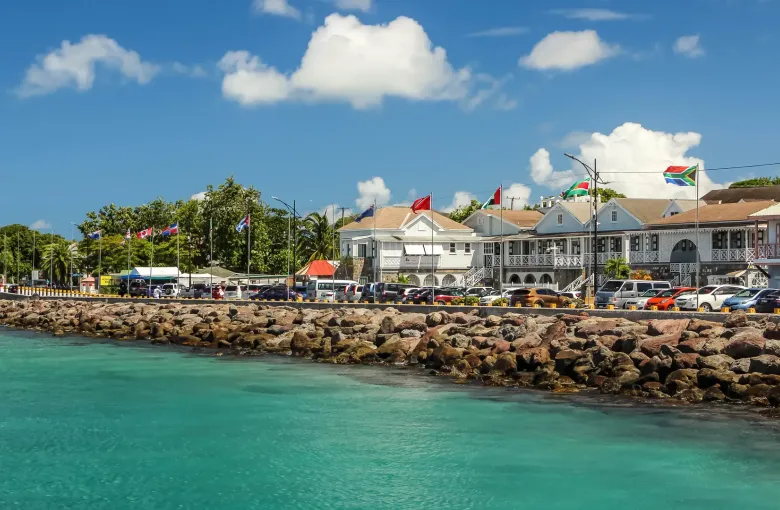
- The City of Charlestown on Nevis is the second island's capital, and its own Tentative List entry.
The old sugar estates are the fourth, and they are everywhere: in the field boundaries, in the great houses that are now hotels, and in the railway line that still crosses the north of St Kitts.
The museum on the Charlestown waterfront, described exactly.
The Museum of Nevis History stands on the Charlestown shore in a shingled building whose own sign reads Hamilton House, Trott House c. 1850. The site is associated with the birth of Alexander Hamilton, who was born on Nevis, and the building standing there now is a later structure rather than the original house.
We are describing the sign and the site rather than making a claim about the walls, because those are two different statements and only one of them is safe to make. Check opening hours locally; this guide publishes none.
Reading the islands as two, not one.
Nevis has its own capital, its own administration and its own history, and the Federation treats the two islands as two. Our culture and etiquette guide explains why getting that right matters more than any other point of courtesy here.
Photograph by Dr. Thomas Liptak, CC BY-SA 4.0, via Wikimedia Commons.
Sources
- Brimstone Hill Fortress National Park Society: History of the fortress: that St Christopher was the first Caribbean island to be permanently settled by both the English and the French, who shared it between 1627 and 1713, and was a springboard for English and French colonialism in the Caribbean; that the native Amerindians were virtually exterminated and African people brought in as slaves, and that the plantation system based on sugar production and slavery had its beginnings there; that the Fortress was constructed intermittently between the 1690s and 1790s and is the remains of a large, complete military community of the 18th century; that its Citadel is one of the earliest and finest surviving examples of the style of fortification known as the polygonal system; that Brimstone Hill is nearly 800 feet high with steep and precipitous slopes, its walls fashioned from the hard volcanic rock of the hill itself and its mortar produced on site from local limestone; that the site looks out over forested mountains, cultivated fields, the township of Sandy Point and neighboring islands; that it is a National Park under the National Conservation and Environment Protection Act of 1987, managed by a voluntary Society founded in 1965; and that during the 23rd session of the World Heritage Committee, held in Morocco from 29 November to 4 December 1999, the Brimstone Hill Fortress National Park was inscribed on the World Heritage List. Accessed 18 September 2026.
- UNESCO World Heritage Convention: Saint Kitts and Nevis States Party record: that the country accepted the Convention on 10 July 1986; that one property is inscribed on the World Heritage List, Brimstone Hill Fortress National Park, cultural, in 1999; and that two sites are on the Tentative List, the Historic zone of Basseterre and the City of Charlestown, both entered in 1998, a Tentative List being an inventory of properties a State Party intends to consider for nomination. Accessed 18 September 2026.
Other Articles
The City of Charlestown, Nevis
Culture and Etiquette in Saint Kitts and Nevis